Spring brings so many wonders of new life. The winter – as mild as it was – was long enough for one to appreciate just how magnificent spring is when it does arrive. As I have posted previously, each spring the chorus of northern spring peepers [Pseudacris crucifer] serenades us in the evenings. I could also hear another sound that for the longest time I mistook for a cricket. The peeper makes a fairly shrill peep. This other sound was a much softer and quite pleasant vibrating whistle.
Last summer at one of the meetings or conferences that we attended I picked up a CD entitled: “Natural Sounds of Ontario, Birds, Frogs and Mammals” by Monty Brigham. It is distributed by RMP Biological Ltd. C/o Monty Brigham, P.O. Box 1061, Manotick, ON K4M 1A9, Canada. Sale of the CD supports the activities of the Eastern Ontario Biodiversity Museum in Kemptville ON. See http://www.rmpbiological.pwo.ca/ for more details.
The CD is a compilation of 97 natural sounds. Through this CD I was able to determine that the sound that I thought was a cricket was actually an American Toad [Bufo Americanus]. According to Peterson Field Guide, Reptiles and Amphibians of Eastern/Central America, by Roger Conant and Joseph T. Collins, ISBN 0-395-90452-8, this toad is probably the most common in this area and we are located in the midst of its range. For some more local information on the toad see http://www.nature.ca/rideau/b/b3d-e.html. This toad has a voracious appetite for insects and other invertebrates which is great as we have lots.
So now when I go to sleep to the amphibious lullaby I will know who is performing.
Sunday, April 30, 2006


Saturday, April 01, 2006
Screaming In the Woods, or Another Meso-Predator Bights the Dust.
At four thirty this morning I was wakened by a violent noise a distance away in the woods, that sounded like a small mammal - possibly racoon - in a vicious fight. This reminded me of a topic that was presented at the Ontario Woodlot Association AGM that was held in Peterborough, Ontario on Saturday March 18th last month. The talk was entitled Forest Songbirds in Southern Ontario presented by Erica Nol of Trent University. The presentation was introduced with the following text:
Forest songbirds are an integral part of our forest ecosystems. The range and abundance of songbirds is determined to a large extent by the availability of suitable breeding habitat. Come and learn about some of the common forest songbirds found in southern Ontario woodlots, their habitat requirements and some of the pressures impacting their habitat and populations. In her talk I recall that she described the impact of meso-predators on forest songbirds. Meso-predators typically include the racoon, skunk, fox, bobcat and opossum. Opossums are not known here but are becoming common in Southern Ontario. These mammals will attack bird nests and prey on the eggs and young. The thrush family is a typical woodland bird that builds its nest low to the ground and thus is suseptible to this predator.
The speaker stated that the absence of major predators such as the wolf and mountain lion has allowed the release – or expansion – of meso-predators since they keep the meso predators in check. I am not sure where the coyote or fisher would fit into the predator ranks, but I am quite sure that what I heard was a coyote or fisher attacking or preying on a racoon. I have heard that racoon sound before when we lived in the suburbs when racoons were fighting either with themselves or another animal. In the suburbs we had many racoons and skunks in our garbage yet around here we have much fewer visits by these meso-predators. I am inclined to believe that the coyote and fisher are doing their part in playing the role of the major predator and keeping the meso-predator numbers down. Domestic cats, though unnatural probably qualify as meso-predators as well.
Forest songbirds are an integral part of our forest ecosystems. The range and abundance of songbirds is determined to a large extent by the availability of suitable breeding habitat. Come and learn about some of the common forest songbirds found in southern Ontario woodlots, their habitat requirements and some of the pressures impacting their habitat and populations. In her talk I recall that she described the impact of meso-predators on forest songbirds. Meso-predators typically include the racoon, skunk, fox, bobcat and opossum. Opossums are not known here but are becoming common in Southern Ontario. These mammals will attack bird nests and prey on the eggs and young. The thrush family is a typical woodland bird that builds its nest low to the ground and thus is suseptible to this predator.
The speaker stated that the absence of major predators such as the wolf and mountain lion has allowed the release – or expansion – of meso-predators since they keep the meso predators in check. I am not sure where the coyote or fisher would fit into the predator ranks, but I am quite sure that what I heard was a coyote or fisher attacking or preying on a racoon. I have heard that racoon sound before when we lived in the suburbs when racoons were fighting either with themselves or another animal. In the suburbs we had many racoons and skunks in our garbage yet around here we have much fewer visits by these meso-predators. I am inclined to believe that the coyote and fisher are doing their part in playing the role of the major predator and keeping the meso-predator numbers down. Domestic cats, though unnatural probably qualify as meso-predators as well.
Sunday, March 19, 2006
A brief Report on the OWA AGM 2006 Our Forests our Legacy
Carroll and I attended the 2006 Annual General Meeting of the OWA (Ontario Woodlot Association). This year’s theme title was “Our Forests – Our Legacy” a conference for woodlot owners and managers of Ontario's private forests. It was held on March 18, 2006 in Peterborough, ON.
Some personal observations, I found the talk on “The Value of Natural Capital in Settled Areas of Canada“ particularly interesting. Much of the estimates of the Values were not very rigorously calculated however there were some very good examples given. One is New York City’s dilemma where it has to decide to invest eight billion dollars in a water treatment plant, or invest in protecting green space in the Catskill mountains where the water supply currently originates. The second option examined the cost of encouraging area farms to use natural friendly practices such as natural buffers along watercourses etc. The entire presentation is available on the Internet. If and when I find it I will post the URL here.
There were also many other titbits provided in the other presentations which I will blog post on later.
The Meeting Program as published follows:
Ontario Woodlot Association
13th Annual General Meeting and Woodlot Conference
Our Forests – Our Legacy
You are invited to attend the Ontario Woodlot Association’s annual general meeting and woodlot conference, Our Forests – Our Legacy, to be held on Saturday, March 18, 2006, in Peterborough, Ontario.
Conference Details
This year’s annual general meeting and conference will feature topics that are relevant to woodlot owners and managers from all walks of life. We’ve invited presenters who will capture your imagination and provide you with a range of information about managing your woodlot.
Here are some of the features of this year’s event.
The Value of Natural Capital in Settled Areas of Canada (Jim Anderson, Ducks Unlimited)
Natural areas provide numerous benefits that have economic value, not only for people living near these areas, but also for other communities further away. Natural areas contribute to clean water, clean air, wildlife habitat, recreation, biodiversity, erosion control, aesthetics, cultural pursuits, etc. This presentation will provide some insight into a case study where economic estimates of the values of natural areas -- natural capital -- have been developed.
Woodland Amphibians and Vernal Pools (Janine McLeod, Biologist)
Vernal pools are fascinating ecosystems with unique habitat. Fairy shrimp, wood frogs and mole salamanders are some of the species that would not survive without these small, temporary wetlands. Learn what you can do as a landowner to help conserve these important natural niches in your woodlot.
Agroforestry Opportunities for Landowners (Dr. Andrew Gordon, University of Guelph and Neil Thomas, Landowner)
Dr. Andrew Gordon will discuss some of the agroforestry options available to landowners in Ontario. Agroforestry is a way to enhance already productive agricultural operations by providing farmers with a second commodity to grow and harvest -- trees. The second part of this presentation will feature eastern Ontario landowner Neil Thomas who will tell about his personal experience with agroforestry.
Forest Songbirds in Southern Ontario (Erica Nol, Trent University)
Forest songbirds are an integral part of our forest ecosystems. The range and abundance of songbirds is determined to a large extent by the availability of suitable breeding habitat. Come and learn about some of the common forest songbirds found in southern Ontario woodlots, their habitat requirements and some of the pressures impacting their habitat and populations.
Careful Logging Practices (Martin Streit, Upper Canada Forestry Services)
One of the important steps in managing your woodlot (and in maximizing your future financial returns) is to use logging methods that will minimize the damage to residual trees and the site. This presentation will introduce landowners to a variety of careful logging practices that will help protect their woodlots.
When: Saturday, March 18, 2006
Where: Ervinrude Centre, 911 Monaghan Road, Peterborough, ON
Time: 8:30 a.m. to 4:00 p.m.
Registration: We are requesting that you pre-register for the conference. To register or to get more information, please call Rhonda at the Ontario Woodlot Association at 1-888-791-1103 ext. #221 or e-mail us at before March 1, 2006.
Registration fee: OWA members $20.00 and non-members $25.00 (includes lunch).
Supporters of this year’s conference include: Ferguson Forest Centre, Model Forest Network, K.H. Kesso & Sons Ltd., Nelson Paint Company of Canada, and the Peterborough County Stewardship Council.
As always, guests are welcome… so bring a friend!
Some personal observations, I found the talk on “The Value of Natural Capital in Settled Areas of Canada“ particularly interesting. Much of the estimates of the Values were not very rigorously calculated however there were some very good examples given. One is New York City’s dilemma where it has to decide to invest eight billion dollars in a water treatment plant, or invest in protecting green space in the Catskill mountains where the water supply currently originates. The second option examined the cost of encouraging area farms to use natural friendly practices such as natural buffers along watercourses etc. The entire presentation is available on the Internet. If and when I find it I will post the URL here.
There were also many other titbits provided in the other presentations which I will blog post on later.
The Meeting Program as published follows:
Ontario Woodlot Association
13th Annual General Meeting and Woodlot Conference
Our Forests – Our Legacy
You are invited to attend the Ontario Woodlot Association’s annual general meeting and woodlot conference, Our Forests – Our Legacy, to be held on Saturday, March 18, 2006, in Peterborough, Ontario.
Conference Details
This year’s annual general meeting and conference will feature topics that are relevant to woodlot owners and managers from all walks of life. We’ve invited presenters who will capture your imagination and provide you with a range of information about managing your woodlot.
Here are some of the features of this year’s event.
The Value of Natural Capital in Settled Areas of Canada (Jim Anderson, Ducks Unlimited)
Natural areas provide numerous benefits that have economic value, not only for people living near these areas, but also for other communities further away. Natural areas contribute to clean water, clean air, wildlife habitat, recreation, biodiversity, erosion control, aesthetics, cultural pursuits, etc. This presentation will provide some insight into a case study where economic estimates of the values of natural areas -- natural capital -- have been developed.
Woodland Amphibians and Vernal Pools (Janine McLeod, Biologist)
Vernal pools are fascinating ecosystems with unique habitat. Fairy shrimp, wood frogs and mole salamanders are some of the species that would not survive without these small, temporary wetlands. Learn what you can do as a landowner to help conserve these important natural niches in your woodlot.
Agroforestry Opportunities for Landowners (Dr. Andrew Gordon, University of Guelph and Neil Thomas, Landowner)
Dr. Andrew Gordon will discuss some of the agroforestry options available to landowners in Ontario. Agroforestry is a way to enhance already productive agricultural operations by providing farmers with a second commodity to grow and harvest -- trees. The second part of this presentation will feature eastern Ontario landowner Neil Thomas who will tell about his personal experience with agroforestry.
Forest Songbirds in Southern Ontario (Erica Nol, Trent University)
Forest songbirds are an integral part of our forest ecosystems. The range and abundance of songbirds is determined to a large extent by the availability of suitable breeding habitat. Come and learn about some of the common forest songbirds found in southern Ontario woodlots, their habitat requirements and some of the pressures impacting their habitat and populations.
Careful Logging Practices (Martin Streit, Upper Canada Forestry Services)
One of the important steps in managing your woodlot (and in maximizing your future financial returns) is to use logging methods that will minimize the damage to residual trees and the site. This presentation will introduce landowners to a variety of careful logging practices that will help protect their woodlots.
When: Saturday, March 18, 2006
Where: Ervinrude Centre, 911 Monaghan Road, Peterborough, ON
Time: 8:30 a.m. to 4:00 p.m.
Registration: We are requesting that you pre-register for the conference. To register or to get more information, please call Rhonda at the Ontario Woodlot Association at 1-888-791-1103 ext. #221 or e-mail us at
Registration fee: OWA members $20.00 and non-members $25.00 (includes lunch).
Supporters of this year’s conference include: Ferguson Forest Centre, Model Forest Network, K.H. Kesso & Sons Ltd., Nelson Paint Company of Canada, and the Peterborough County Stewardship Council.
As always, guests are welcome… so bring a friend!
Sunday, March 12, 2006
The Yellow Birch
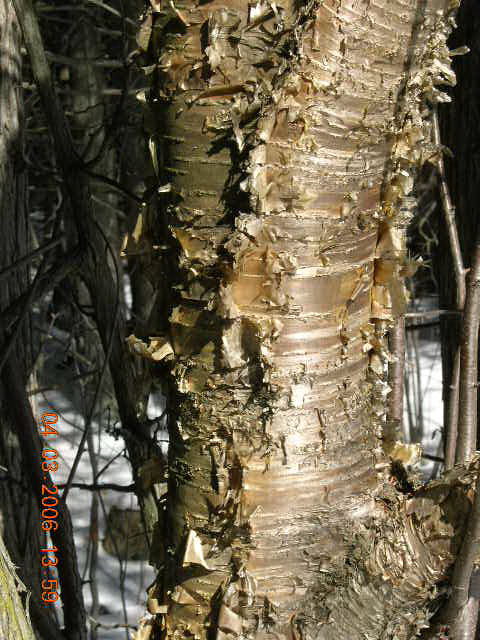 There are several mature yellow birches [Betula alleghaniensis Britt.] in the Heartwood woodlot. This tree is located to the north of a clearing in Area C of the Woodlot Management Plan. I have always been fond of the weird and different birch tree. Birches are normally white while this birch is a beautiful coppery bronze.
During my high school years in the late '60's, I lived some 4 kilometres (2½ miles) out in the country west of the Island of Montreal in Quebec. During the winter and right after school and just before supper, I used to regularly step into my snowshoes and traipse out to the woods past the fields behind our house. The snow was typically 60 centimetres (2 feet) deep those days. Being mid winter I would head out when the sun was still up but by the time I was heading home it would be dark.
Armed with a small hand axe, pocket-knife and a few matches, once I reached my sheltered favourite spot in the woods, I would lay down a small mat of criss-crossed branches on top of the snow and build a small campfire upon it. Using the same spot all winter, over time the small fireplace would develop into a large hole in the snow about 2 metres (6 feet) wide. The snow inside this circle would be melted down to the earth layer.
I would place a log on the snow at the edge of the hole to sit on where I would frequently sit and gaze silently into the flame and listen to the crackling of the fire, the snapping of the frozen branches and distant sounds. This was one of my ways of dealing with turbulent teenage and high school years. In later years I remember my mother saying that I always came home relaxed from these walks. I have learnt since that indeed the characteristics of the flicker of a fire are known to be natural rhythms and relaxing and therapeutic to the brain and is recognised as a meditation and relaxation exercise.
The yellow birch bark as with all the other birches provided an excellent fire starter. The ribbons of bark would light even when wet. I would always only remove the loose flags of bark but never injured the core bark of the tree. This made fire starting easy and after a while I was able to start fires at any outside temperature and even in rain. In time you learned tricks such as to use the small dead branches at the base of coniferous trees as kindling. These were usually dry even after a heavy rain.
What I recall of that forest was that the yellow birches tended to be isolated trees among other species. This forest was a sugar bush dominated by the sugar maple [Acer Saccharum] and ash with poplar along the clearing edges. The forest must have been tapped for maple sugar at one time, since there were remains of a sugar cabin in the forest. The remains included a damaged 3 metre (10 feet) long maple sap steaming pan or kettle. This rubble must have already been at least 10 years old and thus dated back to the '50s.
After about an hour I would slowly let the fire die out and head home in the dark, striding back on my snowshoes in the blue glistening snow, which often sparkled in the moon light against the backdrop of the black silhouetted trees. That was all part of the experience.
Sunday, March 05, 2006
A Second Visit from a not-so-Shy Great Gray
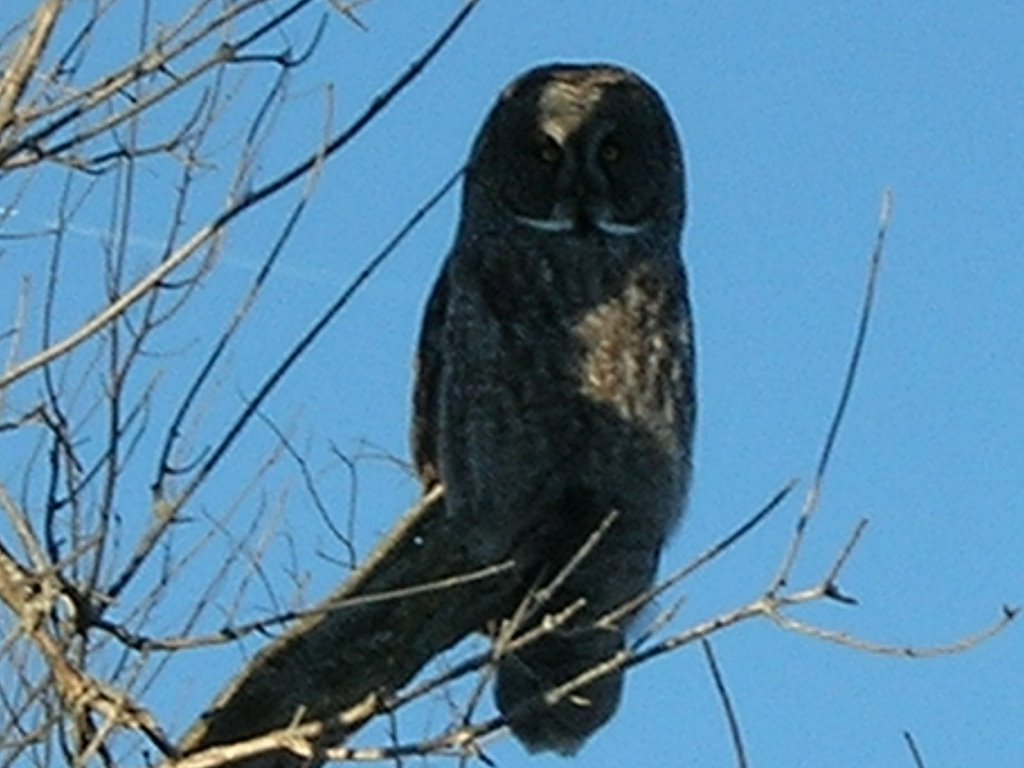
This afternoon, as we drove up our driveway this big staring Owl welcomed us home. It was probably the same Great Gray Owl [Strix Nebulosa] that visited us last weekend. The owl was perched in the tallest Manitoba maple in our back yard. This tree died just this summer but it was for exactly this purpose that I did not take it down. It make a great perch for birds. Anyway, I thought that we would spook the bird as we busily exited the vehicle and entered the house, but instead, I was able to enter the house, return with a camera, take several pictures from up close - about 10 metres (30 ft.) away. We then unloaded the trunk and entered the house. All the while the owl remained unphased and instead attentively inspected all of our activities. Only about 15 minutes later after turning on the dryer – which caused air to blow out of the dryer vent – did the owl disappear. This is the best of the pictures I took.
.
All winter, we we been broadcasting cracked corn on the snow at the front of our house for the wild turkeys and I suspect that this is likely also attracted field mice, which in turn is attracting this owl.
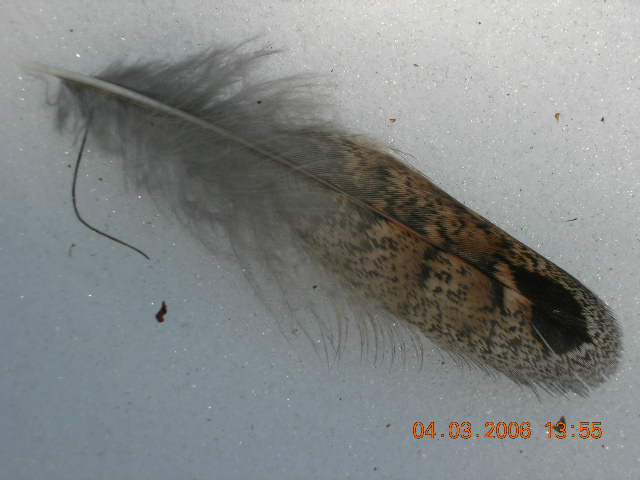
A Feather on Crusty Snow
Yesterday was a beautiful day with a bright sun and clear blue sky. The air was cool, hovering around the freezing mark, and the mild west wind made the humid air nippy. The snow is not very deep at about 15 cm (half a foot). There is a thick crust of ice on top of old snow and a light wisp of new snow on top of the ice. The wispy layer is blown off the ice in the windy clearings. When walking one noisily breaks through the crust, so any ideas of startling and sighting some wildlife were out. Indeed I did not flush out any wildlife as they were well forewarned by this noisy operation.
This snow and ice strata allowed for easy observing of animal tracks and the dramas told. Snowshoe hare tracks were plentiful as were those of fisher, coyote and fox. There were also some ruffed grouse tracks. The ice layer must make it hard for the herbivores to forage. The snowshoe hares have completely eaten and stripped all the bark from one branch that broke off of a poplar tree along one of the trails. Poplar is not a tasty food so the supply must be getting scarce. Is that possibly why the hares are moving around so much and all the tracks?
Halfway out I came across a handsome feather that fell on the snow. It is pictured above. From the down at the base of the feather it is likely a breast feather and the colour pattern makes me think that it could be form a ruffed grouse; but there is considerably more brown than is typical of a ruffed grouse and it is quite large so it could also be from a hawk or owl.
Saturday, February 25, 2006
Definitively a Great Gray

Late this afternoon I sat down for a break to read up on some research on my inherited wall clock. My mother gave me a wall clock that has been in her family for 80 some years. After some Internet research I found literature that helped me identify the maker and origin of the clock. It led me further to some online bookstores that sold books on this specific clock maker, now identified as Gustav Becker a well know clock maker from Freiburg in what was then Germany and now part of Poland. Gustav Becker died in 1885 but the company remained in existence up to WW2.
Yesterday we received a parcel notice from the post office. Since our mailbox is too small, it had to be picked up in the village. I had ordered the two books about Gustav Becker so I was expecting this parcel to be those two books. So this morning I drove the 6 country kilometres (4 or so miles) through white open fields into the Kars village though a snowstorm to retrieve my anticipated prize. All the while, Carroll has been tentatively watching the Turin 2006 Winter Olympics this morning which interested me too but not as much as this.
So during my break I read up on the clock and found out that it was in fact built or sold in 1926. It was still blowing and snowing outside, and so hard that the snow created horizontal lines in the air against the gray wooded background.
Then out of the corner of my eye I could make out a large bird alighting in a red pine tree very close to the house. At first I automatically assumed that it was a turkey as it was a big black bird. Then after further examination it had a round head with a noticeably flat face that rotated like a turret. It was not a turkey but an owl. The bird was perched in the far side of the tree so it was difficult to identify. After several minutes at that perch it flew to another tree near the front of the house. I was now able to get a few photos of it with our portrait camera which were not the best but better than nothing – I ought to get a better camera some day. The background was gray and the subject was gray, and also it was starting to get dark, all of which colluded to create what amounts to a black and white photograph. As you will see from the above picture it was perched with its back to us, but at times when it swiveled its head to the side I was able to make out the white swipe mark below its eye discs. The owl later moved to a lower perch and faced directly towards us. We were now able to clearly see the mustache shaped white marks below the eye discs. This is a characteristic mark and it confirmed without a doubt that we were looking at a Great Gray Owl [Strix Nebulosa].
Back in February 13th last year, I had reported a sighting of a grey owl but the evidence was not definitive. That post also provides considerably more detail about the owl and the fact that it was not a natural bird in this area and that such sightings are usually accidental. The gray in fact has become a regular in these parts for the last couple of years, during winters.
Saturday, February 18, 2006
Closing the Loop on Woodlot Certification
- Closing the Loop on Woodlot Certification
We normally get a bag of flyers in our mailbox Friday night or Saturday mornings. There is the normal bunch of flyers from Home Hardware, Leons Furniture, Home Depot, Sears etc. I always take a minute or two to go through each of the flyers to see if there is anything of remote interest on sale. I admit it that I am a flyer junky. Neighbours at our former home in suburbia did the right thing and reduced pollution by refusing flyers – or more aptly put, junk mail – in their mailboxs. I could never do that.
I came across something interesting in today’s Home Depot flyer. As part of its marketing strategy Home Depot is marketing ECO Options that cater to clients who are “Looking for ways to make better environmental choices when they renovate their home”. On page eight, Home Depot is selling a Maple Veneer Core Panel 4’ x 8’ x ¾”with the FSC trademark or Forestry Stewardship Council A.C.
The ad then includes a descriptive green bar with the following text:
FSC Certification helps sustain our forests The Forest Stewardship council is an international non-profit organization that supports environmentally appropriate, socially beneficial and economically viable management of the world’s forests. When you see the FSC symbol, you know that sustainable forest practices have been followed
So how does this close the loop?
You will see from a posting on this blog on Thursday September 1, 2005 that I had Scott Davis, Certification Coordinator of the Eastern Ontario Model Forest (EOMF), Forest Certification Program visit and inspect my woodlot. As a result we had our woodlot certified and we now adhere to the certification criteria and entered the woodlot certification program. We also joined the Eastern Ontario Certified Forest Owners (EOCFO) organisation formed by individuals in Eastern Ontario who had been seeking, and in 2003 obtained, FSC group forest certification for their woodlots.
What does this mean?
FSC certification program requires that:
- Wood is not harvested faster than it grows;
- Water, wildlife and forest ecosystems are protected;
- Standards are developed through a stakeholder process, not controlled by industry;
- Standards measure on-the-ground results, not just policies, programs and plans; and
- Standards, performance and recommendations are made public.
See http://eocfo.eomf.on.ca/ for full details.
So now we have come full circle. Our good management practices will now be recognised not only because it is the right thing to do in its own right but also in a more tangible means where the measures are recognised and valued in the marketplace. Also this will now let the non-woodlot owner and client for wood products participate in and promote the program.
I would say it is a good thing.
Sunday, January 22, 2006
A Young Butternut Tree in Winter
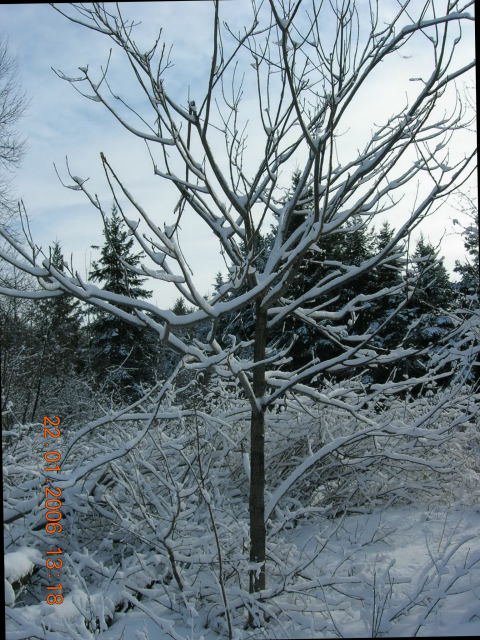
This picture is of a small butternut tree growing about 300 metres (~1000 ft) from the house. On the ground to the right is a bare patch that I believe is created by the butternut root’s characteristic of transmitting the juglone toxin to neighbouring tree roots thus limiting their growth. Only shallow rooted plants such as grass will grow in this area that do not contact the roots. To the left it is also clear. The branches on the ground are left over from a Manitoba maple that was felled and limbed just before the snow fell.
Saturday, January 21, 2006
A visit of a Leaf-Footed Bug
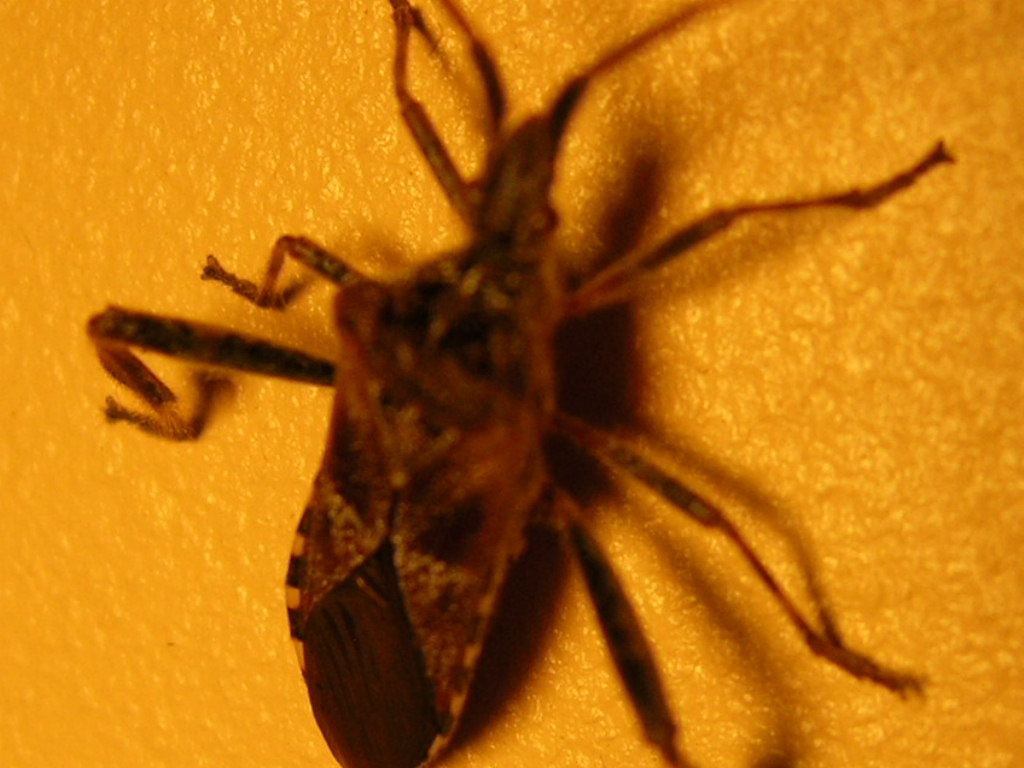
Throughout the winter we are in the company of several persevering insects. These include ladybugs in the highest abundance as well as some cluster-flies and the odd single curious bug such as the one pictured here.
According to Insects by Borror and White it is the leaf-footed bug, Family Coreidae. There is little else provided in the field guide. It may be predaceous or a plant feeder.
According to http://bugguide.net/node/view/3393 it is a Western Conifer Seed bug [Leptoglossus occidentalis].
According to http://www.forestry.ubc.ca/fetch21/FRST308/lab2/leptoglossus_occidentalis/leaf.html it damages douglas fir, ponderosa pine and incense cedar. None of these trees exist on this woodlot that I know of so I wonder what host trees it feeds on around here?
INSECTS, Borror, Donald J. and White, Richard E., Peterson Field Guides, 1970, ISBN 0-395-91171-2 (pbk.).
Sunday, January 15, 2006
Only Two Turkeys So Far this Winter

From past postings on this blog, you will note that we have had as many as a dozen or so turkeys on a single visit at our bird feeding station for the last three winters. This year has been disappointing as we have only had these two turkeys pictured here.
I captured this picture this morning just as they started to take flight. The wing breadth and span is quite impressive and they fly very well. This time they flew off over the tree tops out of sight.
Saturday, January 07, 2006
Found several Snowshoe Hare Beds
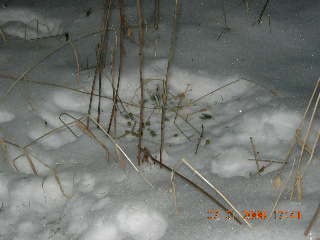
Just before dark this evening, I took a little stroll around the two spruce plantation plots near the house. I found numerous snowshoe hare tracks and several beds. The snowshoe hare must rest right on top of the snow. It is a well used patch with a concentration of rabbit droppings.
I also found ruffed grouse tracks and flushed out two perched high up in the trees.
An Inspection of a Fisher Pelt
A colleague brought a pelt – fully tanned hide with fur intact – of a fisher [martes pennanti] to work, which we proceeded to inspect and hover over during lunch break. He is a certified trapper in the Province of Quebec so he is permitted to trap fur-bearing animals. The pelt was that of a male fisher. It is not as nice and dark as that of a female I am told. What intrigued me about this pelt were the porcupine quil puncture marks that were clearly visible from the inside of the pelt. The head, shoulder and upper body area of the pelt were scared by several dozen quil punctures. Probably not a good skin for making waterproof clothing. I have heard that the fisher is able to resist injury caused by the quils and this pelt obviously proves the point. The fisher was caught because it had become a local nusance and was devouring neighbourhood cats where my colleague lives in Quebec. It was still quite healthy and thus not affected by the quils.
Friday, December 30, 2005
Glistening Ash Trees

With the cooling weather, mother nature is again decorating our trees and just on time for Christmas. This photo is of the tops of a grove of very tall ash trees can be seen from our house. This photo was taken in the morning from our house looking east into the sun. This type of ice coating could be seen on trees throughout the entire area. On that morning we drove through the countryside to Vars where we caught the highway 417 on our way to New Brunswick. We could still see the same decorations for a good 50 kilometres (30 mi.) away from home.
Sunday, December 18, 2005
Return of the Snow Buntings
Just this week while driving home I was fortunate to observe several large flocks of snow buntings [Plectrophenax nivalis] out in the open fields near here. They were around last winter too but appear to be more abundant this year that before. Back the 70’s when I was posted in the Arctic I frequently observed them there during the summer. According to the literature in winter they come down to these latitudes almost right across North America. They have a very white patch on their wings which is very visible as they swirl over the fields. I could see them land in areas where the snow layer is thin and usually wind swept, presumably to feed on the seeds exposed on the bare earth. They are quite the site to see.
Friday, December 09, 2005
American Bittersweet

In earlier posts I mentioned finding several occurrences of a vine along the northern woodlot boundary next to the snake fence. The vine is very woody and it spirals clockwise up around tree saplings. The identification of the vine from the ground was difficult up to now because they reached up at least 10 metres (30 feet) and well into the canopy before it produced any leaves or flowers or berries. The leaves were also hidden by tree foliage. There are at least two relatively large vines with a base trunk diameter of nearly 3 cm. (one inch plus). The vine wraps around the trunk of the trees and in many cases the host tree died from mere physical strangulation. The vine trunk has a characteristically grey and relatively smooth bark.
During my walk in the clearing area G at the north-eastern corner of the woodlot I found American Bittersweet [Celastrus scandens L] which I was able to positively identify by its beautiful red berries and orange shells which (according to the various websites), is only produced by the female plant. I would venture to say that the woody trunk of this plant was identical in description to the vines noted above. I feel quite confident that the above vines are also American bittersweet.
Years ago while we were still preteens, my mother would take my bother and me, for walks in the woods. In a forest across what was then the old #2 highway (today it is the 2 and 20), and also across the CN and CP railway tracks which ran parallel to the highway – we found one patch of bushes that had berries just like these. I remember fondly how our mother used them with coniferous boughs to make beautiful Christmas wreaths. I recall though that these plants appeared to grow as bushes and not vines like those above.
Friday, December 02, 2005
Remnants of the BA British American Oil Company in the Woodlot
During my visit to Area G in the woodlot, I found several rusty oil cans. I thought then that if I was able to determine the dates of the oil cans I would be able to establish when much of the logging activity was carried out. It also would help date the age of the new tree growth.
On several of the oil cans I was able to make out the familiar-to-me BA symbol which stood for the British American Oil Company. The symbol was very familiar to me since as a youth we lived right next to a BA Gas Station in the Montreal outskirts. During our hot summer vacation days, my brother and I often washed car windshields and pumped gas there as volunteers anxiously anticipating a 10-cent tip. We usually made enough for an ice cream at the Dairy Queen which was several miles down the highway. So after making enough money for an ice cream my brother and I would bicycle off for our reward of our labours.
In the interest of dating the cans, I web-browsed and found an interesting and pleasantly designed website about BA memorabilia. I particularly liked the historical essay of BA. To cut to the chase, BA was bought out by Gulf Canada and continued under the same name until 1969 when the Gulf Canada name replaced the BA symbol. Gulf Canada later became Petro Canada which still exists today.
So we can now safely estimate that Area G was logged for its cedar trees before 1969.
On several of the oil cans I was able to make out the familiar-to-me BA symbol which stood for the British American Oil Company. The symbol was very familiar to me since as a youth we lived right next to a BA Gas Station in the Montreal outskirts. During our hot summer vacation days, my brother and I often washed car windshields and pumped gas there as volunteers anxiously anticipating a 10-cent tip. We usually made enough for an ice cream at the Dairy Queen which was several miles down the highway. So after making enough money for an ice cream my brother and I would bicycle off for our reward of our labours.
In the interest of dating the cans, I web-browsed and found an interesting and pleasantly designed website about BA memorabilia. I particularly liked the historical essay of BA. To cut to the chase, BA was bought out by Gulf Canada and continued under the same name until 1969 when the Gulf Canada name replaced the BA symbol. Gulf Canada later became Petro Canada which still exists today.
So we can now safely estimate that Area G was logged for its cedar trees before 1969.
Saturday, November 19, 2005
A Butternut Grove
During my walk today I visited the clearing area at the northeastern corner of the woodlot referred to as Area G in the woodlot management plan. Area G is the only clearing in the whole woodlot which was not intentionally kept open through cultivation or clear cutting. It should in time have grown in with trees and yet there is but a thin and sparse planting of several poplar trees and others. I always wondered why is this so? This area had very old and well rotted cedar tree stumps which were cut some 30 or more years ago. In fact there was evidence that it was cleared at least 45 years ago. The field has remained undisturbed for all these years and yet but few trees took root as well as grass and some small herbaceous vines.
Having become sensitised to the plight of the butternut tree [Juglans cinerea L.] and the fact that in certain parts of North America it is becoming an endangered species due to major die off created by the butternut canker, I have become more experienced at identifying the tree. So during this visit to area G to my amazement I found very many butternut trees in area. Many were dead trunks with the characteristic butternut canker scares, some were alive but in poor condition and a few others seemed still healthy. I counted some 3 dozen trees or remains of trees all together. Now that the trees were bare it was easier to identify and count them all. One butternut tree was much larger than the others and may well have been the parent that provided the seed source for the rest. It had a dbh (diameter at breast height) of 35 cm (14 in.). In forestry, the stem diameter of a tree is measured at breast height or 1.3 metres (approx. 4 feet) above the ground hence the term dbh.
I have long wondered why area G stayed clear and think I may have hit upon the answer. The butternut tree has an interesting characteristic in that it produces Juglone toxin in its roots. Other plants whose roots touch the butternut root will draw this toxin and wilt and even die. This also occurs with black walnut. The article at http://cecommerce.uwex.edu/pdfs/A3182.PDF published by the University of Wisconsin well describes this phenomenon. This provides a plausible explanation for why area G is so lightly treed. One has to wonder then if reforestation of the area will work at all without removing all the roots of the dead butternut trees, a ridiculously arduous and prohibitively expensive job. Buckthorn and the elm also adversely affect or stunt the growth of neighbouring plants near their roots, but I am not sure if these species use the same process, something to investigate for another post.
Having become sensitised to the plight of the butternut tree [Juglans cinerea L.] and the fact that in certain parts of North America it is becoming an endangered species due to major die off created by the butternut canker, I have become more experienced at identifying the tree. So during this visit to area G to my amazement I found very many butternut trees in area. Many were dead trunks with the characteristic butternut canker scares, some were alive but in poor condition and a few others seemed still healthy. I counted some 3 dozen trees or remains of trees all together. Now that the trees were bare it was easier to identify and count them all. One butternut tree was much larger than the others and may well have been the parent that provided the seed source for the rest. It had a dbh (diameter at breast height) of 35 cm (14 in.). In forestry, the stem diameter of a tree is measured at breast height or 1.3 metres (approx. 4 feet) above the ground hence the term dbh.
I have long wondered why area G stayed clear and think I may have hit upon the answer. The butternut tree has an interesting characteristic in that it produces Juglone toxin in its roots. Other plants whose roots touch the butternut root will draw this toxin and wilt and even die. This also occurs with black walnut. The article at http://cecommerce.uwex.edu/pdfs/A3182.PDF published by the University of Wisconsin well describes this phenomenon. This provides a plausible explanation for why area G is so lightly treed. One has to wonder then if reforestation of the area will work at all without removing all the roots of the dead butternut trees, a ridiculously arduous and prohibitively expensive job. Buckthorn and the elm also adversely affect or stunt the growth of neighbouring plants near their roots, but I am not sure if these species use the same process, something to investigate for another post.
Saturday, November 12, 2005
Flying Turkeys and Rutting Deer
Took a walk in the woodlot today dressed in my protective chain saw gear with the intent of doing some serious bush whacking. The hardhat and screened face shield or visor along with the legging chaps provide much needed protection when bush whacking through dense under brush. The male white-tailed deer [Odocoileus virginianus] or bucks are now entering the rut and becoming quite aroused. During my walk in the bush today I found three patches indicative of the bucks in rut. Bucks will scratch a bare earth patch on the ground about a 30 cm. (a foot) across and nearby one can usually expect to find a small shrub all mangled up often with the bark scratched right off which the buck does by thrashing his antlers. I found these throughout the woodlot and not in any specific area. There were also deer tracks although not more than usual.
On the walk back I came across three wild turkeys [Meleagris gallopavo] who flew off from a perch high up in a tree. When turkeys are perched in trees it usually means that they were already scared or chased up. It may well be that they saw or heard me coming as I was bushwhacking or they may already have been chased up by other predators.
On the walk back I came across three wild turkeys [Meleagris gallopavo] who flew off from a perch high up in a tree. When turkeys are perched in trees it usually means that they were already scared or chased up. It may well be that they saw or heard me coming as I was bushwhacking or they may already have been chased up by other predators.
Saturday, November 05, 2005
The Vernal Pool
During our trip to St. Catharines Ontario, two weekends ago, we toured several woodlots on Sunday. During one of the tours we were introduced to the concept of the vernal pool a visited a few that were purposely designed as such in a reforested field that used to be farmed. Vernal as in vernal equinox I presume implies seasonal or that it dries out at least once yearly. We learnt that a vernal pool will support a unique habitat. The process of drying will not let certain plant and animal species survive in a vernal pool that would otherwise survive in a continually filled pool for example fish. This means that certain species which cannot cohabit with for example fish can survive in a vernal pool. These species include virtually all amphibians including many frog species and salamanders and bugs.
We have many amphibian here on our property and I know of a couple of pools that dry up each year. There is a swale or shallow ditch that is only full in the springtime. I imagine that these pools must have actually contributed to and provided the ideal conditions for the abundance of frogs in this woodlot.
We have many amphibian here on our property and I know of a couple of pools that dry up each year. There is a swale or shallow ditch that is only full in the springtime. I imagine that these pools must have actually contributed to and provided the ideal conditions for the abundance of frogs in this woodlot.
Monday, October 24, 2005
Visit to the Carolinian Forest and the Comfort Maple.

Last weekend my wife Carroll and I were in St. Catharines, Ontario and surroundings to attend an OWA (Ontario Woodlot Association) meeting and to tour some local woodlots. Even though it rained steadily all day Saturday and most of Sunday it was a great visit.
The area on the Niagara Peninsula is now covered with vineyards, were the area used to be dominated by fruit trees. On Sunday we visited about half a dozen woodlots. I understand that the area forests are called Carolinian since the forests resemble those of the Carolinas in the United States. We saw many tulip trees of formidable size, black walnut is very common and well established. We also saw sassafras trees, which is quite rare here but common in the mid-eastern United States. Because of the climate there is a much larger diversity of plants and trees and the trees grow much faster.
We visited several woodlots that belonged to OWA members including a mature maple sugar woodlot, a newly planted field, soon to be forest, and several other forests with spectacular and unusual trees like the chinquapin oak and a swamp white oak.
The day culminated with a visit to the spectacular “Comfort Maple” pictured above. Carroll and I are to the far right and right next to the dog. The others are the hard core OWA members that stayed on after the meeting regardless of the rain. This tree is claimed to be the oldest living sugar maple in Canada. It is estimated to have germinated circa 1500 a.d. http://www.geocities.com/Heartland/Hollow/3442/comfort_maple/photos/photo_2.html has pictures of the tree and a short description.
In an attempt to measure the tree, I used the reach of my outstretched arms which is very close to two metres and it took about three and half of these to measure the circumference. So the approximate circumference was thus seven metres. The diameter is calculated as 2.22 metres (7 1/3 feet). On any account, this is a big tree.
Saturday, October 15, 2005
Field Session on management for value of red pine plantations in the Petawawa Research Forest
Today, I and 14 other members of the Renfrew Chapter of the OWA attended a field session on management for value in red pine plantations in the Petawawa Research Forest. Steve D’Eon, Forest Manager of the Petawawa Research Forest (PRF) hosted the session.
A little background to the Petawawa Research Forest – it was established as a forest research site in 1918 and is the oldest continuously operated forest research centre in Canada. The site encompasses 100 square km; about 85% being productive forest land. It is dominated by mixed wood stands (70%) and also containing stands of hardwood (22%) and softwood (8%). Until 1996 the site hosted the Petawawa National Forestry Institute and more than 2 000 experimental plots and sites were established. In 1996 the research programs were transferred to other Canadian Forest Service research centres across Canada but the PRF remains, has been maintained and serves as a facility for scientific research by the CFS (Canadian Forestry Service) science and technology networks and for co-operating scientists and partners from other agencies.
The program for the session involved plantation red pine (PPr) with three general aspects being examined:
1. Initial spacing: how red pine uses the site and responds to density such as those created by planting at different initial spacing. We visited Crowbar's Field – Crowbar was the name of the farmer who owned the field before it became part of the Forest – within the PRF which has 7'x7', 10'x10', and 12'x12' initial spacing. This site provided excellent teaching tools to illustrate the biology of growing PPr and was very interesting to observe the reaction of the trees under these somewhat clinical conditions.
2. Thinning: how one can manipulate density later in a plantation's life to grow more valuable products. We looked at a first thinning (age ~30+) at the PRF Sturgeon Lakes area and then some older plantations that have been thinned a few times to different residual densities. We also looked at some data from a rich site, data on products and prices for those products and relate our yields/values to the thinning regimes and the site productivity. The Sturgeon Lakes area is on the poorer side of sites.
3. Next crop: Growing the next crop using plantation red pine as a starter crop. We looked at three options on what one can do as a plantation approaches rotation age to start the next forest/plantation. These are, clear cut, plant in strips, under plant Pw using two planting layouts, and catch natural red pine with scarification. Scarification basically means to scratch the duff layer on the ground to expose the mineral soil that thus allows tree seeds to take. This was also at the Sturgeon Lakes area where PRF staff are generally practicing continuous cover forestry using plantations established in the 1930's.
It was an excellent day despite the rain showers.
A little background to the Petawawa Research Forest – it was established as a forest research site in 1918 and is the oldest continuously operated forest research centre in Canada. The site encompasses 100 square km; about 85% being productive forest land. It is dominated by mixed wood stands (70%) and also containing stands of hardwood (22%) and softwood (8%). Until 1996 the site hosted the Petawawa National Forestry Institute and more than 2 000 experimental plots and sites were established. In 1996 the research programs were transferred to other Canadian Forest Service research centres across Canada but the PRF remains, has been maintained and serves as a facility for scientific research by the CFS (Canadian Forestry Service) science and technology networks and for co-operating scientists and partners from other agencies.
The program for the session involved plantation red pine (PPr) with three general aspects being examined:
1. Initial spacing: how red pine uses the site and responds to density such as those created by planting at different initial spacing. We visited Crowbar's Field – Crowbar was the name of the farmer who owned the field before it became part of the Forest – within the PRF which has 7'x7', 10'x10', and 12'x12' initial spacing. This site provided excellent teaching tools to illustrate the biology of growing PPr and was very interesting to observe the reaction of the trees under these somewhat clinical conditions.
2. Thinning: how one can manipulate density later in a plantation's life to grow more valuable products. We looked at a first thinning (age ~30+) at the PRF Sturgeon Lakes area and then some older plantations that have been thinned a few times to different residual densities. We also looked at some data from a rich site, data on products and prices for those products and relate our yields/values to the thinning regimes and the site productivity. The Sturgeon Lakes area is on the poorer side of sites.
3. Next crop: Growing the next crop using plantation red pine as a starter crop. We looked at three options on what one can do as a plantation approaches rotation age to start the next forest/plantation. These are, clear cut, plant in strips, under plant Pw using two planting layouts, and catch natural red pine with scarification. Scarification basically means to scratch the duff layer on the ground to expose the mineral soil that thus allows tree seeds to take. This was also at the Sturgeon Lakes area where PRF staff are generally practicing continuous cover forestry using plantations established in the 1930's.
It was an excellent day despite the rain showers.
Tuesday, October 11, 2005
The Butternut Tree
So far I have identified about half a dozen butternut trees on this woodlot. In certain areas all that remains are dead trees likely killed off by the ice storm followed by the Butternut Canker. I will have to check them out more carefully one day to determine the cause of death. Other trees appear completely healthy. One article that reports on a study of the DNA of the Butternut Canker fungus states that the disease had been introduced to North America around the 1960’s. The disease has had a devastating effect on the NA butternut population which centres around Northeastern US. In Canada it exists in Southern Quebec, Southern Ontario and parts of the Maritimes. In some areas of the US, the populations have been reduced by as much as 80%.
Several of the Butternut trees here seem to remain quite healthy and according to internet research i.e. see: http://www.na.fs.fed.us/spfo/pubs/howtos/ht_but/ht_but.htm biologists are interested in finding surviving butternut trees with the hope of finding a canker resistant strain. In Canada The Forest Gene Conservation Association, based in Peterborough ON, wants landowners to come forward with reports of occurrences of the tree. See http://www.fgca.net/conservation/sar/butternut_helpus.aspx
There is another project one could embark upon in one’s spare time.
Several of the Butternut trees here seem to remain quite healthy and according to internet research i.e. see: http://www.na.fs.fed.us/spfo/pubs/howtos/ht_but/ht_but.htm biologists are interested in finding surviving butternut trees with the hope of finding a canker resistant strain. In Canada The Forest Gene Conservation Association, based in Peterborough ON, wants landowners to come forward with reports of occurrences of the tree. See http://www.fgca.net/conservation/sar/butternut_helpus.aspx
There is another project one could embark upon in one’s spare time.
Monday, October 10, 2005
How we moved one very big rock
The sub-soil (that below the organic layer) of this woodlot is primarily made up of glacial till, or what the locals call “hard pan”. According to the Dictionary, till is “Glacial drift composed of an unconsolidated, heterogeneous mixture of clay, sand, pebbles, cobbles, and boulders” and I would say that pretty well describes our subsoil. It is called hard pan because undisturbed till is very hard to dig. Once disturbed though it can turn into a soup if wet enough. The till deposits or small hills left by the glaciers, around this area are commonly referred to as the “Drumlins of North Gower”. North Gower is the old township name for this area before it was grouped with Marlborough Township to become Rideau Township which in turn was amalgamated with the City of Ottawa.
The till here contains predominantly bluish grey rocks which I am led to believe is limestone. It is the same material that construction gravel is made of in these parts. There is the occasional but rare granite rock amongst them.
There was one rather large such rock that I had to move from our backyard about 20 metres (65 feet) to the fence line. The rock was large enough that I could not budge it even with a well-positioned 2 metre long pinch bar used like a lever. The rock measured roughly 1.2 M (3.93 ft) by 0.4 M (1. 3 1ft) by 0.5 M (1.64 ft) for a total volume of 0.24 cubic metres or approximately 8.4 cubic feet. These measurements are rough to around 10% but probably good enough for this purpose.
The first problem was to get some idea of the weight of the rock. I found a much smaller rock of the same material that was as large as I thought I could reasonably lift. If I knew then how much it weighed I would definitely have found something smaller. In a large olive pail from a restaurant I submersed the rock in water and made a mark on the inside of the pail at the water line. I then withdrew the rock from the water and then determined the volume displacement of the rock by carefully measuring the amount of water it took to refill the pail to the mark. I needed 13 litres plus or minus 100 ml of water – Eureka!
Using the average reading of several weigh scales I found about the house including a bathroom scale and some others, I determined that the rock weighed close to 79 lbs. plus or minus a pound. Yes the weigh scales are still in pounds. This equates to 35.8 kg. Doing the math then, the density of the rock is 2.76 metric tons per cubic metre or 172 lbs. per cubic foot.
To give some idea of how heavy that is, a rock the size of a NBA regulation size basketball would weigh around 20 kg or 44 lbs., the weight of a healthy six year old boy.
With these conversions the rock turned out to weigh around 661 kilograms or 1460 lbs. It is no wonder that it wouldn’t budge with the bar. This is the weight of a small automobile such as the VW Rabbit.
To lift the rock I erected a tripod over the rock and hung a 2 ton (4000 lbs. or 1814 kg.) rated chain hoist from the peak. A chain hoist has a gear mechanism with a built in brake, and two sets of chains and gears. One set is the lifting chain which moves very slowly, while the other set is a looped chain that the operator pulls on. The gearing has a high mechanical advantage so as the operator say pulls three feet of chain on the loop the lifting chain might move an inch or more. The operator has to pull on the chain in either direction to raise or lower the lifting chain.
I made the tripod out of three eastern white cedar polls each 5 metres (16 ft) long. I initially tried 6 metres (20 ft) but the poles would bend under the weight. If the poles were not green and had a chance to dry for six months this likely would not have happened. At the narrow end the 5 metre poles were of a 9 or 10 cm diameter. The next problem was how to securely fasten the three poles such that it would hold such a large weight. While at the Forest fair several weeks ago I observed some boy scouts erecting a tripod and borrowed that method. The scouts lash the poles by laying down the three poles next to each other on the ground with all the points together. They fasten the rope (clove hitch) to one pole and then proceeded to weave the rope over and under each adjacent pole back and forth until they have 12 rows (six each way), a bit like basket weaving. You will probably find this in any Boy Scout book. Actually I have since found an excellent description of this method on the following Boy Scout website: http://www.4thtyldesley.co.uk/skills/lashings/lash003.htm
Once fastened the poles are lifted up. The end poles are spread apart and the centre pole is pushed ahead and voila a sturdy tripod.
I used a 2cm, (¾ in) diameter polypropylene rope for the lashing which worked well and is quite strong.
To fasten the rock to the hook on the hoist, we used a very heavy chain with a grab hook. Placed the chain around each end of the rock and crossing over the chain in the middle and on top of the rock.
At first we needed to move the big rock up an incline for several metres. We did this by lifting the rock with the tripod centred slightly uphill. Lifting the rock would drag it up a bit, we would then lower it, reposition the tripod and repeat. This put a tremendous amount of pressure in the one down hill tripod leg, but it held. It is critical that the tripod straddles the rock. In other words the rock must sit inside the triangle created by the tripod feet. If it doesn’t the already heavy tripod could flip over with a huge and dangerous weight attached to it.
Once the rock was moved to a flat surface, we fashioned a cradle two metres long by 1.2 metres wide out of six boards – three lengthways and three crossways and evenly spaced apart. The boards were cut at the sawmill so were of various thickness’ around 10 cm by 7 cm. (4X3).
We laid down three other three-metre long boards on the ground under the rock, like railroad tracks in the direction that we wanted to move the rock.
We used as rollers the three pieces we cut off the poles we shortened. We placed the cradle on the rollers, which were on the railroad tracks, and then slowly lowered the rock onto it.
Using a chain and the ATV we slowly pulled the cradle with the rock in the desired direction. One of us drove while the other kept feeding the rear log roller to the front under the nose of the cradle. At one point the last roller slipped off from under the cradle. The tail of the cradle was dragging on the ground and the ATV even in bull-low four-way differential lock could not budge it. We were able to move it using the Dodge Ram.
Because the terrain was not always even, sometimes the nose of the cradle would dip down into the ground and we had difficulty getting the next roller under. To resolve that problem we used a car jack (scissor type) to lift the front end of the cradle and placed the roller under.
The rest was pretty easy. Once at the destination, we moved the tripod over the desired spot and lifted the rock off the cradle, removed the cradle, rollers etc. and lowered it into position. The beauty of the tripod method with the chain hoist was that we could very carefully and precisely position the rock with a bit of lateral (sideways) pressure, even for a rock that big.
The till here contains predominantly bluish grey rocks which I am led to believe is limestone. It is the same material that construction gravel is made of in these parts. There is the occasional but rare granite rock amongst them.
There was one rather large such rock that I had to move from our backyard about 20 metres (65 feet) to the fence line. The rock was large enough that I could not budge it even with a well-positioned 2 metre long pinch bar used like a lever. The rock measured roughly 1.2 M (3.93 ft) by 0.4 M (1. 3 1ft) by 0.5 M (1.64 ft) for a total volume of 0.24 cubic metres or approximately 8.4 cubic feet. These measurements are rough to around 10% but probably good enough for this purpose.
The first problem was to get some idea of the weight of the rock. I found a much smaller rock of the same material that was as large as I thought I could reasonably lift. If I knew then how much it weighed I would definitely have found something smaller. In a large olive pail from a restaurant I submersed the rock in water and made a mark on the inside of the pail at the water line. I then withdrew the rock from the water and then determined the volume displacement of the rock by carefully measuring the amount of water it took to refill the pail to the mark. I needed 13 litres plus or minus 100 ml of water – Eureka!
Using the average reading of several weigh scales I found about the house including a bathroom scale and some others, I determined that the rock weighed close to 79 lbs. plus or minus a pound. Yes the weigh scales are still in pounds. This equates to 35.8 kg. Doing the math then, the density of the rock is 2.76 metric tons per cubic metre or 172 lbs. per cubic foot.
To give some idea of how heavy that is, a rock the size of a NBA regulation size basketball would weigh around 20 kg or 44 lbs., the weight of a healthy six year old boy.
With these conversions the rock turned out to weigh around 661 kilograms or 1460 lbs. It is no wonder that it wouldn’t budge with the bar. This is the weight of a small automobile such as the VW Rabbit.
To lift the rock I erected a tripod over the rock and hung a 2 ton (4000 lbs. or 1814 kg.) rated chain hoist from the peak. A chain hoist has a gear mechanism with a built in brake, and two sets of chains and gears. One set is the lifting chain which moves very slowly, while the other set is a looped chain that the operator pulls on. The gearing has a high mechanical advantage so as the operator say pulls three feet of chain on the loop the lifting chain might move an inch or more. The operator has to pull on the chain in either direction to raise or lower the lifting chain.
I made the tripod out of three eastern white cedar polls each 5 metres (16 ft) long. I initially tried 6 metres (20 ft) but the poles would bend under the weight. If the poles were not green and had a chance to dry for six months this likely would not have happened. At the narrow end the 5 metre poles were of a 9 or 10 cm diameter. The next problem was how to securely fasten the three poles such that it would hold such a large weight. While at the Forest fair several weeks ago I observed some boy scouts erecting a tripod and borrowed that method. The scouts lash the poles by laying down the three poles next to each other on the ground with all the points together. They fasten the rope (clove hitch) to one pole and then proceeded to weave the rope over and under each adjacent pole back and forth until they have 12 rows (six each way), a bit like basket weaving. You will probably find this in any Boy Scout book. Actually I have since found an excellent description of this method on the following Boy Scout website: http://www.4thtyldesley.co.uk/skills/lashings/lash003.htm
Once fastened the poles are lifted up. The end poles are spread apart and the centre pole is pushed ahead and voila a sturdy tripod.
I used a 2cm, (¾ in) diameter polypropylene rope for the lashing which worked well and is quite strong.
To fasten the rock to the hook on the hoist, we used a very heavy chain with a grab hook. Placed the chain around each end of the rock and crossing over the chain in the middle and on top of the rock.
At first we needed to move the big rock up an incline for several metres. We did this by lifting the rock with the tripod centred slightly uphill. Lifting the rock would drag it up a bit, we would then lower it, reposition the tripod and repeat. This put a tremendous amount of pressure in the one down hill tripod leg, but it held. It is critical that the tripod straddles the rock. In other words the rock must sit inside the triangle created by the tripod feet. If it doesn’t the already heavy tripod could flip over with a huge and dangerous weight attached to it.
Once the rock was moved to a flat surface, we fashioned a cradle two metres long by 1.2 metres wide out of six boards – three lengthways and three crossways and evenly spaced apart. The boards were cut at the sawmill so were of various thickness’ around 10 cm by 7 cm. (4X3).
We laid down three other three-metre long boards on the ground under the rock, like railroad tracks in the direction that we wanted to move the rock.
We used as rollers the three pieces we cut off the poles we shortened. We placed the cradle on the rollers, which were on the railroad tracks, and then slowly lowered the rock onto it.
Using a chain and the ATV we slowly pulled the cradle with the rock in the desired direction. One of us drove while the other kept feeding the rear log roller to the front under the nose of the cradle. At one point the last roller slipped off from under the cradle. The tail of the cradle was dragging on the ground and the ATV even in bull-low four-way differential lock could not budge it. We were able to move it using the Dodge Ram.
Because the terrain was not always even, sometimes the nose of the cradle would dip down into the ground and we had difficulty getting the next roller under. To resolve that problem we used a car jack (scissor type) to lift the front end of the cradle and placed the roller under.
The rest was pretty easy. Once at the destination, we moved the tripod over the desired spot and lifted the rock off the cradle, removed the cradle, rollers etc. and lowered it into position. The beauty of the tripod method with the chain hoist was that we could very carefully and precisely position the rock with a bit of lateral (sideways) pressure, even for a rock that big.
Thursday, October 06, 2005
Planning Meeting for an Ottawa Area Chapter of the Ontario Woodlot Association
Planning Meeting for an Ottawa Area Chapter of the Ontario Woodlot Association
Attended a meeting in Kemptville at the OWA Office to begin planning the establishment of a local Chapter of the OWA. Right now the closest chapter that is accessible to local woodlot owners is Renfrew which is an hour and a half away. The OWA Exec Director as well as another member who is also on the EOMF Staff and I attended. We discussed the requirements for a Chapter, decided on the interim boundaries, prepared a short-term workplan and a possible kick-off event.
Attended a meeting in Kemptville at the OWA Office to begin planning the establishment of a local Chapter of the OWA. Right now the closest chapter that is accessible to local woodlot owners is Renfrew which is an hour and a half away. The OWA Exec Director as well as another member who is also on the EOMF Staff and I attended. We discussed the requirements for a Chapter, decided on the interim boundaries, prepared a short-term workplan and a possible kick-off event.
Saturday, October 01, 2005
Outdoor Woodlot Conference 2005, also Useful Silvicultural Guide.
Attended the event, which this year took place just north of Eganville. Where we had rain last year, this time we had beautiful summer weather. It was an unbeleivable 28 deg. c. (82 deg f.) and sunny with a few clouds. I found the few sessions I attended again quite interesting, although the focus was on sugar maple woodlots of which I have very few. I think I finaly grasped the concept of basal area at one of these sessions. Basal area is a measure of the density of cumulative cross sectional wood in the trees in any one spot. It is readily calculated using a foresters prism. The method is quite approximate and is most effective if the density and size of trees are uniform.
I offered to volunteer to man the booth for the Renfrew Chapter of the Ontario Woodlot Association, so did not partake in all the events, but did take in one session plus one short woodlot visit.
The gem I picked up at this event was on how to manage cedar of which I have quite a lot. There is very little on cedar management in the literature of more conventional texts. One of the attendees who is a forester for the Renfrew County gave some excellent tips as well as refered me to a text entitled “A Silviculture Guide to Managing Southern Ontario Forests” which devotes 30 odd pages to just cedar management.
I have since bought the book through the website at: for a mere $27.50 cnd, or approx. $24.00 usd. It is a wealth of information, rightfully refered to by some as the bible. It is a total of 648 pages plus a 19 page preface, jamb packed with information. Can’t go wrong for the price.
It can be ordered by mail at:
Natural Resources Information Centre
300 Water Street
PO Box 7000
Peterborough, ON
K9J 8M5
Or by email to mnr.nric@mnr.gov.on.ca
Or by phone inquiries can be made at: 1-800-667-1940.
I ordered it directly by visiting http://www.mnr.gov.on.ca/MNR/ then on the left near the bottom I selected “Shop Online”; then select “English” , then “products”; then “forests” and you will see the book listed. This is a great website for lots of othe stuff too as you will see.
The publication should be cited as:
OMNR. 2000. A silvicultural guide to managing southern Ontario forests, Version 1.1 Ont. Min. Nat. Resour. Queen’s Printer for Ontario. Toronto. 648 P. The ISBN is 0-7778-9229-4.
I offered to volunteer to man the booth for the Renfrew Chapter of the Ontario Woodlot Association, so did not partake in all the events, but did take in one session plus one short woodlot visit.
The gem I picked up at this event was on how to manage cedar of which I have quite a lot. There is very little on cedar management in the literature of more conventional texts. One of the attendees who is a forester for the Renfrew County gave some excellent tips as well as refered me to a text entitled “A Silviculture Guide to Managing Southern Ontario Forests” which devotes 30 odd pages to just cedar management.
I have since bought the book through the website at: for a mere $27.50 cnd, or approx. $24.00 usd. It is a wealth of information, rightfully refered to by some as the bible. It is a total of 648 pages plus a 19 page preface, jamb packed with information. Can’t go wrong for the price.
It can be ordered by mail at:
Natural Resources Information Centre
300 Water Street
PO Box 7000
Peterborough, ON
K9J 8M5
Or by email to mnr.nric@mnr.gov.on.ca
Or by phone inquiries can be made at: 1-800-667-1940.
I ordered it directly by visiting http://www.mnr.gov.on.ca/MNR/ then on the left near the bottom I selected “Shop Online”; then select “English” , then “products”; then “forests” and you will see the book listed. This is a great website for lots of othe stuff too as you will see.
The publication should be cited as:
OMNR. 2000. A silvicultural guide to managing southern Ontario forests, Version 1.1 Ont. Min. Nat. Resour. Queen’s Printer for Ontario. Toronto. 648 P. The ISBN is 0-7778-9229-4.
Saturday, September 24, 2005
Kemptville Forest Fair 2005
Attended the Forest Fair again this year. The weather was great. The main feature of the fair is the wood auction and this year there seemed to be more wood up for sale than last year. There was a wide variety of wood from cherry to maple, oak, butternut to name a few. There were also booths of local organisations as well as sales booths for books etc. There was one section with a display of insects intended for children. The display was quite interesting, and of course I had to inquire if the display manager knew anything about the glow-worms that I have found here along our driveway. This seems to be an uncommon insect. Since then I have collected four glow-worms in a pickle jar and sent them to her (display manager) to add to her collection of live insects. She will be feeding the glow-worms meal works since the glow-worm is predacious. The mealworms apparently thrive well on breakfast cereal.
I look forward to getting a report of what type of a beetle this worm is related to.
The following is a notice I received about the forest fair which has some helpful information:
I look forward to getting a report of what type of a beetle this worm is related to.
The following is a notice I received about the forest fair which has some helpful information:
To All;
Just a quick note to remind everyone the Forest Fair of Eastern Ontario is this
Event Sponsors Include
Eastern
Ministry of Natural Resources
Rasin Region Conservation
Lavern Heideman & Son
Saturday, September 17, 2005
Tree Identification Workshop sponsored by the Friends of Gatineau Park
Attended this workshop which took place at the Gatineau Park Visitor Centre, 33 Scott. Rd. Chelsea Quebec. This park is located north of the City of Ottawa and took a little more than an hours drive to get there from here. Since moving to Kars I have spent very little time in the Gatineaus but while living in Ottawa it was quite popular for our family. There are many excellent and well maintained cross-country ski trails there. The International Gatineau 55 Cross Country Ski Race event used to be held there.
The Tree identification workshop was a full day from 930 to 1630. Like all events it is the few little gems of information that make these events worthwhile. The level of the workshop was a basic introduction or Tree identification 101, but it is good since it gets one organised in understanding the methods of identification. We spent some time understanding the use of Keys for identification. We learnt about terminology for identifying leaves, names for leaf shapes and terms for parts of the leaves. I was particularly interested in easily distinguishing the types of ashes that we have on our woodlot. There are white, black and green ash that are common around here. I learnt that black ash is the only ash that has no stalks on the leaflets. That was a start for me anyway.
A simple trick to help in tree identification is the MAD-VE Rule. MAD-VE stands for Maple, Ash, Dogwood, Viburnum (- not Virbinum, sorry), Elderberry. These are the only trees that have opposite leaves, stems and buds. All other trees are alternate.
Another gem, the leaf of the slippery elm has a sand papery texture, whereas the leaf of the American Elm is smooth.
We also discussed tree silhouettes and much more. It was a good introductory course.
In the afternoon we did a field trip and went through a few tree identification exercises. What struck me was although this area is only about 40 km away from home the selection of trees have changed quite a bit. For example bur oaks which are common in Kars are just not heard of in these parts of Gatineau Park.
The field trip focused on identifying Basswood (American Linden), White Spruce, Slippery Elm, Tamarack (Eastern Larch), American Elm, Trembling Aspen, Paper Birch, and Red Oak.
Myself and two other classmates almost walked into a black bear sow and her cub, which added considerably to an already exciting day. We heard later for the park staff that a sow and cub have been relocated away from the area and that these two where likely the same pair that have returned.
To check out the many other events in Gatineau Park go to: http://www.rezoe.com/amicigatineau/english.htm
The Tree identification workshop was a full day from 930 to 1630. Like all events it is the few little gems of information that make these events worthwhile. The level of the workshop was a basic introduction or Tree identification 101, but it is good since it gets one organised in understanding the methods of identification. We spent some time understanding the use of Keys for identification. We learnt about terminology for identifying leaves, names for leaf shapes and terms for parts of the leaves. I was particularly interested in easily distinguishing the types of ashes that we have on our woodlot. There are white, black and green ash that are common around here. I learnt that black ash is the only ash that has no stalks on the leaflets. That was a start for me anyway.
A simple trick to help in tree identification is the MAD-VE Rule. MAD-VE stands for Maple, Ash, Dogwood, Viburnum (- not Virbinum, sorry), Elderberry. These are the only trees that have opposite leaves, stems and buds. All other trees are alternate.
Another gem, the leaf of the slippery elm has a sand papery texture, whereas the leaf of the American Elm is smooth.
We also discussed tree silhouettes and much more. It was a good introductory course.
In the afternoon we did a field trip and went through a few tree identification exercises. What struck me was although this area is only about 40 km away from home the selection of trees have changed quite a bit. For example bur oaks which are common in Kars are just not heard of in these parts of Gatineau Park.
The field trip focused on identifying Basswood (American Linden), White Spruce, Slippery Elm, Tamarack (Eastern Larch), American Elm, Trembling Aspen, Paper Birch, and Red Oak.
Myself and two other classmates almost walked into a black bear sow and her cub, which added considerably to an already exciting day. We heard later for the park staff that a sow and cub have been relocated away from the area and that these two where likely the same pair that have returned.
To check out the many other events in Gatineau Park go to: http://www.rezoe.com/amicigatineau/english.htm
Wednesday, September 14, 2005
Re: Found a Black Frog
As a follow up on the curious black frog I sought out the opinion of some more informed persons. In my past wanderings, I had come across the Bishops Mills Natural History Centre. So I fielded the question to Frederick W. Schueler of the Centre.
The co-ordinates for the centre are:
Bishops Mills Natural History Centre
Frederick W. Schueler, Aleta Karstad, Jennifer Helene Schueler
RR#2 Bishops Mills, Ontario, Canada K0G 1T0
on the Smiths Falls Limestone Plain 44* 52'N 75* 42'W
(613)258-3107 http://pinicola.ca
Following is the discourse:
Pieter wrote:
> From your website, I gather that you specialise in reptiles and amphibians. Can I ask you a question about an unusual find?
>
> I found a pitch-black frog in our woodlot. It definitely had the shape and behaviour of a frog and not a toad. Its skin was pitch black and glossy. It is a bit smaller than a full sized leopard frog. Following up in the Peterson Field Guide on Reptiles and Amphibians, I was expecting to find an explanation, but much to my surprise no frog nor toad exists in the guide that meets this description. An Internet search only identified black frogs in other and usually tropical continents.
Response from Fred:
there are two possibilities - it's either a very cold Frog (Rana sp.) reacting to cool moist temperatures in an unseasonable way, or it's a melanistic variant of one of these species. The melanic pigmentation of
any animal can be overproduced and result in a black individual. On the other hand, the melanaophore pigment cells of many frogs can expand in certain circumstances - characteristically on dark background or when
it's cool and wet - and produce a black colouration, This is most frequent in Wood Frog males in the spring, and in small toads taken from under cover in black soils in the summer.
Did you retain the frog? And if so is it still black?
fred.
---------
To that I replied and the following discourse ensued:
Pieter wrote:
> Your explanation sounds plausible. The frog was found when I stirred up a rotting woodpile. It emerged from under plastic that was covering the pile.
Response
I would think a Wood Frog or Green Frog is most likely. I didn't mention that young Green Frogs have a variant called "melanoid" in which their skin is dark and fairly transparent - this is a graduated thing so an individual can have more or less of it - so if it was a Green Frog it might have been predisposed to blackness by having a bit of melanoid in its makeup.
---------
Fred also directed me to an interesting bulletin board which is the NatureList or Eastern Ontario Natural History list-serve at:
http://mail.thenaturejournal.com/mailman/listinfo/naturelist_thenaturejournal.com
I have subscribed to the site and it is quite intriguing. It does a good job at connecting those who are inquisitive with questions about nature related topics with those who are informed and have the answers.
The co-ordinates for the centre are:
Bishops Mills Natural History Centre
Frederick W. Schueler, Aleta Karstad, Jennifer Helene Schueler
RR#2 Bishops Mills, Ontario, Canada K0G 1T0
on the Smiths Falls Limestone Plain 44* 52'N 75* 42'W
(613)258-3107
Following is the discourse:
Pieter wrote:
> From your website, I gather that you specialise in reptiles and amphibians. Can I ask you a question about an unusual find?
>
> I found a pitch-black frog in our woodlot. It definitely had the shape and behaviour of a frog and not a toad. Its skin was pitch black and glossy. It is a bit smaller than a full sized leopard frog. Following up in the Peterson Field Guide on Reptiles and Amphibians, I was expecting to find an explanation, but much to my surprise no frog nor toad exists in the guide that meets this description. An Internet search only identified black frogs in other and usually tropical continents.
Response from Fred:
there are two possibilities - it's either a very cold Frog (Rana sp.) reacting to cool moist temperatures in an unseasonable way, or it's a melanistic variant of one of these species. The melanic pigmentation of
any animal can be overproduced and result in a black individual. On the other hand, the melanaophore pigment cells of many frogs can expand in certain circumstances - characteristically on dark background or when
it's cool and wet - and produce a black colouration, This is most frequent in Wood Frog males in the spring, and in small toads taken from under cover in black soils in the summer.
Did you retain the frog? And if so is it still black?
fred.
---------
To that I replied and the following discourse ensued:
Pieter wrote:
> Your explanation sounds plausible. The frog was found when I stirred up a rotting woodpile. It emerged from under plastic that was covering the pile.
Response
I would think a Wood Frog or Green Frog is most likely. I didn't mention that young Green Frogs have a variant called "melanoid" in which their skin is dark and fairly transparent - this is a graduated thing so an individual can have more or less of it - so if it was a Green Frog it might have been predisposed to blackness by having a bit of melanoid in its makeup.
---------
Fred also directed me to an interesting bulletin board which is the NatureList or Eastern Ontario Natural History list-serve at:
http://mail.thenaturejournal.com/mailman/listinfo/naturelist_thenaturejournal.com
I have subscribed to the site and it is quite intriguing. It does a good job at connecting those who are inquisitive with questions about nature related topics with those who are informed and have the answers.
Monday, September 12, 2005
Glow-worms are Back
This evening several dozen glow-worms were observed along our driveway. This was previously reported September 15th 2004 when the numbers were considerably less than this year. So they are thriving.
Saturday, September 03, 2005
Black Frog
Today I found a black frog behind the house. It definitely had the shape and behaviour of a frog and not a toad. Its skin was pitch black and glossy. It is a bit smaller than a full sized leopard frog. Not knowing what species it was I made a mental note and went on about my business.
Following up in the Peterson Field Guide on Reptiles and Amphibians*, I was expecting to find the frog, but much to my surprise no frog nor toad exists in the guide that meets this description. An internet search only identified black frogs in other and usually tropical continents. Had I known that this frog is not so common I would have caught it. But then what could I do with it, besides possibly take a picture.
Is this a freak of nature I wonder? If anybody knows any more about this type frog or has an explanation for it, I would be interested to know. Please leave a comment or email me at leanhoser@canada.com.
*A Field Guide to Reptiles & Amphibians, Eastern and Central North America, Roger Connant and Joseph T. Collins, Illustrated by Isabelle Hunt Connant and Tom R. Johnson, Third Edition, Expanded.
Sponsored by the National Audubon Society, The National (US) Wildlife Federation, and The Roger Tory Peterson Institute, Houghton Mifflin Company, Boston, New York, 1998 ISBN 0-395-90452-8
Following up in the Peterson Field Guide on Reptiles and Amphibians*, I was expecting to find the frog, but much to my surprise no frog nor toad exists in the guide that meets this description. An internet search only identified black frogs in other and usually tropical continents. Had I known that this frog is not so common I would have caught it. But then what could I do with it, besides possibly take a picture.
Is this a freak of nature I wonder? If anybody knows any more about this type frog or has an explanation for it, I would be interested to know. Please leave a comment or email me at leanhoser@canada.com.
*A Field Guide to Reptiles & Amphibians, Eastern and Central North America, Roger Connant and Joseph T. Collins, Illustrated by Isabelle Hunt Connant and Tom R. Johnson, Third Edition, Expanded.
Sponsored by the National Audubon Society, The National (US) Wildlife Federation, and The Roger Tory Peterson Institute, Houghton Mifflin Company, Boston, New York, 1998 ISBN 0-395-90452-8
Thursday, September 01, 2005
Woodlot Site Visit with Eastern Ontario Model Forest Staff
The Certification coordinator for Eastern Ontario Model Forest (EOMF) out of Kemptville spent the morning with me walking the Heartwood woodlot. The EOMF Certification program - see website - is an organisation established to promote and recognise sustainable forestry. One of the EOMF programs is the qualification of identified woodlots that meet a specific standard, thus ensuring that the woodlot is well managed within specific guidelines.
We are seriously considering certification for our woodlot since we strongly support the values espoused by EOMF and definitely support the “Seven Generation test” of sustainability. For more detail on the test see the EOMF website.
The morning was very enlightening, since my guest was very well informed and familiar with the local tree species. We found many butternut [Juglans cinerea L.] trees in the north end of MFTIP Plan Area C , and many of these were damaged and diseased due to the ice storms, while several in Area F were very healthy. Now that I was able to identify them I have found several more near the acre around our house.
We found a dogwood in Area G which stood about 6 feet high like a small shrub, unlike the more familiar and much shorter red osier dogwood [Cornus stolonifera] that is bush common in various spots throughout the woodlot. We were not able to definitively identify this dogwood, and I will have to return to the field to make a certain identification with field guides in hand.
In the same area G we found pin cherry [Prunus pensylvanica L. f.] and black cherry [Prunus serotina Ehrh.].
At the lowland Area F we found a jack-in-the-pulpit [Arisema triphylle] in seed. All that could be seen now was the short 30-cm. stalk with red berries. Upon first inspection I thought it was poison ivy since the leaf shape is very similar to it, but poison ivy has white berries, not red. Also this plant was isolated which is not a common characteristic of poison ivy.
Just as we exited the woodlot we found service berry. I had previously suspected that I found service berry [Amelanchier stolonifera Weig.] here but this was confirmed by my guest. I found this to be difficult to distinguish. I notice that there are a number of different types of service berry, again more detailed inspection will be required to confirm which exact species we saw.
We are seriously considering certification for our woodlot since we strongly support the values espoused by EOMF and definitely support the “Seven Generation test” of sustainability. For more detail on the test see the EOMF website.
The morning was very enlightening, since my guest was very well informed and familiar with the local tree species. We found many butternut [Juglans cinerea L.] trees in the north end of MFTIP Plan Area C , and many of these were damaged and diseased due to the ice storms, while several in Area F were very healthy. Now that I was able to identify them I have found several more near the acre around our house.
We found a dogwood in Area G which stood about 6 feet high like a small shrub, unlike the more familiar and much shorter red osier dogwood [Cornus stolonifera] that is bush common in various spots throughout the woodlot. We were not able to definitively identify this dogwood, and I will have to return to the field to make a certain identification with field guides in hand.
In the same area G we found pin cherry [Prunus pensylvanica L. f.] and black cherry [Prunus serotina Ehrh.].
At the lowland Area F we found a jack-in-the-pulpit [Arisema triphylle] in seed. All that could be seen now was the short 30-cm. stalk with red berries. Upon first inspection I thought it was poison ivy since the leaf shape is very similar to it, but poison ivy has white berries, not red. Also this plant was isolated which is not a common characteristic of poison ivy.
Just as we exited the woodlot we found service berry. I had previously suspected that I found service berry [Amelanchier stolonifera Weig.] here but this was confirmed by my guest. I found this to be difficult to distinguish. I notice that there are a number of different types of service berry, again more detailed inspection will be required to confirm which exact species we saw.
Monday, August 29, 2005
Blue Jays – Even the Bird World has its Rascals
The mischievous blue jays [Cyanocitta cristata] have returned as they do year after year. Mid summer they always leave the local bird population in relative peace and free of gang warfare but alas there is peace no more. The American robins [Turdus migratorius] take particular exception to this gang behaviour on their turf. And in winter the Jays are fighting with the (Northern) Cardinals [Cardinalis cardinalis], they just won’t quit.
Among this gang is one blue jay that has a distorted call. When it tries to call, cajole or cry out, all it can muster is a strange cackle or rattle. That same distinctive bird and its cohorts have returned each year that we have been here.
A very predatory orange cat that we thought at first was feral, but now think belongs to one of our neighbours, and that they appropriately call “Venom” continuously visits us. We keep our two cats “Brutus” – the bully-boy-bruiser – a big neutered orange and white bowling ball, and “Missy” our affectionate and fluffy Birman, (looks like a fluffy Siamese cat) indoors from late fall – when it is too cold – to mid summer.
We don’t let our cats out until mid August, when the bird hatchlings have all fledged and gone into adolescence, and even then we only let the cats out for short day trips.
Venom and Brutus seem to like to hang out together. I fear however that Venom is teaching Brutus some bad bird catching tricks.
Back to the blue jays, they make excellent warning sentinels for the cats. The cats are easily found by following the cacophony of blue jays who will follow the cats while calling the alarm of imminent danger from the tree tops overhead. It helps me find and chase Venom away with my handful of rocks for throwing, which by the way is very inaccurate while on the run.
Among this gang is one blue jay that has a distorted call. When it tries to call, cajole or cry out, all it can muster is a strange cackle or rattle. That same distinctive bird and its cohorts have returned each year that we have been here.
A very predatory orange cat that we thought at first was feral, but now think belongs to one of our neighbours, and that they appropriately call “Venom” continuously visits us. We keep our two cats “Brutus” – the bully-boy-bruiser – a big neutered orange and white bowling ball, and “Missy” our affectionate and fluffy Birman, (looks like a fluffy Siamese cat) indoors from late fall – when it is too cold – to mid summer.
We don’t let our cats out until mid August, when the bird hatchlings have all fledged and gone into adolescence, and even then we only let the cats out for short day trips.
Venom and Brutus seem to like to hang out together. I fear however that Venom is teaching Brutus some bad bird catching tricks.
Back to the blue jays, they make excellent warning sentinels for the cats. The cats are easily found by following the cacophony of blue jays who will follow the cats while calling the alarm of imminent danger from the tree tops overhead. It helps me find and chase Venom away with my handful of rocks for throwing, which by the way is very inaccurate while on the run.
Sunday, August 14, 2005
A Scream in the Grass
In the middle of this afternoon will walking into the tall grass near the house I heard a peculiar little scream being repeated. As I walked closer to the source of this sound I found a garter snake that had caught a leopard frog by the hind legs and started to consume it. The snake was of a medium size while the frog was quite large, so the eating process was quite tedious and slow, the frog of course was under stress and quite alive and thus screaming. It is a very peculiar sound coming from a frog. As I approach the situation the snake would back up into the grass, but it was easy enough to find because of the repeated call from the frog. I decided to let nature take its course and not to interfere.
Saturday, August 06, 2005
ATV - Quite the Tool for a Small Operation
Three weeks ago I procured a 1997 Suzuki King Quad ATV. It has 2-wheel, 4-wheel, or 4-wheel differential-lock wheel settings; three gear range settings - high, low and super low; and 5 forward shift speeds and one reverse. So one could say that it has 18 speeds (6 speeds for each range setting). This 300 cc engine equipped ATV is apparently considered one of the best for low speed and high torque work.
The ATV came with a forward winch, a ball hitch and a chain grab hook also fastened to the hitch. About chains, several years ago I happened to have purchased an ols style logging chain at a farm auction, never really thinking that I could use it for anything more elegant that pulling other vehicles out of a rut with my 4X4 ’91 Dodge Power Ram 150. The chain has a grab hook at one end and a slip hook at the other.
A grab hook is shaped with a slot allowing the hook to grab a link in a chain whereas the slip hook allows the chain to slip through like a lasso.
I was quite impressed with what this little machine can do. I was comfortably able to skid very sizeable – up to 30 cm (12 in.) diameter at the butt end and 5 metre (16 ft.) long – logs.
So the logging chain has been used extensively for the last weeks of my summer holidays. Skidding logs can be a very dangerous mind you, if the chain is not properly hitched to the tractor. For example http://www.health.state.ny.us/nysdoh/face/02ny055.htm is a report of a fatality caused by the chain being fastened too high on the tractor hitch and used on steep terrain. In the case of the ATV thankfully the hitch is exactly at the level of the rear axle. When the load is too heavy such as when a skidded log gets stuck behind a stump, in super low and differential lock, the four tires will merely dig four holes. Also the terrain on this woodlot is quite level having been a farm.
To move rocks of up to 500 pounds, I built a 1-M. (3 ft.) by 1.5 M. (4 ft.) stoneboat or sledge, out of 2 inch diameter logs, that I can tow behind the ATV.
Larger rocks simply don’t let the sledge move but these can be rolled by wrapping a chain around the bottom of the rock using the grab hook and then pull the chain over the rock to roll it several metres (yards) at a time with the ATV. This will not work for flat shaped rocks of that size.
The ATV came with a forward winch, a ball hitch and a chain grab hook also fastened to the hitch. About chains, several years ago I happened to have purchased an ols style logging chain at a farm auction, never really thinking that I could use it for anything more elegant that pulling other vehicles out of a rut with my 4X4 ’91 Dodge Power Ram 150. The chain has a grab hook at one end and a slip hook at the other.
A grab hook is shaped with a slot allowing the hook to grab a link in a chain whereas the slip hook allows the chain to slip through like a lasso.
I was quite impressed with what this little machine can do. I was comfortably able to skid very sizeable – up to 30 cm (12 in.) diameter at the butt end and 5 metre (16 ft.) long – logs.
So the logging chain has been used extensively for the last weeks of my summer holidays. Skidding logs can be a very dangerous mind you, if the chain is not properly hitched to the tractor. For example http://www.health.state.ny.us/nysdoh/face/02ny055.htm is a report of a fatality caused by the chain being fastened too high on the tractor hitch and used on steep terrain. In the case of the ATV thankfully the hitch is exactly at the level of the rear axle. When the load is too heavy such as when a skidded log gets stuck behind a stump, in super low and differential lock, the four tires will merely dig four holes. Also the terrain on this woodlot is quite level having been a farm.
To move rocks of up to 500 pounds, I built a 1-M. (3 ft.) by 1.5 M. (4 ft.) stoneboat or sledge, out of 2 inch diameter logs, that I can tow behind the ATV.
Larger rocks simply don’t let the sledge move but these can be rolled by wrapping a chain around the bottom of the rock using the grab hook and then pull the chain over the rock to roll it several metres (yards) at a time with the ATV. This will not work for flat shaped rocks of that size.
Tuesday, July 12, 2005
A Review of Viabililty of Commercial Thinning of the Bush
At the Confer Management Workshop, I became acquainted with a Forester/consultant who seeks out woodlots for commercial thinning. He gave one of the talks at the workshop. I approached him indicating that according to my Managed Forest plan that I am due for a thinning.
He came by today to examine the forest. The assessment that he gave was that the white spruce (Sw) plantations were probably eight to ten hears away from a first thinning. The red pine (Pr) is ready for a thinning but there is not a large enough plot to make it commercially viable.
Both the Pr and the Sw were planted at the same time yet their growing behaviours are quite different. The Pr will grow at a continuous rate regardless of the conditions while Sw will tend to slow down when the conditions are poor such as poor soil, poor drainage or poor light. Hence Sw also tends to be self-thinning.
The forester recommended that I thin out the Pr and especially take out the damaged trees. Many of the Pr were damaged by porcupine which caused the trees to grow into “Y” shapes.
He came by today to examine the forest. The assessment that he gave was that the white spruce (Sw) plantations were probably eight to ten hears away from a first thinning. The red pine (Pr) is ready for a thinning but there is not a large enough plot to make it commercially viable.
Both the Pr and the Sw were planted at the same time yet their growing behaviours are quite different. The Pr will grow at a continuous rate regardless of the conditions while Sw will tend to slow down when the conditions are poor such as poor soil, poor drainage or poor light. Hence Sw also tends to be self-thinning.
The forester recommended that I thin out the Pr and especially take out the damaged trees. Many of the Pr were damaged by porcupine which caused the trees to grow into “Y” shapes.
Sunday, June 05, 2005
Fletcher Wildlife Garden Visit in Ottawa
In the interest of learning to be able to definitively identify two very invasive plans I visited the Fletcher Wildlife Garden in Ottawa to see the live weeds. In particular I was curious to learn more of the “dog strangling vine” or Black swallow-wort [Cynanchum nigrum] and the Garlic Mustard [Alliaria petiolata]. The garlic mustard was pretty well under control through active volunteer weeding programs, however the swallow-wort situation was another story. According to my colleague, at the FWG this weed is actually pale swallow-wort[Cynanchum rossicum], not black, and it has literally taken over the forest floor. I was personally amazed to see such a phenomenon. It has completely choked raspberry bushes for example, and is even taking over tall standing grass. The term “dog strangling vine seems to be applied to either species (Black or Pale) of Swallow-wort. Pale swallow-wort has become a major problem in up state New York as described at this website: http://www.swallow-wort.com and also in Ontario such as the Don and Rouge Valleys in the middle of Toronto.
I arrived on time today to be volunteered to weed some garlic mustard, which I did willingly. Identifying the plant now is pretty well ingrained. I do not yet know of any occurrences of these weeds on this property and feel confident that I will now be able to identify either weed at a glance.
I arrived on time today to be volunteered to weed some garlic mustard, which I did willingly. Identifying the plant now is pretty well ingrained. I do not yet know of any occurrences of these weeds on this property and feel confident that I will now be able to identify either weed at a glance.
Monday, May 23, 2005
Visit of the Vultures
Today we were visited by turkey vultures [Cathartes aura]. They are quite impressive and graceful at soaring. I had read some time back that vultures have a keen sense of smell, especially of decaying flesh. Yesterday I had found the decaying carcass of a starling under some tin sheets left from an old barn that had collapsed. I had uncovered the tin from the carcass so that it remained visible to the open air. To think that the vultures were able to smell this small carcass even when there is a reasonable breeze. Quite extraordinary I would say. As soon as they spotted me they left after some low level hovering.
I wonder if they ever located lefty’s carcass?
I have been an active birder back in the late 60’s and early 70’s and at that time the turkey vulture was unknown in these parts and yet now they are quite common here. In fact the older bird books that I have such as BIRDS OF NORTH AMERICA, by Robbins, Bruun, Zim and Singer [1966] (ISBN was not yet available at time of printing), clearly shows that this bird did not venture north of Lake Ontario in the east. A newer book entitled FIELD GUIDE TO BIRDS, EASTERN REGION by Donald and Lillian Stokes, [1996] ISBN 0-316-81809-7 shows the turkey vulture ranging this far north.
This phenomenon is also noticeable in other bird species. Hello to global warming.
I wonder if they ever located lefty’s carcass?
I have been an active birder back in the late 60’s and early 70’s and at that time the turkey vulture was unknown in these parts and yet now they are quite common here. In fact the older bird books that I have such as BIRDS OF NORTH AMERICA, by Robbins, Bruun, Zim and Singer [1966] (ISBN was not yet available at time of printing), clearly shows that this bird did not venture north of Lake Ontario in the east. A newer book entitled FIELD GUIDE TO BIRDS, EASTERN REGION by Donald and Lillian Stokes, [1996] ISBN 0-316-81809-7 shows the turkey vulture ranging this far north.
This phenomenon is also noticeable in other bird species. Hello to global warming.
Saturday, April 16, 2005
Workshop on Conifer Plantation Management
April 16, 2005
The Ministry of Natural Resources through the Ottawa Stewardship Co-ordinator put on this one-day workshop at the Fred Barrett Arena in Gloucester Ward. The City of Ottawa Municipality also sponsored the event. It was a good opportunity to meet some local woodlot owners or persons interested in woodlot management. Through casual contacts I was made aware of an interesting supplier of machinery that might ideally suite my scale of operation.
This workshop covered many of the basics of woodlot management, and like any event there is always something new to be learnt.
The programme ran from 8:30 to 15:00 hrs:
1. Introduction to Plantation Management – Gleaned titbits; the bible of silviculture management is available from www.mnr.gov.on.ca entitled: Silviculture Guide to Managing Ontario Forests for a very reasonable $25.00. The Ontario Woodland Improvement Act or WIA operated from 1967 to 1995. Our property was planted through that program in 1973. The first thinning should occur in 25 to 30 years. Thereafter subsequent thinnings are to occur every 8 to 10 years. It is proposed that every fourth row be removed and every 5 or 6th tree in adjacent rows.
2. Forest Operations – Titbits; when hauling trees out to minimise collateral tree damage, cut trees to 16 feet (4.88 M.) before hauling them out that is don’t pull out full-length trees.
3. Timber Sales and Marketing – Titbits; there are three types of tree sales: Stumpage, Roadside, and Delivered. Stumpage is the sale of the uncut tree; for Roadside the trees are stacked ready for pickup by the buyer; and then Delivered means the transaction is at the sawmill. Stumpage is usually priced per unit or at a lump sum. As good fences make good neighbours, good contracts make good friends.
4. Biodiversity and Wildlife Values – Human impact will reduce more species in the next 25 years than natural selection during the last million years. To encourage biodiversity thin plantations near hardwoods first.
5. Field visit by bus: conifer plantations to be thinned and/or recently thinned) Visited three plantations in various states of management.
The Ministry of Natural Resources through the Ottawa Stewardship Co-ordinator put on this one-day workshop at the Fred Barrett Arena in Gloucester Ward. The City of Ottawa Municipality also sponsored the event. It was a good opportunity to meet some local woodlot owners or persons interested in woodlot management. Through casual contacts I was made aware of an interesting supplier of machinery that might ideally suite my scale of operation.
This workshop covered many of the basics of woodlot management, and like any event there is always something new to be learnt.
The programme ran from 8:30 to 15:00 hrs:
1. Introduction to Plantation Management – Gleaned titbits; the bible of silviculture management is available from www.mnr.gov.on.ca entitled: Silviculture Guide to Managing Ontario Forests for a very reasonable $25.00. The Ontario Woodland Improvement Act or WIA operated from 1967 to 1995. Our property was planted through that program in 1973. The first thinning should occur in 25 to 30 years. Thereafter subsequent thinnings are to occur every 8 to 10 years. It is proposed that every fourth row be removed and every 5 or 6th tree in adjacent rows.
2. Forest Operations – Titbits; when hauling trees out to minimise collateral tree damage, cut trees to 16 feet (4.88 M.) before hauling them out that is don’t pull out full-length trees.
3. Timber Sales and Marketing – Titbits; there are three types of tree sales: Stumpage, Roadside, and Delivered. Stumpage is the sale of the uncut tree; for Roadside the trees are stacked ready for pickup by the buyer; and then Delivered means the transaction is at the sawmill. Stumpage is usually priced per unit or at a lump sum. As good fences make good neighbours, good contracts make good friends.
4. Biodiversity and Wildlife Values – Human impact will reduce more species in the next 25 years than natural selection during the last million years. To encourage biodiversity thin plantations near hardwoods first.
5. Field visit by bus: conifer plantations to be thinned and/or recently thinned) Visited three plantations in various states of management.
Sunday, April 03, 2005
American Woodcock on Soggy Ground
Last weekend there were patches of bare earth peaking out through the snow. This weekend we have a few patches of snow remaining on bare earth. The last 24 hours we have had a very intense rainfall estimated around 2.5 cm (1. In.) in a day and this deluge has contributed considerably to the disappearance of the snow.
In my short walk today I flushed out an American Woodcock, [Philohela (1) minor (old scientific name) Scolopax (2) minor] a very orangy-brown coloured bird in flight. It was interesting to flush out something other than the usual ruffed grouse. The ground was quite soggy everywhere throughout the forest floor other than those few patches where there was still some ice and snow on the ground. The streams are all overflowing. The fields in the adjacent lots are completely flooded in many cases. For example one field west of here in the next concession, is a solid lake. The Canada geese will come down into these fields for a stopover. At night you can hear the cacophony of honkers. There are also several small coveys of pintail ducks.
1. Field Guide to the Birds, Roger Tory Peterson, 1947 and Birds of North America, Robbins, Bruun and Zim. 1966.
2. http://www.enature.com/flashcard/show_flash_card.asp?recordNumber=BD0234 and other current webpages.
In my short walk today I flushed out an American Woodcock, [Philohela (1) minor (old scientific name) Scolopax (2) minor] a very orangy-brown coloured bird in flight. It was interesting to flush out something other than the usual ruffed grouse. The ground was quite soggy everywhere throughout the forest floor other than those few patches where there was still some ice and snow on the ground. The streams are all overflowing. The fields in the adjacent lots are completely flooded in many cases. For example one field west of here in the next concession, is a solid lake. The Canada geese will come down into these fields for a stopover. At night you can hear the cacophony of honkers. There are also several small coveys of pintail ducks.
1. Field Guide to the Birds, Roger Tory Peterson, 1947 and Birds of North America, Robbins, Bruun and Zim. 1966.
2. http://www.enature.com/flashcard/show_flash_card.asp?recordNumber=BD0234 and other current webpages.
Tuesday, March 29, 2005
A new Turkey joins the Crowd
This morning, at the usual time we had a new visitor, a second Tom. This resulted in considerably more strutting on the part of both males. And there was a fair amount of chasing going on as well. I had to break up the contests as I had to leave for work.
Saturday, March 26, 2005
X-Rated Turkey
The turkeys arrived today at the crack of dawn, which is becoming a usual event. At first they all partake in a feeding frenzy but the Tom soon starts to strut his stuff. This morning he was strutting as usual when he hid behind a tree and all I could see was his tail feathers flicking up and down. It looked as though he was standing with difficulty and needed help balancing. I looked around the tree and here was Mr. Tom standing on the back of a female who was crouched on the ground. While seeming to balance precariously he proceeded to make steps on the back of the poor female. This seeming abuse went on for a good 10 minutes or more. The process seemed quite futile, until suddenly the female’s tail flicked straight up. The Tom immediately squatted onto the female and most likely culminated the mating ritual.
The Tom then jumped away and the female went off with ruffled feathers. I guess we can be expecting some more turkeys this summer.
The Tom then jumped away and the female went off with ruffled feathers. I guess we can be expecting some more turkeys this summer.
Tuesday, March 22, 2005
Report from MNR
MNR replied within half an hour after the start of business Monday on the possibility of rabies in the porcupine. I was informed that it is highly unlikely that the porcupine has rabies. MNR of Ontario has not received a report of a porcupine with rabies since 1982. So I have returned the carcass to the forest to let nature take its course. I was none-the-less curious about quills, so I plucked and collected a dozen for future analysis. Porcupine quill embroidery is in high demand. A little box decorated by quills can go for as much as $300.00 or more. Quill embroidery is a common art of North American Aboriginals in the Great Lakes area and especially popular before the arrival of beads.
Sunday, March 20, 2005
Lefty didn't make it.
I went out in the middle of the afternoon to check up on the Porcupine, and sadly it had perished. I was now able to better examine the carcass. It was not malnourished which was the first thing I questioned especially in the middle of winter. It was likely sick. I will report it to the Ontario Ministry of Natural Resources (MNR) Monday morning as soon as the office opens since it may be rabid. I was initially planning to let nature take its course but with the risk of rabies, I would not want to spread the disease to other local carnivores like the coyotes or fisher. Rabies is a very contageous and always fatal disease that can be spread to humans and is carried through saliva or tears and usually caught through a bite or a scratch from the rabid animal. I wrapped the carcass up in a heavy spent grain bag and put that inside a garbage bag. The quills still stuck through.
I then buried it under a foot of snow for freezing and safe keeping in case MNR want to pick it up.
I then buried it under a foot of snow for freezing and safe keeping in case MNR want to pick it up.
I found Lefty
I took a short walk through the bush near the house this morning. The snowshoe trails that I created last weekend made an excellent path to walk on since I did not sink into the snow on the crusted and hardened snowshoe track. Off the tracks however was another story. There the snow was still deep and quite soft.
Just as I was about to arrive at the house I found Lefty, the porcupine that I had spotted earlier in January – see Jan 30th report. He or she was now sitting in the snow and was not moving much. Lefty is in pretty bad shape. Looks like a very old porcupine. It is blind in the left eye and its nose is heavily worn. It has two very significant orange coloured incisors, like a beaver, and the characteristic claw on its left front foot was bent upwards. Its fur is very matted. I thought that its foot might be stuck in a branch but that was not the case as I was able to move it away with a stick.
Just as I was about to arrive at the house I found Lefty, the porcupine that I had spotted earlier in January – see Jan 30th report. He or she was now sitting in the snow and was not moving much. Lefty is in pretty bad shape. Looks like a very old porcupine. It is blind in the left eye and its nose is heavily worn. It has two very significant orange coloured incisors, like a beaver, and the characteristic claw on its left front foot was bent upwards. Its fur is very matted. I thought that its foot might be stuck in a branch but that was not the case as I was able to move it away with a stick.
Saturday, March 19, 2005
Renfrew Chapter AGM
I attended the Renfrew Chapter of the Ontario Woodlot Association at the Legion in Eganville, 2 hours and 156 km. drive from here. The group only recently joined OWA but were in existence for at least nine years as the Renfrew Woodlot Owners Association.
The meeting began with normal AGM business including President's reports etc. followed by two presentations.
Wade Knight, Exec. Dir. of the OWA gave a presentation on an update on MFTIP. There are plans by the Province, Minister of Finance, to revisit the assessment of Woodlots and to treat them the same as farm properties.
Dave Gallagher and Vincent Csunyoscka then gave a report on a new initiative entitled The New County Private Woodlot Stewardship Committee. It was quite interesting since it promotes a volunteer approach to promoting woodlot management. I think a lot can be learned from that presentation that can be helpful for the City of Ottawa.
The Chapter is doing some excellent work with respect to educating youth on forests and woodlot management.
The meeting began with normal AGM business including President's reports etc. followed by two presentations.
Wade Knight, Exec. Dir. of the OWA gave a presentation on an update on MFTIP. There are plans by the Province, Minister of Finance, to revisit the assessment of Woodlots and to treat them the same as farm properties.
Dave Gallagher and Vincent Csunyoscka then gave a report on a new initiative entitled The New County Private Woodlot Stewardship Committee. It was quite interesting since it promotes a volunteer approach to promoting woodlot management. I think a lot can be learned from that presentation that can be helpful for the City of Ottawa.
The Chapter is doing some excellent work with respect to educating youth on forests and woodlot management.
Sunday, March 13, 2005
Flushed a Ruffed Grouse
After completing my set tasks for today I rewarded myself with a walk in the woods. I started walking but the snow was quite difficult to walk through so back the house I went and put on my snowshoes. The snow by now has a good crust on it but with today’s warmth the snow softened considerably. In clearings the snow was easily half a metre (1½ feet) thick. In the woods it was quite a bit less ranging around 15 cm. (½ ft.) thick. There was lots of activity according to the tracks. The porcupine tends to plough through the deep snow and create paths that it sticks to. These paths often sink down 15 to 20 cm. down in the snow. There was lots of snowshoe hare activity, coyotes have been scouring the area, and the fisher seems to have a hard time hobbling through the deep snow. There are some solitary deer tracks. On my way into the woods I flushed out a ruffed grouse. This was probably the closest I have ever come to one. Snowshoeing in that thick and heavy snow was a good workout.
Sunday, March 06, 2005
Changes with the end of winter
Our daughter left us with a white spruce seedling last fall. It was part of a cancer fundraiser at Loblaws (a local super market) with the tree provided by Ferguson Forest in Kemptville. It was too late to plant it so we put it in some water in a cup and kept it on a windowsill for the winter. It is wrapped in a narrow plastic sleeve. Recently the plant started to produce moisture or condensation on the inside of the plastic. Might it be that the seedling has awakened and is starting active photosynthesis? All winter there was no moisture to speak of as there is now, and there has been no temperature change inside the house. The only real difference is that the days are getting noticeably longer, that must be the trigger.
The dozen turkeys are becoming regular visitors. When we are not near the windows to spook them, they even just hang out in our door yard.
The dozen turkeys are becoming regular visitors. When we are not near the windows to spook them, they even just hang out in our door yard.
Saturday, February 26, 2005
Ontario Woodlot Association Conference and Annual General Meeting
Today Carroll and I attended the OWA Conference and AGM in Acton Ontario. Acton is a lovely small town just west of Toronto. The conference consisted of five presentations.
The first was entitled Land Trusts and Conservation Easements. I found it interesting as is spoke about the legal vehicles that exist by which one can ensure that one’s property is preserved in a particular way with certain conditions. For example a common wish is to conserve the property for perpetuity. This usually means that an agreement is established with a recipient stewardship organisation such as Ducks Unlimited or the Nature Conservancy.
Several excellent examples i.e. Mud Lake in or near Oak Ridges Moraine north of Toronto were presented.
It was an interesting talk since the content was well balanced and realistic demonstrating the advantages i.e. potential income tax benefits etc. as well as the risks.
The second paper was on Tree Marking. By Martin Streit of Domtar, Cornwall (soon to close apparently).
This was a very practical and informative session. It was basically an introduction to forestry practices and touched upon what I would call rules of thumb about timber harvesting. It was an ideal paper for the small woodlot owner who would not normally be able to hire a forester.
The third presentation was about Old Growth Forests presented by a very enthusiastic Bruce Kershner, Botanist from Manhattan who has been studying and seeking old growth trees for over 20 years. Near Niagara Falls he found 280 year old trees in Clifton Hills. As we go north we tend to find more old growth trees. He distinguished primary old growth from secondary, secondary being forests than have grown where land was once settled. He found OG pine trees that generated seed that grew faster and healthier than seed from younger trees, leading to the argument that preserving OG protects the gene pool and also has economic benefits.
The fourth presentation was entitled Building a Case for Sustainable Management of Private Woodlands.
This was quite revealing with the most prominent point being that a well managed forest can provide considerably more income per acre per year than farming. Several actual case studies were presented and the economics of each woodlots harvest compared to comparable farms in the area.
The fifth and last session was on Forest Health. The more prominent recent pests and diseases were presented. These included:
The emerald ash borer – a devastating pest to all ash trees, of which I have many
The Long horned beetle
Pine shoot beetle
Beech Bark disease
Hickory Bark beetle,
Pine false webworm
Spruce budworm,
Redhumped Oakworm
Ash anthiacnose (spelling not sure)
And the Butternut Canker.
The conference and AGM was interesting with a very good turn out, apparently more than in previous years.
There you have it. Carroll and I took Friday off to travel down and made a long weekend of it.
The first was entitled Land Trusts and Conservation Easements. I found it interesting as is spoke about the legal vehicles that exist by which one can ensure that one’s property is preserved in a particular way with certain conditions. For example a common wish is to conserve the property for perpetuity. This usually means that an agreement is established with a recipient stewardship organisation such as Ducks Unlimited or the Nature Conservancy.
Several excellent examples i.e. Mud Lake in or near Oak Ridges Moraine north of Toronto were presented.
It was an interesting talk since the content was well balanced and realistic demonstrating the advantages i.e. potential income tax benefits etc. as well as the risks.
The second paper was on Tree Marking. By Martin Streit of Domtar, Cornwall (soon to close apparently).
This was a very practical and informative session. It was basically an introduction to forestry practices and touched upon what I would call rules of thumb about timber harvesting. It was an ideal paper for the small woodlot owner who would not normally be able to hire a forester.
The third presentation was about Old Growth Forests presented by a very enthusiastic Bruce Kershner, Botanist from Manhattan who has been studying and seeking old growth trees for over 20 years. Near Niagara Falls he found 280 year old trees in Clifton Hills. As we go north we tend to find more old growth trees. He distinguished primary old growth from secondary, secondary being forests than have grown where land was once settled. He found OG pine trees that generated seed that grew faster and healthier than seed from younger trees, leading to the argument that preserving OG protects the gene pool and also has economic benefits.
The fourth presentation was entitled Building a Case for Sustainable Management of Private Woodlands.
This was quite revealing with the most prominent point being that a well managed forest can provide considerably more income per acre per year than farming. Several actual case studies were presented and the economics of each woodlots harvest compared to comparable farms in the area.
The fifth and last session was on Forest Health. The more prominent recent pests and diseases were presented. These included:
The emerald ash borer – a devastating pest to all ash trees, of which I have many
The Long horned beetle
Pine shoot beetle
Beech Bark disease
Hickory Bark beetle,
Pine false webworm
Spruce budworm,
Redhumped Oakworm
Ash anthiacnose (spelling not sure)
And the Butternut Canker.
The conference and AGM was interesting with a very good turn out, apparently more than in previous years.
There you have it. Carroll and I took Friday off to travel down and made a long weekend of it.
Sunday, February 20, 2005
Turkey's and local seed supplies.
We had the pleasure of another visit of 12 turkeys. This is great - the numbers are increasing. Last year it was 8, now we have 12. In the past we were not able to discern any males among them, but this year there is definitely one tom with the characteristic "beard". This beard is a rather odd looking tuft of stiff thick hairs , sort of like the tip of a big paintbrush. He is also quite a bit larger than the others whom I presume are all hens. The turkeys love the cracked corn that we spread out on the snow for them.
We used to get our birdseed, - usually sunflower seeds and cracked corn - from a local feed store called Agri-West in North Gower, about 6 km distant, but unfortunately it is now permanently closed. The Agri-West store in Kemptville has also been closed but was bought out by a new owner so the service is still there, but 16 km away. A 50lb bag (yes this was still measured out in imperial units) of black sunflower seeds is a reasonable $19.95 ea. Fifty lbs is 22.73 kg. Now a 40KG. (88lb.) of cracked corn is $9.65. We found that these two types of seed were the most popular with the birds so we do not buy the mixes anymore since many of the other seeds remain behind in the feeder.
For the best price in town for these two seeds see Kemptville Feed & Seed Ltd. 306 Van Buren St. Kemptville, ON, K0G 1J0. (613) 258-0585.
We used to get our birdseed, - usually sunflower seeds and cracked corn - from a local feed store called Agri-West in North Gower, about 6 km distant, but unfortunately it is now permanently closed. The Agri-West store in Kemptville has also been closed but was bought out by a new owner so the service is still there, but 16 km away. A 50lb bag (yes this was still measured out in imperial units) of black sunflower seeds is a reasonable $19.95 ea. Fifty lbs is 22.73 kg. Now a 40KG. (88lb.) of cracked corn is $9.65. We found that these two types of seed were the most popular with the birds so we do not buy the mixes anymore since many of the other seeds remain behind in the feeder.
For the best price in town for these two seeds see Kemptville Feed & Seed Ltd. 306 Van Buren St. Kemptville, ON, K0G 1J0. (613) 258-0585.
Saturday, February 19, 2005
The Gray Owls In Wisconsin
My thirteenth cousin, - yes that is true, found this out through a genealogy study on the internet - and name sake, brought to my attention this link to an interesting website describing the unusually high number of sightings of the subject owls in Wisconsin and the reason for this unusual migration.
Sunday, February 13, 2005
A Grey Coloured Owl
Arriving into a clearing in area 10A I heard an owl launch from a branch, that is I could hear the claws releasing the branch - it may be that it was attempting to turn on its perch to fly in a direction away from me. Once aloft it flew ever so silently away. The body was a noticeable and strikingly even grey. It was too far away to detect any better detail. The body was about 30 cm (1 foot) long but other than that there was insufficient information to confirm which species it was. I have heard that there have been more than normal sightings of Great Grey Owls in the area. The Great Grey was previously quite uncommon in this area 20 odd years ago and existed in more northern latitudes in western Canada.
Saturday, February 12, 2005
The Large Tooth Aspen
Huge aspens heavily wood the areas 10A and 10B at the very back of the property right next to the swamp. There are many fallen trees that have either blown over and have most of their roots pulled out of the ground or have the trunks snapped off. These create many obstructions and make the area quite difficult to walk through. The diameters of these trees are quite considerable. I released a white spruce by cutting one of these giants. With the setting sun I had to quit for the day, and tomorrow I plan to return and get the age of the tree by counting the rings and measure the length; and yet this was not the tallest of the trees - others were easily 6 metres (20 feet) taller. It seems that once trees reach a certain size then tend to slow down in growth in crown and height. These trees tend to exhibit an increase in girth and yet have a very small size for its canopy, as did this tree.
I was puzzled as to why there were almost all aspens in this area and no maple trees. There is one huge maple tree in the 10D area that is extraordinarily large in girth and very tall. This maple was noticeably tapered while the aspens tended to maintain the smaller decrease in girth with the height. One would think that this maple tree would have provided a suitable seed source for the area. According to a forester this is likely that a past farmer on this land had let his cattle graze in the forest. Since maple shoots are sweet and poplars bitter, the maples were selectively picked while the poplars remained untouched. This would be a prime example of unintentional genetic cleansing.
So with yellow hardhat, goggles, ear protectors, trusty Model 026 Stihl Chainsaw, and steel-toed boots, off I went clearing several hundred metres of trail along the snake rail fence I was at last weekend, as well as in the back. The back area remains very difficult to walk through for the dense underbrush made up of mainly glossy and European Buckthorn, and some ash saplings.
I was puzzled as to why there were almost all aspens in this area and no maple trees. There is one huge maple tree in the 10D area that is extraordinarily large in girth and very tall. This maple was noticeably tapered while the aspens tended to maintain the smaller decrease in girth with the height. One would think that this maple tree would have provided a suitable seed source for the area. According to a forester this is likely that a past farmer on this land had let his cattle graze in the forest. Since maple shoots are sweet and poplars bitter, the maples were selectively picked while the poplars remained untouched. This would be a prime example of unintentional genetic cleansing.
So with yellow hardhat, goggles, ear protectors, trusty Model 026 Stihl Chainsaw, and steel-toed boots, off I went clearing several hundred metres of trail along the snake rail fence I was at last weekend, as well as in the back. The back area remains very difficult to walk through for the dense underbrush made up of mainly glossy and European Buckthorn, and some ash saplings.
Sunday, February 06, 2005
Sensitive Fern and Hoarfrost
In area block D10, picked some fertile leaves (also called frondes) of the Sensitive Fern, [Onoclea sensibilis L.] that were sticking out of the snow. The ferns have either infertile or fertile leaves. Infertile would be like regular leaves of any plant, and the fertile leaves are like a seedpod but in this case bearing spores rather than seeds. Indeed this " fertile leaf" which looks more like a brown stick with a bunch of beads stuck to its branches in rows. It drops small brown specks, which can be seen when taped onto a sheet of white paper. I presume that these are spores.
This morning we have ice fog that leaves hoarfrost on all the trees. Looks like lacework among the branches, quite beautiful really. I imagine that this is caused by high humidity, and indeed it is currently at around 95% relative humidity outside, and the temperature well below the freezing mark which is now at –10 degrees Celsius or 14 Fahrenheit.
For an example of hoarfrost that is very similar to what we are looking at today see:
http://flickr.com/photos/oubliette/3340857/
Reference: A Field Guide to the Ferns and Their Related Families of Northeastern and Central North America with a section on species also found in the British Isles and Western Europe by Boughton Cobb, Houghton Mifflin Company, Boston, 1963.
This is Number 10 in the Peterson Field Guide Series at the time of printing.
This morning we have ice fog that leaves hoarfrost on all the trees. Looks like lacework among the branches, quite beautiful really. I imagine that this is caused by high humidity, and indeed it is currently at around 95% relative humidity outside, and the temperature well below the freezing mark which is now at –10 degrees Celsius or 14 Fahrenheit.
For an example of hoarfrost that is very similar to what we are looking at today see:
http://flickr.com/photos/oubliette/3340857/
Reference: A Field Guide to the Ferns and Their Related Families of Northeastern and Central North America with a section on species also found in the British Isles and Western Europe by Boughton Cobb, Houghton Mifflin Company, Boston, 1963.
This is Number 10 in the Peterson Field Guide Series at the time of printing.
Saturday, February 05, 2005
Speckled Alder and Cattails
Took a walk all the way to the far property line, which is across the old riverbed. This is area D10 in the grid plan described earlier. The whole area is frozen over and thus easy to walk. The snow was only about 4 to 6 cm (2-3 in.) deep over the ice. The entire river bed section that I walked was covered in cattails which indicates that the swamp is shallow. Cattails do not tend to grow in deep water. I also came across speckled alder [Alnus incana ssp. rugosa] along the shoreline where the water is too deep for the buckthorn. Otherwise buckthorn tended to dominate. Came across tracks in the snow of man [Homo sapiens] on foot following the shoreline of the swamp. There were two sets of tracks and one was much larger than the other.
Came across frequent Fisher tracks even near our house right up to the bird feeder wich is no more than a dozen metres from our door. It was probably in pursuit of the red squirrel that enjoys the sunflower seeds in the bird feeder. There is still one red squirrel feeding today, so it is one (life) for the squirrel and zero (meals) for the fisher, this time.
Came across frequent Fisher tracks even near our house right up to the bird feeder wich is no more than a dozen metres from our door. It was probably in pursuit of the red squirrel that enjoys the sunflower seeds in the bird feeder. There is still one red squirrel feeding today, so it is one (life) for the squirrel and zero (meals) for the fisher, this time.
Subscribe to:
Posts (Atom)
