Monday, October 08, 2007

New Brunswick Trespassing Rules

Since the last post I have found the trespassing rules for the Province of New Brunswick (NB). There are interesting similarities and yet complete contradictions to the Ontario Rules.

New Brunswick similarly uses the red and yellow discs but the description is not as specific about the disc dimensions. Instead it describes yellow or red discs or painted bands around the trees and posts.

In NB, the posted red disk or painted red bands around trees or posts means no shooting, hunting or trapping is allowed, not even for the owner, which strikes me a a bit odd. In Ontario the red disc implies no trespassing and thus no hunting or any activity of any kind and this does not apply to the owner.

A description of the New Brunswick Rules can be found at http://www.legal-info-legale.nb.ca/showpub.asp?id=4


Monday, October 01, 2007

The 10 cm. (4 inch) Red Dot


If you drive the Ontario country side, especially near forests you will from time to time see a red circle painted on a tree, rock or fence post. I had been told that the symbol meant “no trespassing”. If you seek out the origin of this custom on the web there is very little information about the custom.
In time I found this custom well described in the Ontario Hunting Regulations for example in
Hunting Regulations 2007 • 2008, ISSN 0882-1936 under General Regulations on page 25 is the following text and I quote:

A person is trespassing if the person enters onto property
or carries out an activity on property that the owner has given
notice is not allowed. Commonly the owner may give this
notice to the general public by having a fence, sign, symbol or
by verbally telling someone.
A hunting licence does not give hunters the right to enter
private property.
ALWAYS ask for permission and obey signs. Signs may be in
three formats:
• Red or yellow markings of such a size that a circle of
10 cm (4 inches) can be contained wholly within them.
Red means no entry is permitted. Yellow markings mean no
entry is permitted except for activities that may be allowed.
• Graphic representation of a permitted or prohibited activity.
• A written sign.
If it is not evident what activities are allowed, ask for permission
from the landowner. Not all land is signed. Unsigned
lands may be private land as well. (If property is fenced, no
access is permitted without permission of the landowner.) It is
your responsibility to find out who owns the land you wish to
hunt on and obtain permission. If unsure, stay out. Positive
landowner/hunter relationships are important to the
future of hunting in Ontario.
Be sure you are familiar with the Occupiers’ Liability Act and
the Trespass to Property Act before entering private land. (You
may obtain these two acts from Publications Ontario or online
at www.e-laws.gov.on.ca). You will also be violating the Fish
and Wildlife Conservation Act if the landowner asks you to
leave and you do not do so immediately, or if you do not obey
signs prohibiting trespassing, hunting or fishing.
 
We know of very little incidence of trespassing on our woodlot, and based on the above, it seems that a fence will suffice and there is no need to “Post” red circles.
Interestingly this regulation is quite well described for Ontario. If one were to look at regulations in other provinces such as New Brunswick or Nova Scotia one will find the regulations have a different meaning not nearly as clear and explicit. New Brunswick rules are described in a later post. 


This information can also be found on:
. http://publicdocs.mnr.gov.on.ca/View.asp?Document_ID=10734&Attachment_ID=20631

Sunday, September 16, 2007

Goosefoot


Earlier this summer in June, we had some excavation done on our property. This activity disturbed areas which have been untouched for many decades. In particular this was around an old collapsed horse barn. Subsequently weeds appeared which were entirely unfamiliar to me. One is what I believe is Maple Leafed Goosefoot [Chenopodium gigantospermum] as pictured here. I am not entirely certain of its identification although I can not find any literature that provides me with a better I.D. to prove the contrary. Could it be that the seeds remained dormant for so many years? The infestation as the pictures will attest was intense, and very unusual. I can not think of any other way that the seeds were introduced here. It was limited to one particular area so was not likely brought in on the equipment.

Chicken in the Woods


About two weeks ago I was returning to the habit of doing regular patrols of the forest. The leaves are starting to dry up so you can see quite a bit more through the underbrush. Also all bird nests will be abandoned by now so one is less likely to disturb them. During that first walk I came across this very showy fungus growing on the base of a butternut tree. Unfortunately a fungus on a tree is a bad sign for the tree, likely meaning that the inside core of the tree is rotting. This fungus resembled most closely the “Chicken in the woods” [Laetiporous sulphureus] and is supposedly quite common according to Mushrooms of Ontario and Eastern Canada, ISBN 1-55105-199-0. I found it to be an interesting sight none-the-less.

Monday, September 03, 2007

Adding some photos

I have updated some old posts by adding pictures that have been waiting to be released. Last week after enduring 7 years of slow speed dial up internet connection out here in the rhubarb, we are connected to a radio based high speed connection.
The service is transmitted from a several hundred metre high antenna located about 4 kilometres south of Kemptville Ontario. It will be so much easier now to update blog postings.

Monday, July 02, 2007

Black and Blue moth with an Orange Head on a Blue Flower


After living several decades in the “burbs”, one tends to lose touch with, and at the same time become more aware of the huge diversity of plants and insects that exists in the country side. At our previous home in the Ottawa suburbs, we were exposed to a very limited variety of insects, including mainly ants and flies, wasps, some bees and the odd butterfly, crickets and very few mosquitoes. I would think that pesticides had a role to play in that, after all that is what they were intended for, were they not? Today I came across this orange-headed black moth with an iridescent blue body. With the wings closed it looks like an iridescent blue patch draped on its shoulders. When we first moved here we found many of these moths in our house as we were building. According to “Bugs of Ontario” ISBN 1-55105-287-3, this is a Virgninia Ctenucha [Ctenucha virginica].

Today I found several of these moths feeding on flowers of this blue plant called blueweed, [Echium vulgare L.]. According to “Weeds of Canada” ISBN 0-88864-311-X, this was introduced from North Africa as a garden plant. It was used as an antidote for snake bites. The moth was feeding off the flower nectar as were a number of bumble bees.

This plant along with a number of other unusual weeds emerged on the weeping bed of our septic system where topsoil was brought in, hence the likely seed source of this plant. It doesn’t occur anywhere else on the property.

Sunday, June 17, 2007

Back in the Saddle

The centennial celebration went well and is all behind now. I will now catch up on posts on this blog. The event was quite successful, with some 800 participants. I have been taking pictures all the while and will catch up on past observations at the woodlot.

Bye for now.

Saturday, February 10, 2007

Suspension of blog postings

Last October I decided to get involved with the organisation of my High School's Centennial Celebration that is to take place on May 18,19 and 20. 2007. We anticipate a large turn out - as many as 2000 - student alumni from all over the world. The last time I was involved in the year 2000 we had 1700 alumni from as far as Argentina, Japan, Australia, Africa etc. Many participants had a great time in 2000 and plan to return and others missed the event so we expect more this time.

The school is located in Ste. Anne de Bellevue on the western tip of the Island of Montreal, which is more than two hours drive from here in Kars.

This organising is taking up every spare moment of my time from now until the Victoria Day long weekend, so I won't be posting much on this blog until then.

If you are interested, see www.machigh.org for more info.

Thursday, December 28, 2006

Muskrat Town


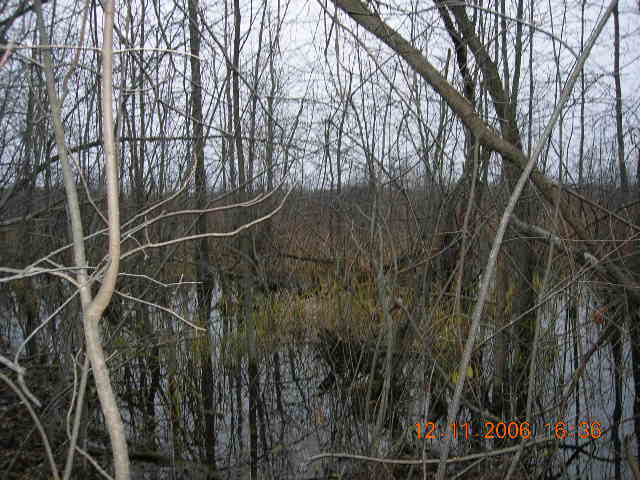
During my walk on the the ice-covered marsh several weeks ago I came across at least two dozen muskrat houses or lodges all located fairly close together. This is only what I witnessed on my short walk so there are likely many more. In past years the lodges were few possibly because the water level was much lower. In fact there was very little if any open water and mostly bog. The water must be at least a 30 cm. [1 foot] higher now allowing for all this open water and now ice.

The muskrat [Ondatra zibethicus] is a very large rodent and according to http://www.aquatic.uoguelph.ca/mammals/freshwater/accounts/muskrat.htm there can be as many as a dozen inhabitants in one of these lodges. If this is so then there could be over several hundred individual muskrats in this marsh area.

Several years ago I blogged that I trapped, or rather cornered, a fisher - a very large member of the weasel family - up a tree. The tree looked over open water and I did see a muskrat swiming in it. It would seem that the fisher was then stalking the muskrat.

Although an omnivor - eats both plants and animals - the muskrat is mainly a herbivor and thrives best on cattails of which there are many as you can see in the picture.

With respect to the food chain it is obvious from the many internet websites that the muskrat is prey for a large number of predators as is the snowshoe hare.

Monday, December 25, 2006

The Swamp Rose.


A couple of weeks ago we had a relative cold snap where the temperatures plummeted to minus 15 degrees Celsius (5 degrees Fahrenheit) for the entire night. Next morning there was also a light dusting of snow on the ground so I thought that this would be an ideal time to walk the woods to seek out some animal tracks, but alas none were found. The temperatures dropped enough mind you to freeze the ice on marsh at the back of the property; solid enough to allow me to walk on. There was nary a crack in the ice other than right next to shore where there was some running water.

While walking on the marsh ice I found a rose as pictured here. According to “Shrubs of Ontario” by Soper and Heimburger ISBN 0-88854-283-6, published by the Royal Ontario Museum, 1982, this is the Swamp Rose [Rosa palustris Marsh] and its range includes all of Southern Ontario. According to various websites it is also common in all of eastern United States, southern Quebec and the Maritimes.

Saturday, December 16, 2006

Stores for the Red Squirrel

This is the second year now that I have witnessed these small piles of Sw (white spruce) cones throughout the forest under the Sw tree of course. It is a rather unusual sight. I know that when we lived in town we had black squirrels that contributed immensely to the random planting of crocus and tulip bulbs, chestnuts, and acorns, as they cached their winter supplies. There was no other explanation for how the tulips and crocuses grew among our bushes. I have yet to figure out how these rodents ever found their hidden treasures. The numbers of successfully sprouted tulips would belie that they were not that successful.

The only settled tree dwellers found here are red squirrels [Tamiasciurus hudsonicus] who regularly chatter and chirp as they announce to all other forest dwellers your imminent arrival. There was once a black squirrel seen on the property but I am guessing that the food supply for it was not sufficiently abundant. It seems that the black squirrel http://www.fcps.edu/StratfordLandingES/Ecology/mpages/eastern_gray_squirrel.htm, - which is actually a black phase of the eastern gray squirrel [Sciurus carolinensis], according to Burt and Grossenheider* - is only interested in “The big sugar” provided by bird feeds in the suburbs and not this paltry fare of the native forest.

So these small piles of cones must be the work of red squirrels as they set up their winter food caches. This squirrel must also have regular eating places. One will often find piles of cone shucks under a tree or on a prominent rock.

The range of the Red Squirrel tends to be to the north and west of here whereas the Grey or Gray Squirrel ranges south down all the way to Florida.

Burt and Grossenheider, “A Field Guide to The Mammals, 1964, The Peterson Field Guide Series, The Riverside Press, Cambridge, Mass.

Saturday, December 09, 2006

Greeting Cards are Available with FSC Certified Stock


We recently received junk mail from a charity that included ‘free’ greeting cards. The cards had the FSC Mark on them which looks like the mark pictured here. This is great news and also very important news. We – you and I – can now choose to buy card stock that originates from properly managed woodlots and through an approved chain of custody. It also encourages us certified woodlot owners to continue this practice and helps sell the concept to the other more sceptic or uninformed woodlot owners.

We, greeting card consumers can now opt to make one more purchasing decision that will protect the environment for our future generations – our grandchildren.

You are either a part of the problem or a part of the solution. Here is an opportunity to be part of the solution.

When you look under the symbol on the cards you will see a certification code. For example the card that we happened to receive had the certificate code: sw-coc-1356. I am guessing that SW stands for Smartwood. COC stands for chain of custody. If one looks up this code on www.fsc.org you will find out that the card was printed by Primrose Printing Inc. O/A as Allegra Print & Imaging, located at 278 Albert Street Ottawa, Ontario K1P_5G8, Canada.

We should patronise these companies.

The interesting fact is that the FSC site is an international organisation. Participants include countries with rainforests like Bolivia.

Friday, November 17, 2006

The Vernal Pools topped up and quacking ducks


Last evening when I arrived home I was welcomed by a most untimely choral greeting. I was hearing peeps in the woods, a sound typically reserved for late spring. This I am quite sure must have been the spring peeper frogs whose seasonal rhythms must have been upset by the unusually warm and very wet weather. We have had about two weeks of steady rain and the woods are very wet. All the vernal pools that were dry a couple of weeks ago are now brimming. Vernal pools typically dry up at least once a year which creates a special environment, i.e. no fish or similar predators, where certain species like salamanders can survive.

The wetlands at the back of the property where teaming with duck. I couldn’t see them from the edge of the high water in the woods by I could hear the cacophony. It is an odd behaviour. The ducks would go into these quacking fits. They would all quack at different times. I presume it has something to do with courting and procreation. Does anybody know what that is about? I could see the ducks flying overhead but I could not identify them through the trees. This is the first year that I have seen this presence of duck on our property.
http://www.vernalpool.org/

Saturday, June 03, 2006

Loostrife Report No. Three


This is year three that I am reporting on Purple Loosestrife [Lythrum salicaria L.] According to "Weeds of Canada and the Northern United States", 1999, by France Royer and Richard Dickinson, ISBN 0-88864-311-X, Purple Loosestrife has been introduced in the late 1800s, and yet it was only in the last couple of decades that the plant has become an invasive and unmanageable plant. As a kid I can still remember seeing the plant grow along the roadside and often picked it and brought it home to Ma to put in a vase.

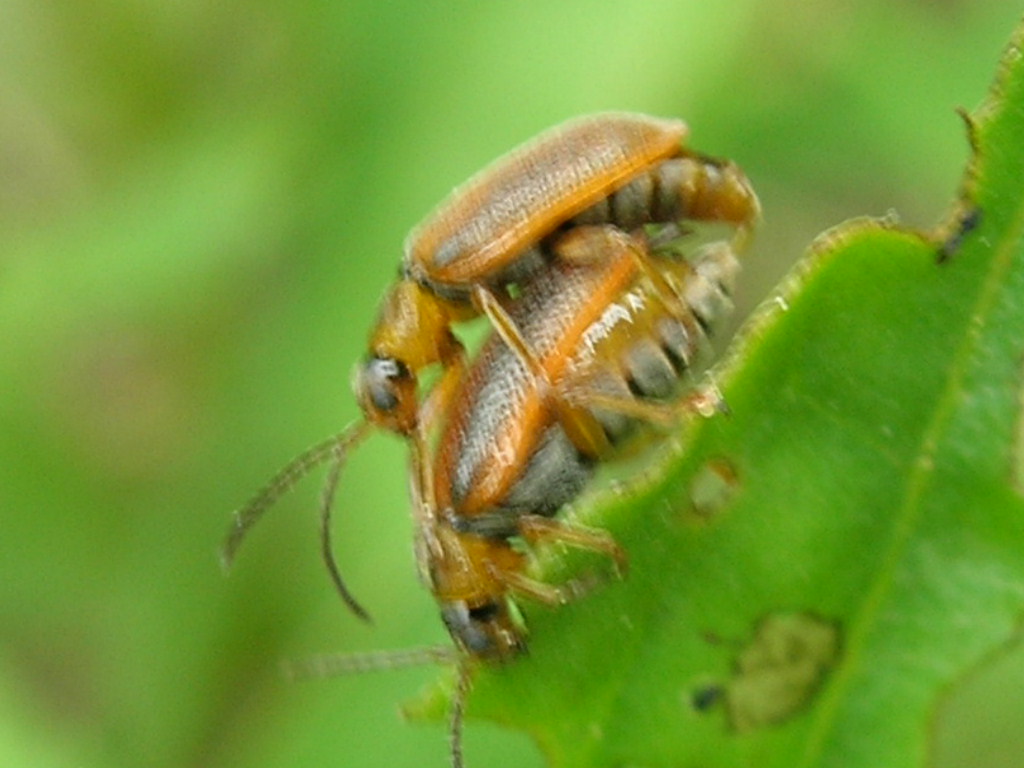
Two years ago I posted a lament on the loosestrife curse. Last year I reported the finding of the loosestrife beetle or Galerucella beetle and this year in Heartwoodlot the loosestrife has become basically invisible. Whatever plants remain are no more than some 30 cm. (1 foot) tall and all are riddled with holes in the leaves. Each plant is literally infested with several Galerucella beetles such as the couple pictured here. There are also egg clusters visible. I believe that this is the Galerucella calmariensis or black margined beetle, but I am no expert. Obviously the beetle population is doing well but its food supply is dwindling and hence the overcrowding.

The only problem now is that we no longer get that beautiful view of the purple field, but we can live with that. I do like the cattails and bulrushes just as much and they are now re-emerging nicely.

Monday, May 22, 2006

The Bloomin’ Hawthorne Tree


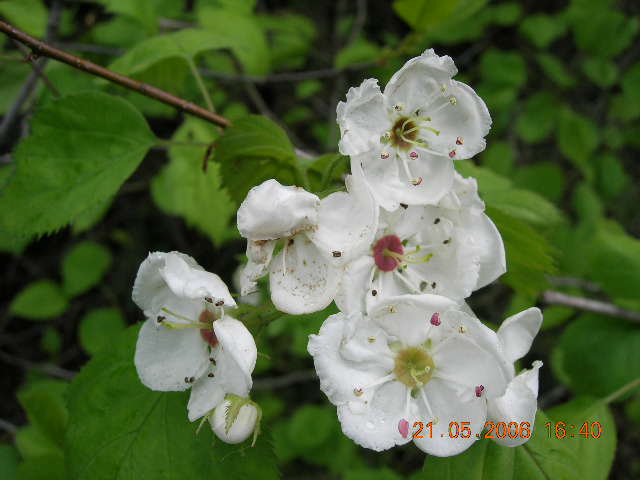
The Hawthorne bushes are blooming. The Hawthorne variety here exhibits a flower that is very similar to apple and is very short lived. The blossoming apple tree that I photographed just over a week ago is still partially in bloom whereas the hawthorns started blooming about two days ago and are already dropping their petals. With the steady rain that we have had it as been difficult to get a good picture before the flower started to disappear. A picture of the tree shows nothing after what was left after the heavy rains so here is a picture of a blossom instead.

I have been trying to identify which Hawthorne species we have but apparently there are hundreds of varieties. It will take a much more concerted effort to identify it exactly. I have a few leaves from the tree but they look very similar to several varieties on the field guide and too different yet for positive identification. I will need to examine the characteristics of rest of the tree further for a definitive identification.

Sunday, May 21, 2006

WHAT TO DO WITH THE GARLIC MUSTARD

One tends to fear those things unkown more than anything. The purple loosestrife episode is behind me. In the past I covered considerable posts on purple loosestrife which is now happily under control due to an introduced beetle. This spring when the beetle emerges I will post a photo of it now that I have the means to take close up photos.

My new invasive species project will be on garlic mustard. I have for the last day or so spent considerable time finding out how to properly dispose of the garlic mustard plants.

The Andirondack Park Invasive Plant Program is one of the best sites I have found so far. See: http://www.adkinvasives.com/Terrestrial/Ecology/Ecology.html. It also provides a best management practices that you can down load as a word document. It also covers a number of other invasive plants that do not seem to be too much of a problem here, like Japanese Knotweed.

I have cut and pasted a portion of the text from document BMPs3-06 Appendix A, of the above website entitled Best Management Practices.

CONTROL METHODS FOR GARLIC MUSTARD (Alliaria petiolata)

PLANT DESCRIPTION

Garlic mustard is a naturalized European biennial herb that typically invades partially shaded forested and roadside areas. It is capable of dominating the ground layer and excluding other herbaceous species. Its seeds germinate in early spring and develops a basal rosette of leaves during the first year. Garlic mustard produces white, cross-shaped flowers between late April and June of the following spring. Plants die after producing seeds, which typically mature and disperse in August. Normally its seeds are dormant for 20 months and germinate the second spring after being formed. Seeds remain viable for up to 7 years.

MANAGEMENT OPTIONS

1. Pulling.

Effectiveness:
Hand pulling is an effective method for removing small populations of garlic mustard, since plants pull up easily in most forested habitats. It is best to pull plants when seed pods are not yet mature, but they can be pulled during most of the year.

Methods:
Soil should be tamped down firmly after removing the plant. Soil disturbance can bring existing garlic mustard seed bank to the surface, thus creating a favorable environment for additional germination within the control site.

Cautions:
Care should be taken to minimize soil disturbance but to remove all root tissues. Re-sprouting may occur from mature plants root systems if not entirely removed. Cutting is preferred to pulling when garlic mustard infestations are interspersed amongst native grasses/forbs or other sensitive or rare flora.

Disposal:
If plants have capsules present, they should be bagged and disposed of to prevent seed dispersal. Bag all plant parts & remove from site (compost at DOT Residency, dispose of in approved landfill or incinerate with appropriate permits).

Sanitation:
Clean all clothing, boots, & equipment to prevent spread of seed.

2. Cutting

Effectiveness:
Cutting is effective for medium-to large-sized populations depending on available time and labor resources. Dormant seeds in the soil seed bank are unaffected by this technique due to minimal disturbance of the soil.

Methods:
Cut stems when in flower (late spring/early summer) at ground level either manually (with clippers or a scythe) or with a motorized string trimmer. This technique will result in almost total mortality of existing plants and will minimize re-sprouting.

Cautions:
Cuttings should be conducted annually for 5 to 7 years or until the seed bank is depleted.

Disposal:
Cut stems should be removed from the site when possible since they may produce viable seed even when cut. Bag all plant parts & remove from site (compost at DOT Residency, dispose in approved landfill or incinerate with appropriate permits).

Sanitation:
Clean all clothing, boots, & equipment to prevent spread of seed.

3. Herbicide

Effectiveness:
Roundup will not affect subsequent seedling emergence of garlic mustard or other plants.

Methods:
Use glyphosate formulations only. Should be applied after seedlings have emerged, but prior to flowering of second-year plants. Application should be by spray bottle or wick applicator for individual spot treatments.

Cautions:
This herbicide is not selective (kills both monocots & dicots), thus should be applied carefully to prevent killing of non-target species. All tank mixes should be mixed with clean (ideally distilled) water because glyphosate binds tightly to sediments, which reduces toxicity to plants.
Do not apply in windy conditions because spray will drift and kill other plants. Do not apply if rain is forecast w/in 12 hours because herbicide will be washed away before it can act. Choose Rodeo® formulation for applications in standing water or along a shoreline.

-------

Saturday, May 20, 2006

The Chokecherry is in Bloom


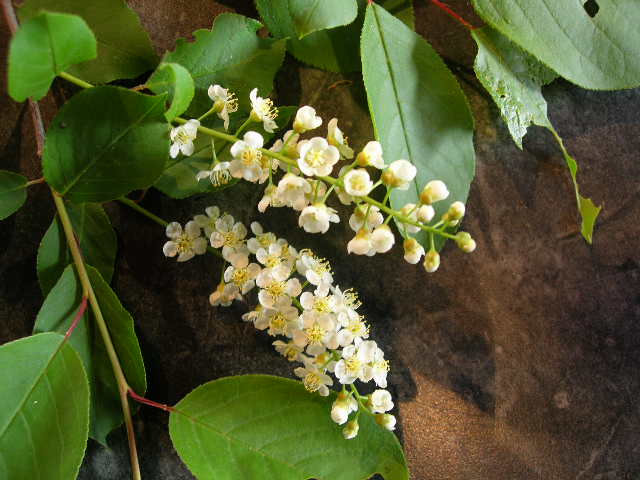
I have been noticing a small shrub along the roadside in my commutes to and from work that has an interesting flower pattern. From a distance the flower arrangement looks like a tree or shrub of little white tubes. In my morning stroll in the rain today, - it has been raining for two weeks straight now – I found the same shrub and took some branches home for identification. The branches are alternate. The leaves looked a lot like Buckthorn but the flowers distinctively were not. A little research and help from my friend Carroll we zeroed in on the Chokecherry [Prunus Virginiana L. var virginiana] which it definitely is. The flowers make a nice arrangement in a vase.

Have not found any more garlic mustard in the woodlot thankfully.

Attack of the Garlic Mustard in the Woodlot


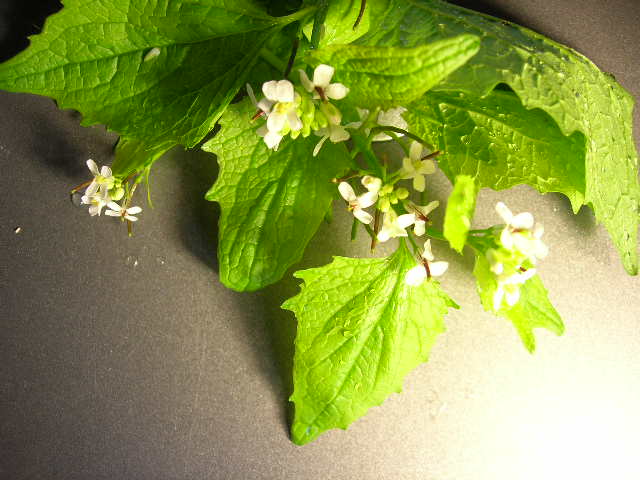
With much concern I discovered Garlic Mustard [Alliaria petiolata (Bieb.) Cavara & Grande] on our property last night for the first time. It took hold in a patch along the eastern edge of our driveway presumably carried in by the dirt on the tires or on the car. For the time being the contamination seems to be confined to a roughly circular area no more than three metres (10 feet) across. This morning I have pulled all the flowering plants from the patch and will now watch it diligently. I also noticed stalks of the plant that probably grew there last year. There are many rosettes that have taken hold in small garbage can lid sized clearings.

The book Ontario Weeds (reprinted February, 2001), By J.F. Alex, published by Ontario Ministry of Ariculture, Food and Rural Affairs, to order see www.gov.on.ca/omafra ) devotes a full page on the plant. It states that Garlic Mustard only reproduces by seed so I will watch the flower development and keep plucking them.

For more info there are many websites on this invasive weed such as: http://www.omafra.gov.on.ca/english/crops/hort/news/hortmatt/2005/10hrt05a4.htm
The flower of the Garlic Mustard is easily recognised by its small white cross shape as in the photograph here. The flowers in this photo range from 8mm to 10 mm. (approx. 5/16 to3/8 in.) across.

In the urban parts of the City of Ottawa especially downtown this invasive weed has completely taken over the gardens especially in the greenspace areas along the edge of the river. I am curious to know what the City or the National Capital Commission – custodian for much of Ottawa’s greenspace – are going to do about it. It has spread there to epidemic proportions and in time I fear that it will spread out to here to a degree where it will no longer be manageable. In other words it will start creeping in from the neighbouring lots which are uninhabited and which I have no control over.

Garlic Mustard will completely take over ground cover areas in forests and choke out natural indigenous species. Thus it has a very negative effect on forest biodiversity. Also a recent article claims that the plant kills fungi in the ground that are essential for the growth of trees such the Sugar Maple. For a story on this see: http://www.680news.com/news/national/article.jsp?content=n051404A

This plot was weedable but I was still not able to remove all the rosettes. They are quite small and planted among rocks which is hard to get at. Some of the larger plants broke off at the root since the roots were firmly embedded among the rocks. I will watch them to see if they will sprout.

Let’s hope that it will be a long time before more of this scourge really arrives.

Sunday, May 14, 2006

Nature’s own Floral Displays or perhaps an Introduced Pioneer Apple Tree


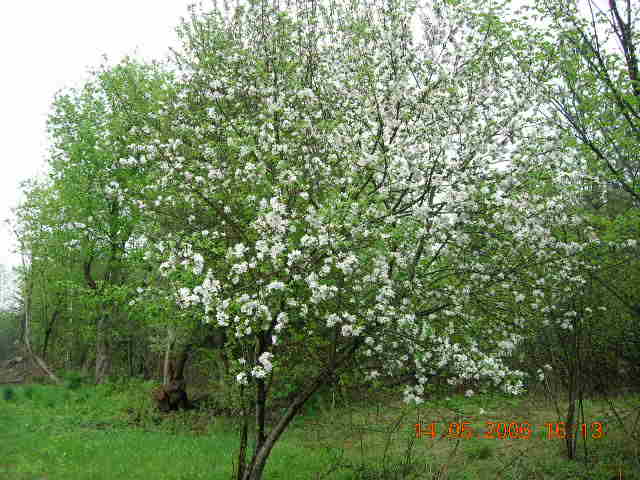
This is a picture of one of a dozen or so apple trees that seem to be haphazardly planted around this woodlot. Most of them bear a small tart apple. Yet one apple tree near the middle of the woodlot bore a yellow-green apple with a rusty hue and rough texture, which I believe is identified as the russet. It produced apples in abundance one year but very few before or since. I tasted one that was probably not ripe yet as it was still sour. I figured that the pioneers probably thought it was great for pies or preserves or something. The russet I am told is a true pioneer apple and I mean pioneer in the sense that the early settlers introduced it. The adjective “pioneer” should not be confused with pioneer trees such as poplars and birches which tend to be the first to take root in clearings and prepare the soil for subsequent higher quality trees like oaks and maples.

I was not even aware of this little apple tree in the photo, until I had cleared out the Manitoba Maples [Acer negundo L.] a.k.a. box-elder (particularly in the US), or Ashleaf maple, that choked out the surrounding area. The tree was completely taken over and dominated by Manitoba Maples. These Maples are locally ranked in the “Soft Maple” category since the wood is indeed not very sound, but they grow profusely. This year the apple tree has come out in full bloom as the photo depicts. It is a lovely celebration of its release.

Another beautiful flowering tree is the Hawthorne, which are abundant in this woodlot along the edges of clearings. Their time to flower has yet to come. Stay tuned.

Sunday, May 07, 2006

A Fat Starnose Mole, Page 2 of 2.


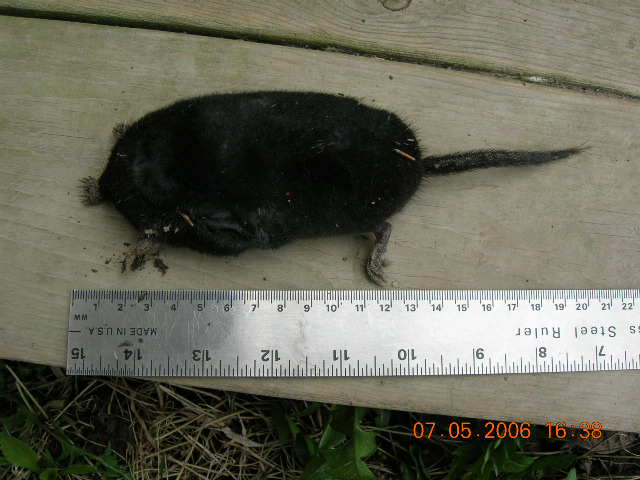
According to my trusty Peterson Field Guide “A Field Guide to the Mammals – Field Marks of all Species found north of the Mexican boundary” by William Henry Burt and Richard Philip Grossenheider, The Riverside Press – Houghton Mifflin Co., Cambridge, MASS. 1964, the Starnose mole is recognized as follows: Head and body, 4 ½ - 5 in.: tail 3-3 ½ in.; wt, 1 1/5 – 2 4/5 oz.

So this mole is within but at the upper end of the range for what this mole should be. 2 4/5 oz is exactly what I weighed this one at. You can see the length of the mole from the pictures with the scale shown.

This field guide was my first field guide, a birthday present in 1965 on my 13th birthday. It still seems as accurate today as it was then.