Found American Winterberry [Ilex verticillata] growing in the swamp on the Southeast border of our property. It is a very vivid and showy bush with very bright red-orange berries.
For some excellent photos of the winterberry flower see: http://www.ontariowildflower.com/lakeedge.htm
It is a very long page with many photos so to find the photo you'll have to do a search for the name.
Monday, December 12, 2011
Saturday, November 26, 2011
Caught a Neighbour Attempting to cut a Trail through our Woodlot
There is the odd time especially during hunting season and after a snow fall that I will find footprints through our woodlot but it is not regular and not the norm. This afternoon however, while walking through our woods, I could hear chainsawing that sounded way too close and likely in our wooded property. It is in an area of very dense underbrush difficult to walk through so I rarely go there. I then investigated only to catch my neighbour with a chainsaw coming out on a fresh cut trail towards another neighbour's property between him and I. He told me honestly -- he's an affable enough guy -- that he was trying to find a way to the property on the other side where there is an ATV trail network. He was trying to cut his way through. There is an estimated 21000 trees on the property so it is not like I'll miss the trees he cut which are mostly small.
We were shocked and concerned none-the-less since he intentionally trespassed and worse still, cut trees to make a trail across our property. I am sure that if we came over and cut down trees to make a trail across his much smaller property without permission that his reaction would be the same if not worse.
Had he taken the initiative to approach us and asked permission it might have been a different matter. To provide any access across our property is not, never was and never will be part of our plan for our woodlot property and for a number of reasons.First of all we value our privacy and security. We live on the lot and increased traffic here increases risk to our personal security. We equally respect our neighbour's properties.
Second of all, when a person trespasses on our property we are liable for any injury that befalls that person. There are hazards like standing dead trees which may fall, pointed sticks one can fall onto etc. in wooded properties. This can put trespassers at risk and we are not prepared to accept that liability.
Thirdly, if we provide access to one person to cross our property it creates a precedent that can become a slippery slope. As soon as there is knowledge that there is a path across the property, word will get out and it is likely that it becomes subject to abuse by all and sundry who do not have permission and are unknown to us. We are not prepared to risk that and to have to monitor the trail use.
Fourth, our woodlot is a managed and certified forest so it is therefore protected. Trees are cut based on a prescriptive plan. Part of that plan is the 25 acres of wetland at the east end of our property which also happens to be protected as a Provincially Significant Wetland. It is therefore further protected by Province of Ontario laws. This severely restricts tree cutting and happens to include the area that I found the neighbour cutting in today.
Regardless, just as we respect other's property I expect our neighbour to respect ours. We write this without prejudice and would respond to all similar actions by other persons in the same way.
I have reported this incident to the local police call center to at least put it on record, should a similar event happen again.
Sunday, October 30, 2011
The Second sighting of A Red Bellied Snake in 11 Years
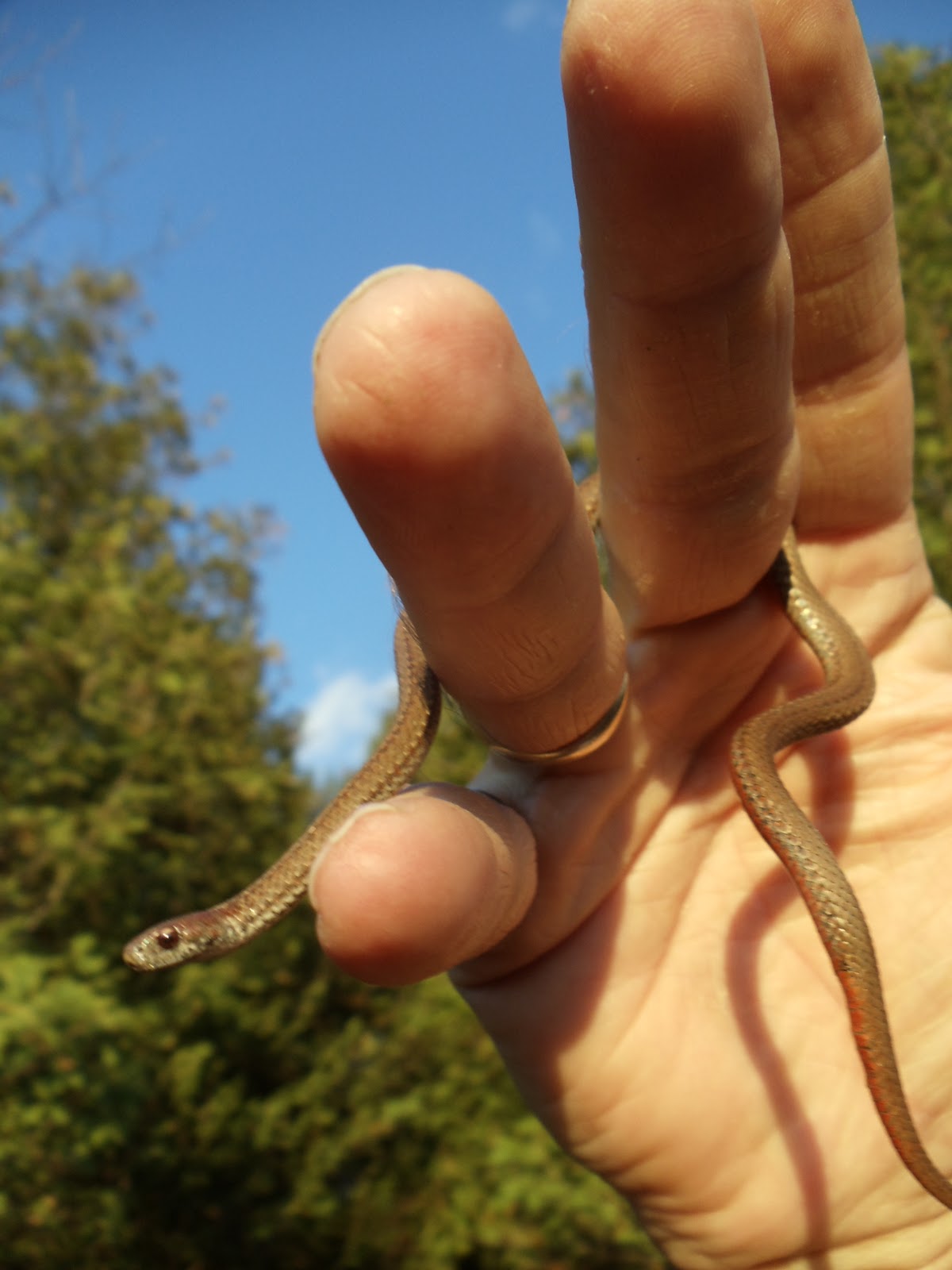
While working in the field on the south west end of our woodlot I noticed our cat playing with a tiny snake. It's reddish orange belly was evident from a distance and I immediately interrupted the cat's play to save it. It is a tiny snake and from the top it is a rather featureless gray but underneath it has a clear orange belly which is characteristic of a red bellied snake [Storeria occipitomaculata]. It did not appear very frightened when I picked it up.
After the photo-shoot I returned the reptile to its little depression in the ground which was about the size of a tea cup and it then slithered out of sight down into the earth. This was likely its hibernacula as they call its winter quarters.
I had seen this snake before early on in the first years when we arrived here on the woodlot but never since, and it was also in the same general area. Its den or hibernacula is located near the forest edge just as the descriptive websites indicate. Since it preys mainly on slugs it is a welcome presence in our woodlot. There are slugs galore around here. We need more red bellied snakes.
After the photo-shoot I returned the reptile to its little depression in the ground which was about the size of a tea cup and it then slithered out of sight down into the earth. This was likely its hibernacula as they call its winter quarters.
I had seen this snake before early on in the first years when we arrived here on the woodlot but never since, and it was also in the same general area. Its den or hibernacula is located near the forest edge just as the descriptive websites indicate. Since it preys mainly on slugs it is a welcome presence in our woodlot. There are slugs galore around here. We need more red bellied snakes.
Saturday, October 22, 2011
Adding Some Horsechestnuts to the Mix
| Chestnuts placed in bare patch |
| Chestnut patch before rock. |
| Chestnuts covered up. |
I planted the nuts along the forest edge or the residential acre in a half metre square patch as shown here and covered the patch with a large flat rock, to protect the nuts against predation by squirrels or raccoons and also to temper large temperature shifts. In spring when the nuts are expected to emerge I will remove the rock. If more that one survives they will be transplanted. I can probably find a spot somewhere for them in this 80 acre lot.
| Rock covering chestnuts for the winter. |
Thursday, August 25, 2011
Pseudoscorpions
From time to time I noticed this small spider -- so I thought -- in the basement. I payed no attention to it for the longest time thinking that it was merely a crab spider. After taking these pictures and further examination, it became evident that crab spiders do not have these pincers. So now what? After considerable searching under different names I found from the bugguide.net that it is a pseudoscorpion. It is common in North America right up to the treeline.
It gets around by hitchhiking on larger flying insects, and is very beneficial to humans, preying on tiny insects like aphids, ants etc. Though it does produce venom, its pincers are too small to inflict injury to humans and are thus considered harmless.
Tuesday, June 14, 2011
A Sparrow's Nest in the Grass
| One of the parents perched on a tree near their nest in the tall grass. |
These little babies look like they are ready to leave the nest at anytime now.
| Song Sparrow fledglings |
The Everwelcome Dragonfly
This dragonfly is one of our most common at this time of year. According to KAUFMAN Field Guide to Insects of North America, ISBN-13/EAN: 978-0-618-15310-7 or ISBN-10: 0-618-15310-1 Page 48 this is the Dot-tailed Whiteface [Leucorrhinia intacta]. In the evenings when the mosquitoes come out in swarms, these Whitefaces are welcome critters since the make quick work of the mosquitoes.
Tuesday, May 31, 2011
The Brilliant Six Spotted Tiger Beetle
While working on a pile of rocks I would from time to time enjoy the company of these beautiful metallic green insects as they swiftly scurry about. According to Bugs of Ontario, it is a Six Spotted Tiger Beetle.
This spring I have seen numerous such beetles as well as the tiny red spiders. Wherever I happen to be working in the ground I come across at least one. This implies that there is an abundance of these little predators. Both the tiger beetle and the tiny red spiders prey on insect pests like ants or caterpillars for the tiger beetle and aphids for the spiders.
This property was abandoned around 1968 and largely reforested around 1971. We moved here 10 years ago and have never used any insecticides on the property so one could say that it is very free insect friendly. I wonder if that is why there is such an abundance of these unusual bugs. Never would have dreamed of seeing them in the suburbs of Bells Corners, where we used to live and we might have seen an ant or mosquito.
This spring I have seen numerous such beetles as well as the tiny red spiders. Wherever I happen to be working in the ground I come across at least one. This implies that there is an abundance of these little predators. Both the tiger beetle and the tiny red spiders prey on insect pests like ants or caterpillars for the tiger beetle and aphids for the spiders.
This property was abandoned around 1968 and largely reforested around 1971. We moved here 10 years ago and have never used any insecticides on the property so one could say that it is very free insect friendly. I wonder if that is why there is such an abundance of these unusual bugs. Never would have dreamed of seeing them in the suburbs of Bells Corners, where we used to live and we might have seen an ant or mosquito.
Saturday, April 30, 2011
White-throated Sparrow
Sunday, February 06, 2011
A Visit of a Small Hawk in our Yard
Bird feeder was very quiet last Thursday morning. Didn't make any mind of it until looking out the back window I saw this little hawk. It looks smaller than a rock pigeon. Definitely smaller than a Crow. While it was perched at sunrise it would periodically and rapidly flick its tail back and forth like an inverted windshield wiper as seen at this distant perch. It was as if it was waking up. At the time there was very little other activity in the yard. I know that it was too large to be a kestrel or sparrow hawk.
Its size made me think that it was a merlin of the falcon family but it didn't have the characteristic side burns. I have at least seven different bird guides thankfully and each describes the same bird in slightly different ways which is often very helpful. I relied on my initial three bird guides by Sibley, Audubon and the Royal Ontario Museum and none were really of much help since they did not give enough information to distinguish the characteristics of this bird. By the odd colouring I thought that it might be a Juvenile cooper's, or sharp-shinned. The colours say maybe a northern goshawk but it is very small for a goshawk.
At this point I hadn't found nor bothered to find the other bird guides, and proceeded to post the following two pictures
I later found another bird guide by Kaufman that much more clearly confirmed this identification as a juvenile Sharp-shinned. It showed a very good semblance of the white spotted back of this bird and I have scanned the page out of the book for the reader's benefit. It is from Field Guide to Birds of North America by Kenn Kaufman, 2000, Houghton Mifflin Company, ISBN 0-618-13219-8. I think this pretty much confirms the identification although the colours of the breast feathers were softer and never showed the sharper and more distinct brown and white pattern.
Friday, January 21, 2011
My Introduction to Prickley Ash
A bane of the woodlot owner is Prickly Ash [Zanthoxylum americanum]. It is a very thorny bush and though I had heard of it I had never identified it in the wild until last summer when I made a visit to a friend's woodlot near Kingston ON. It is an awful thorny bush and likely worse than a wild rose. It is undoubtedly impossible to walk through without chaps or other leg protection.
I was of the false opinion that this was probably not an issue in our area until, on a recent trip this summer in the Perth area I had noticed an unusual bush that stood about 2 metres high and had interesting clusters of berries near the stem. I took a sample of it home for positive identification. Sure enough using Trees in Canada ISBN 1-55041-199-3, it was definitely identified as Prickly ash. I have since found it along a road not more than 6 km away from here, and more recently found a patch of it in our very own woodlot.
Unlike buckthorn and other invasive plants, Prickly Ash is apparently not that hard to control by just cutting it back. Buckthorn on the other hand just keeps sprouting up even after three or four years of cutting back.
Sunday, January 02, 2011
Deer Damage to Little Maples
After a month of nice seasonal wintery weather, over the last week all the snow has basically melted away with the rain. I took advantage of this lowered ground cover to see if I could now find the sugar maples that we planted in the front field last spring. During the summer and fall the herbaceous growth was so thick that I was unable to find any of the maples that we planted. Now with the snow having pushed down the weeds, the saplings were very easy to find with their blue flagging tape around the stems. Had we not marked each tree with blue flagging tape finding them would have been totally hopeless.
Deciduous trees do not complete well against grasses in the first stages of life, until they reach above the height of the mature weeds. In our field the trees have to compete against plants like golden rod, purple loosestife, barn grass and joe pye weed all of which typically grow up to a metre (3 feet) tall. When neighbours throw out old carpeting I often offer to pick them up and use them for weed control around seedlings in grassy areas.
I will cut the carpeting into 60 cm (2 feet) squares and cut a slit from the center out. I will also cut a small 3 inch cross at the centre to make some room to position it around the stem. I then place the carpet piece around the base of the small tree fuzzy side down. This quite effectively stops the weeds from growing right next to the tree and from competing with it for moisture, light and nutrients. Seems to work quite well. Since the carpets take some time to decompose, they can usually be reused to at least start one more tree.
Out of the 10 sugar maples that we planted only two which were quite short did not have their tops chomped off by deer. This is a problem since the terminal bud (at the top of the tree) is what really promotes tree growth. It is not uncommon to find young maples bushy and stunted because of deer browsing. I will have to come up with some sort of a protective mechanism for the terminal bud. The attached website provides some excellent information on controlling deer damage.
Deciduous trees do not complete well against grasses in the first stages of life, until they reach above the height of the mature weeds. In our field the trees have to compete against plants like golden rod, purple loosestife, barn grass and joe pye weed all of which typically grow up to a metre (3 feet) tall. When neighbours throw out old carpeting I often offer to pick them up and use them for weed control around seedlings in grassy areas.
I will cut the carpeting into 60 cm (2 feet) squares and cut a slit from the center out. I will also cut a small 3 inch cross at the centre to make some room to position it around the stem. I then place the carpet piece around the base of the small tree fuzzy side down. This quite effectively stops the weeds from growing right next to the tree and from competing with it for moisture, light and nutrients. Seems to work quite well. Since the carpets take some time to decompose, they can usually be reused to at least start one more tree.
Out of the 10 sugar maples that we planted only two which were quite short did not have their tops chomped off by deer. This is a problem since the terminal bud (at the top of the tree) is what really promotes tree growth. It is not uncommon to find young maples bushy and stunted because of deer browsing. I will have to come up with some sort of a protective mechanism for the terminal bud. The attached website provides some excellent information on controlling deer damage.
Monday, December 27, 2010
A Meal for One Bird is the Life of Another
Wednesday, September 22, 2010
Planting of a Honey Locust
Since I live inside the City of Ottawa I am entitled to one free tree each year as part of the city's Tree Program. This year I requested and received a Honey Locust. That is to say that the tag on the tree states Locust Gleditsia. In my tree book the Honey Locust's scientific name is Gleditsia triacanthos L. Another name for it is the Thorny locust and indeed it is thorny. It produces long bean-like seed pods.
The delivered tree's height is 2.4 m. ~8 feet. and dbh (diameter of the stem at breast height which is 1.3 m (~4¼ feet) above ground) is 1.6 cm (5/8 in).
Its French name is févier épineux.
The tree is planted in the acre around the house.
The delivered tree's height is 2.4 m. ~8 feet. and dbh (diameter of the stem at breast height which is 1.3 m (~4¼ feet) above ground) is 1.6 cm (5/8 in).
Its French name is févier épineux.
The tree is planted in the acre around the house.
Workshop on Fomes Annosa (Heterobasidion annosum)
Yesterday, Sept 21, 2010, I attended a workshop on Fomes Annosa (Heterobasidion annosum) (FA) which was put on by Richard Wilson Phd. a tree pathologist with the Ontario Ministry of Natural Resources based out of Sault Ste Marie. It was held at the Larose Forest which is located about 50 kilometres East of Ottawa.
FA is a fungus that attacks particularly red pine (Pr) trees and only affects injured trees since it gets in through the wound.
The morning consisted of technical presentations including an Overview of Forest Health in Ontario, Fomes Root Rot in Ontario, and Overview of the Pesticides Act and Regulations: What You need to know in order to apply pesticides. The first two presentations were provided by Dr. Wilson while the pesticide presentation was given by Scott Olan, Pesticide Specialist with the Ontario Ministry of the Environment.
In the afternoon we proceeded out to the forest to observe signs and symptoms of Fomes Annosa, discussion on Red Pine management, and various management methods and options.
Heartwood includes a number of small red pine (Pr) groves. FA effects mainly the Pr and what makes it so unique is that Pr roots will graft together with roots of neighbouring Pr trees and share nutrients.
What I learned from this workshop was how trees are exposed to the FA and methods to identify the disease and to minimize its spread. A Pr becomes particularly susceptible when it is cut down. The stump then becomes a scar where the fungus can take hold and it then can travel to the neighbouring trees through the grafted root system killing the neighbouring trees.
One of the interesting methods of controlling this spread it to dig a trench around an affected area thus effectively cutting off the root connections with neighbouring trees. This technique was used in the Larose Forest long ago and it proved to be quite effective since healthy neighbouring trees outside such a trench survived well. We looked at three such trenches which looked like meteor craters or imitations of Stonehenge.
FA is a fungus that attacks particularly red pine (Pr) trees and only affects injured trees since it gets in through the wound.
The morning consisted of technical presentations including an Overview of Forest Health in Ontario, Fomes Root Rot in Ontario, and Overview of the Pesticides Act and Regulations: What You need to know in order to apply pesticides. The first two presentations were provided by Dr. Wilson while the pesticide presentation was given by Scott Olan, Pesticide Specialist with the Ontario Ministry of the Environment.
In the afternoon we proceeded out to the forest to observe signs and symptoms of Fomes Annosa, discussion on Red Pine management, and various management methods and options.
Heartwood includes a number of small red pine (Pr) groves. FA effects mainly the Pr and what makes it so unique is that Pr roots will graft together with roots of neighbouring Pr trees and share nutrients.
What I learned from this workshop was how trees are exposed to the FA and methods to identify the disease and to minimize its spread. A Pr becomes particularly susceptible when it is cut down. The stump then becomes a scar where the fungus can take hold and it then can travel to the neighbouring trees through the grafted root system killing the neighbouring trees.
One of the interesting methods of controlling this spread it to dig a trench around an affected area thus effectively cutting off the root connections with neighbouring trees. This technique was used in the Larose Forest long ago and it proved to be quite effective since healthy neighbouring trees outside such a trench survived well. We looked at three such trenches which looked like meteor craters or imitations of Stonehenge.
Wednesday, August 18, 2010
Stung by a Wasp
We have our nephew from Nova Scotia visiting us here in Eastern Ontario. He has been hired to do renovations and other jobs. One of his jobs is to cut the grass which he completed yesterday. Just as he was finishing this job he was stung several times by a wasp. It is a type of ground wasp and very small, about 10 mm long, as pictured here. His reaction to the stings was quite remarkably minimal, like a mosquito bite. He did apply "Afterbite" immediately which must have helped.
Sunday, May 30, 2010
The Ever Beautiful Flowers of the Highbush Cranberry
As with all other plants the highbush cranberry (Viburnum trilobum) bloomed very early this year. These can be found throughout the woodlot and seem to have propagated quite naturally since they are randomly located. This is yet another white spring flower. An interesting note is that the ring of white petals are infertile flowers designed to attract insects onto less attractive fertile flowers in the centre.
Virgina Waterleaf under the Butternut Tree
The butternut tree nearest our house has a very interesting ground cover plant growing in its shade. After much searching I have been able to identify it as Virginia Waterleaf (Hydrophyllum virginianum). Like the Canada anemone it propagates by rhizomes and well as seed and is just as easily transplanted. It looks like another candidate for our natural landscaping plans. This is a picture of the ground-cover with an inset of the flower as seen under the butternut tree. This is a another white flower with a very slight purplish tinge.
Canada Anemone
It seems like it is time for the white flowers to all come out at the same time. Pictured here is the Canada Anemone (Anemone canadensis) a wild flower which grows on the road allowance adjacent and south east of Heartwood. It creates a nice ground cover and is apparently easy to transplant by moving a part of the rhizomatous root system. I might seriously consider making it part of the future landscaping plan around our house. The internet does warn however that it can be invasive once allowed to flourish.
Saturday, April 24, 2010
Tree planting Today
| The Tree Planting Party |
Subscribe to:
Posts (Atom)


