Saturday, February 25, 2006

Definitively a Great Gray


Late this afternoon I sat down for a break to read up on some research on my inherited wall clock. My mother gave me a wall clock that has been in her family for 80 some years. After some Internet research I found literature that helped me identify the maker and origin of the clock. It led me further to some online bookstores that sold books on this specific clock maker, now identified as Gustav Becker a well know clock maker from Freiburg in what was then Germany and now part of Poland. Gustav Becker died in 1885 but the company remained in existence up to WW2.

Yesterday we received a parcel notice from the post office. Since our mailbox is too small, it had to be picked up in the village. I had ordered the two books about Gustav Becker so I was expecting this parcel to be those two books. So this morning I drove the 6 country kilometres (4 or so miles) through white open fields into the Kars village though a snowstorm to retrieve my anticipated prize. All the while, Carroll has been tentatively watching the Turin 2006 Winter Olympics this morning which interested me too but not as much as this.

So during my break I read up on the clock and found out that it was in fact built or sold in 1926. It was still blowing and snowing outside, and so hard that the snow created horizontal lines in the air against the gray wooded background.

Then out of the corner of my eye I could make out a large bird alighting in a red pine tree very close to the house. At first I automatically assumed that it was a turkey as it was a big black bird. Then after further examination it had a round head with a noticeably flat face that rotated like a turret. It was not a turkey but an owl. The bird was perched in the far side of the tree so it was difficult to identify. After several minutes at that perch it flew to another tree near the front of the house. I was now able to get a few photos of it with our portrait camera which were not the best but better than nothing – I ought to get a better camera some day. The background was gray and the subject was gray, and also it was starting to get dark, all of which colluded to create what amounts to a black and white photograph. As you will see from the above picture it was perched with its back to us, but at times when it swiveled its head to the side I was able to make out the white swipe mark below its eye discs. The owl later moved to a lower perch and faced directly towards us. We were now able to clearly see the mustache shaped white marks below the eye discs. This is a characteristic mark and it confirmed without a doubt that we were looking at a Great Gray Owl [Strix Nebulosa].

Back in February 13th last year, I had reported a sighting of a grey owl but the evidence was not definitive. That post also provides considerably more detail about the owl and the fact that it was not a natural bird in this area and that such sightings are usually accidental. The gray in fact has become a regular in these parts for the last couple of years, during winters.

Saturday, February 18, 2006

Closing the Loop on Woodlot Certification

  • Closing the Loop on Woodlot Certification

We normally get a bag of flyers in our mailbox Friday night or Saturday mornings. There is the normal bunch of flyers from Home Hardware, Leons Furniture, Home Depot, Sears etc. I always take a minute or two to go through each of the flyers to see if there is anything of remote interest on sale. I admit it that I am a flyer junky. Neighbours at our former home in suburbia did the right thing and reduced pollution by refusing flyers – or more aptly put, junk mail – in their mailboxs. I could never do that.

I came across something interesting in today’s Home Depot flyer. As part of its marketing strategy Home Depot is marketing ECO Options that cater to clients who are “Looking for ways to make better environmental choices when they renovate their home”. On page eight, Home Depot is selling a Maple Veneer Core Panel 4’ x 8’ x ¾”with the FSC trademark or Forestry Stewardship Council A.C.
The ad then includes a descriptive green bar with the following text:

FSC  Certification helps sustain our forests  The Forest Stewardship council is an international non-profit organization that supports environmentally appropriate, socially beneficial and economically viable management of the world’s forests.  When you see the FSC symbol, you know that sustainable forest practices have been followed


So how does this close the loop?

You will see from a posting on this blog on Thursday September 1, 2005 that I had Scott Davis, Certification Coordinator of the Eastern Ontario Model Forest (EOMF), Forest Certification Program visit and inspect my woodlot. As a result we had our woodlot certified and we now adhere to the certification criteria and entered the woodlot certification program. We also joined the Eastern Ontario Certified Forest Owners (EOCFO) organisation formed by individuals in Eastern Ontario who had been seeking, and in 2003 obtained, FSC group forest certification for their woodlots.
What does this mean?

FSC certification program requires that:

  • Wood is not harvested faster than it grows;
  • Water, wildlife and forest ecosystems are protected;
  • Standards are developed through a stakeholder process, not controlled by industry;
  • Standards measure on-the-ground results, not just policies, programs and plans; and
  • Standards, performance and recommendations are made public.

See http://eocfo.eomf.on.ca/ for full details.

So now we have come full circle. Our good management practices will now be recognised not only because it is the right thing to do in its own right but also in a more tangible means where the measures are recognised and valued in the marketplace. Also this will now let the non-woodlot owner and client for wood products participate in and promote the program.

I would say it is a good thing.

Sunday, January 22, 2006

A Young Butternut Tree in Winter


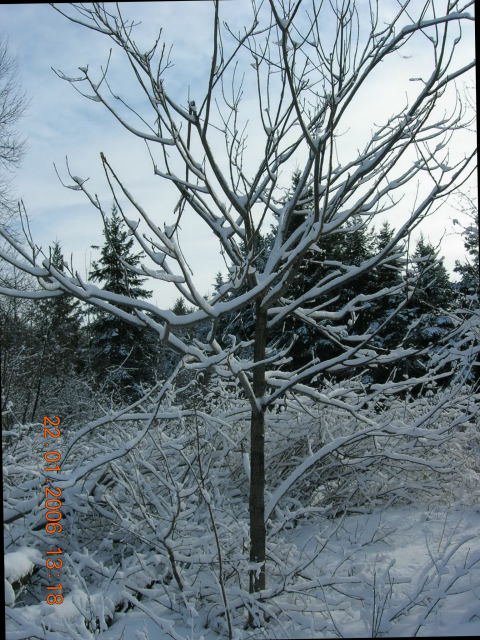
This picture is of a small butternut tree growing about 300 metres (~1000 ft) from the house. On the ground to the right is a bare patch that I believe is created by the butternut root’s characteristic of transmitting the juglone toxin to neighbouring tree roots thus limiting their growth. Only shallow rooted plants such as grass will grow in this area that do not contact the roots. To the left it is also clear. The branches on the ground are left over from a Manitoba maple that was felled and limbed just before the snow fell.

Saturday, January 21, 2006

A visit of a Leaf-Footed Bug


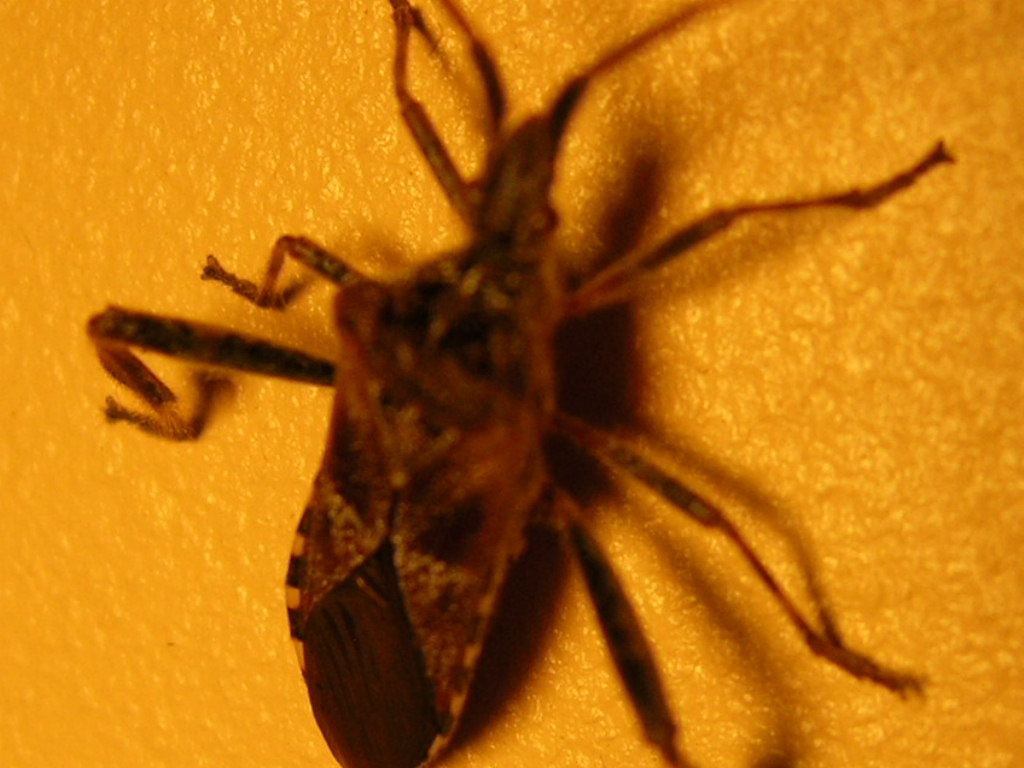
Throughout the winter we are in the company of several persevering insects. These include ladybugs in the highest abundance as well as some cluster-flies and the odd single curious bug such as the one pictured here.

According to Insects by Borror and White it is the leaf-footed bug, Family Coreidae. There is little else provided in the field guide. It may be predaceous or a plant feeder.

According to http://bugguide.net/node/view/3393 it is a Western Conifer Seed bug [Leptoglossus occidentalis].
According to http://www.forestry.ubc.ca/fetch21/FRST308/lab2/leptoglossus_occidentalis/leaf.html it damages douglas fir, ponderosa pine and incense cedar. None of these trees exist on this woodlot that I know of so I wonder what host trees it feeds on around here?

INSECTS, Borror, Donald J. and White, Richard E., Peterson Field Guides, 1970, ISBN 0-395-91171-2 (pbk.).

Sunday, January 15, 2006

Only Two Turkeys So Far this Winter


From past postings on this blog, you will note that we have had as many as a dozen or so turkeys on a single visit at our bird feeding station for the last three winters. This year has been disappointing as we have only had these two turkeys pictured here.
I captured this picture this morning just as they started to take flight. The wing breadth and span is quite impressive and they fly very well. This time they flew off over the tree tops out of sight.

Saturday, January 07, 2006

Found several Snowshoe Hare Beds


Just before dark this evening, I took a little stroll around the two spruce plantation plots near the house. I found numerous snowshoe hare tracks and several beds. The snowshoe hare must rest right on top of the snow. It is a well used patch with a concentration of rabbit droppings.

I also found ruffed grouse tracks and flushed out two perched high up in the trees.

An Inspection of a Fisher Pelt

A colleague brought a pelt – fully tanned hide with fur intact – of a fisher [martes pennanti] to work, which we proceeded to inspect and hover over during lunch break. He is a certified trapper in the Province of Quebec so he is permitted to trap fur-bearing animals. The pelt was that of a male fisher. It is not as nice and dark as that of a female I am told. What intrigued me about this pelt were the porcupine quil puncture marks that were clearly visible from the inside of the pelt. The head, shoulder and upper body area of the pelt were scared by several dozen quil punctures. Probably not a good skin for making waterproof clothing. I have heard that the fisher is able to resist injury caused by the quils and this pelt obviously proves the point. The fisher was caught because it had become a local nusance and was devouring neighbourhood cats where my colleague lives in Quebec. It was still quite healthy and thus not affected by the quils.

Friday, December 30, 2005

Glistening Ash Trees


With the cooling weather, mother nature is again decorating our trees and just on time for Christmas. This photo is of the tops of a grove of very tall ash trees can be seen from our house. This photo was taken in the morning from our house looking east into the sun. This type of ice coating could be seen on trees throughout the entire area. On that morning we drove through the countryside to Vars where we caught the highway 417 on our way to New Brunswick. We could still see the same decorations for a good 50 kilometres (30 mi.) away from home.

Sunday, December 18, 2005

Return of the Snow Buntings

Just this week while driving home I was fortunate to observe several large flocks of snow buntings [Plectrophenax nivalis] out in the open fields near here. They were around last winter too but appear to be more abundant this year that before. Back the 70’s when I was posted in the Arctic I frequently observed them there during the summer. According to the literature in winter they come down to these latitudes almost right across North America. They have a very white patch on their wings which is very visible as they swirl over the fields. I could see them land in areas where the snow layer is thin and usually wind swept, presumably to feed on the seeds exposed on the bare earth. They are quite the site to see.

Friday, December 09, 2005

American Bittersweet


In earlier posts I mentioned finding several occurrences of a vine along the northern woodlot boundary next to the snake fence. The vine is very woody and it spirals clockwise up around tree saplings. The identification of the vine from the ground was difficult up to now because they reached up at least 10 metres (30 feet) and well into the canopy before it produced any leaves or flowers or berries. The leaves were also hidden by tree foliage. There are at least two relatively large vines with a base trunk diameter of nearly 3 cm. (one inch plus). The vine wraps around the trunk of the trees and in many cases the host tree died from mere physical strangulation. The vine trunk has a characteristically grey and relatively smooth bark.

During my walk in the clearing area G at the north-eastern corner of the woodlot I found American Bittersweet [Celastrus scandens L] which I was able to positively identify by its beautiful red berries and orange shells which (according to the various websites), is only produced by the female plant. I would venture to say that the woody trunk of this plant was identical in description to the vines noted above. I feel quite confident that the above vines are also American bittersweet.

Years ago while we were still preteens, my mother would take my bother and me, for walks in the woods. In a forest across what was then the old #2 highway (today it is the 2 and 20), and also across the CN and CP railway tracks which ran parallel to the highway – we found one patch of bushes that had berries just like these. I remember fondly how our mother used them with coniferous boughs to make beautiful Christmas wreaths. I recall though that these plants appeared to grow as bushes and not vines like those above.

Friday, December 02, 2005

Remnants of the BA British American Oil Company in the Woodlot

During my visit to Area G in the woodlot, I found several rusty oil cans. I thought then that if I was able to determine the dates of the oil cans I would be able to establish when much of the logging activity was carried out. It also would help date the age of the new tree growth.

On several of the oil cans I was able to make out the familiar-to-me BA symbol which stood for the British American Oil Company. The symbol was very familiar to me since as a youth we lived right next to a BA Gas Station in the Montreal outskirts. During our hot summer vacation days, my brother and I often washed car windshields and pumped gas there as volunteers anxiously anticipating a 10-cent tip. We usually made enough for an ice cream at the Dairy Queen which was several miles down the highway. So after making enough money for an ice cream my brother and I would bicycle off for our reward of our labours.

In the interest of dating the cans, I web-browsed and found an interesting and pleasantly designed website about BA memorabilia. I particularly liked the historical essay of BA. To cut to the chase, BA was bought out by Gulf Canada and continued under the same name until 1969 when the Gulf Canada name replaced the BA symbol. Gulf Canada later became Petro Canada which still exists today.

So we can now safely estimate that Area G was logged for its cedar trees before 1969.

Saturday, November 19, 2005

A Butternut Grove

During my walk today I visited the clearing area at the northeastern corner of the woodlot referred to as Area G in the woodlot management plan. Area G is the only clearing in the whole woodlot which was not intentionally kept open through cultivation or clear cutting. It should in time have grown in with trees and yet there is but a thin and sparse planting of several poplar trees and others. I always wondered why is this so? This area had very old and well rotted cedar tree stumps which were cut some 30 or more years ago. In fact there was evidence that it was cleared at least 45 years ago. The field has remained undisturbed for all these years and yet but few trees took root as well as grass and some small herbaceous vines.

Having become sensitised to the plight of the butternut tree [Juglans cinerea L.] and the fact that in certain parts of North America it is becoming an endangered species due to major die off created by the butternut canker, I have become more experienced at identifying the tree. So during this visit to area G to my amazement I found very many butternut trees in area. Many were dead trunks with the characteristic butternut canker scares, some were alive but in poor condition and a few others seemed still healthy. I counted some 3 dozen trees or remains of trees all together. Now that the trees were bare it was easier to identify and count them all. One butternut tree was much larger than the others and may well have been the parent that provided the seed source for the rest. It had a dbh (diameter at breast height) of 35 cm (14 in.). In forestry, the stem diameter of a tree is measured at breast height or 1.3 metres (approx. 4 feet) above the ground hence the term dbh.

I have long wondered why area G stayed clear and think I may have hit upon the answer. The butternut tree has an interesting characteristic in that it produces Juglone toxin in its roots. Other plants whose roots touch the butternut root will draw this toxin and wilt and even die. This also occurs with black walnut. The article at http://cecommerce.uwex.edu/pdfs/A3182.PDF published by the University of Wisconsin well describes this phenomenon. This provides a plausible explanation for why area G is so lightly treed. One has to wonder then if reforestation of the area will work at all without removing all the roots of the dead butternut trees, a ridiculously arduous and prohibitively expensive job. Buckthorn and the elm also adversely affect or stunt the growth of neighbouring plants near their roots, but I am not sure if these species use the same process, something to investigate for another post.

Saturday, November 12, 2005

Flying Turkeys and Rutting Deer

Took a walk in the woodlot today dressed in my protective chain saw gear with the intent of doing some serious bush whacking. The hardhat and screened face shield or visor along with the legging chaps provide much needed protection when bush whacking through dense under brush. The male white-tailed deer [Odocoileus virginianus] or bucks are now entering the rut and becoming quite aroused. During my walk in the bush today I found three patches indicative of the bucks in rut. Bucks will scratch a bare earth patch on the ground about a 30 cm. (a foot) across and nearby one can usually expect to find a small shrub all mangled up often with the bark scratched right off which the buck does by thrashing his antlers. I found these throughout the woodlot and not in any specific area. There were also deer tracks although not more than usual.

On the walk back I came across three wild turkeys [Meleagris gallopavo] who flew off from a perch high up in a tree. When turkeys are perched in trees it usually means that they were already scared or chased up. It may well be that they saw or heard me coming as I was bushwhacking or they may already have been chased up by other predators.

Saturday, November 05, 2005

The Vernal Pool

During our trip to St. Catharines Ontario, two weekends ago, we toured several woodlots on Sunday. During one of the tours we were introduced to the concept of the vernal pool a visited a few that were purposely designed as such in a reforested field that used to be farmed. Vernal as in vernal equinox I presume implies seasonal or that it dries out at least once yearly. We learnt that a vernal pool will support a unique habitat. The process of drying will not let certain plant and animal species survive in a vernal pool that would otherwise survive in a continually filled pool for example fish. This means that certain species which cannot cohabit with for example fish can survive in a vernal pool. These species include virtually all amphibians including many frog species and salamanders and bugs.

We have many amphibian here on our property and I know of a couple of pools that dry up each year. There is a swale or shallow ditch that is only full in the springtime. I imagine that these pools must have actually contributed to and provided the ideal conditions for the abundance of frogs in this woodlot.

Monday, October 24, 2005

Visit to the Carolinian Forest and the Comfort Maple.


Last weekend my wife Carroll and I were in St. Catharines, Ontario and surroundings to attend an OWA (Ontario Woodlot Association) meeting and to tour some local woodlots. Even though it rained steadily all day Saturday and most of Sunday it was a great visit.

The area on the Niagara Peninsula is now covered with vineyards, were the area used to be dominated by fruit trees. On Sunday we visited about half a dozen woodlots. I understand that the area forests are called Carolinian since the forests resemble those of the Carolinas in the United States. We saw many tulip trees of formidable size, black walnut is very common and well established. We also saw sassafras trees, which is quite rare here but common in the mid-eastern United States. Because of the climate there is a much larger diversity of plants and trees and the trees grow much faster.

We visited several woodlots that belonged to OWA members including a mature maple sugar woodlot, a newly planted field, soon to be forest, and several other forests with spectacular and unusual trees like the chinquapin oak and a swamp white oak.

The day culminated with a visit to the spectacular “Comfort Maple” pictured above. Carroll and I are to the far right and right next to the dog. The others are the hard core OWA members that stayed on after the meeting regardless of the rain. This tree is claimed to be the oldest living sugar maple in Canada. It is estimated to have germinated circa 1500 a.d. http://www.geocities.com/Heartland/Hollow/3442/comfort_maple/photos/photo_2.html has pictures of the tree and a short description.

In an attempt to measure the tree, I used the reach of my outstretched arms which is very close to two metres and it took about three and half of these to measure the circumference. So the approximate circumference was thus seven metres. The diameter is calculated as 2.22 metres (7 1/3 feet). On any account, this is a big tree.

Saturday, October 15, 2005

Field Session on management for value of red pine plantations in the Petawawa Research Forest

Today, I and 14 other members of the Renfrew Chapter of the OWA attended a field session on management for value in red pine plantations in the Petawawa Research Forest. Steve D’Eon, Forest Manager of the Petawawa Research Forest (PRF) hosted the session.
A little background to the Petawawa Research Forest – it was established as a forest research site in 1918 and is the oldest continuously operated forest research centre in Canada. The site encompasses 100 square km; about 85% being productive forest land. It is dominated by mixed wood stands (70%) and also containing stands of hardwood (22%) and softwood (8%). Until 1996 the site hosted the Petawawa National Forestry Institute and more than 2 000 experimental plots and sites were established. In 1996 the research programs were transferred to other Canadian Forest Service research centres across Canada but the PRF remains, has been maintained and serves as a facility for scientific research by the CFS (Canadian Forestry Service) science and technology networks and for co-operating scientists and partners from other agencies.
The program for the session involved plantation red pine (PPr) with three general aspects being examined:
1. Initial spacing: how red pine uses the site and responds to density such as those created by planting at different initial spacing. We visited Crowbar's Field – Crowbar was the name of the farmer who owned the field before it became part of the Forest – within the PRF which has 7'x7', 10'x10', and 12'x12' initial spacing. This site provided excellent teaching tools to illustrate the biology of growing PPr and was very interesting to observe the reaction of the trees under these somewhat clinical conditions.
2. Thinning: how one can manipulate density later in a plantation's life to grow more valuable products. We looked at a first thinning (age ~30+) at the PRF Sturgeon Lakes area and then some older plantations that have been thinned a few times to different residual densities. We also looked at some data from a rich site, data on products and prices for those products and relate our yields/values to the thinning regimes and the site productivity. The Sturgeon Lakes area is on the poorer side of sites.
3. Next crop: Growing the next crop using plantation red pine as a starter crop. We looked at three options on what one can do as a plantation approaches rotation age to start the next forest/plantation. These are, clear cut, plant in strips, under plant Pw using two planting layouts, and catch natural red pine with scarification. Scarification basically means to scratch the duff layer on the ground to expose the mineral soil that thus allows tree seeds to take. This was also at the Sturgeon Lakes area where PRF staff are generally practicing continuous cover forestry using plantations established in the 1930's.
It was an excellent day despite the rain showers.

Tuesday, October 11, 2005

The Butternut Tree

So far I have identified about half a dozen butternut trees on this woodlot. In certain areas all that remains are dead trees likely killed off by the ice storm followed by the Butternut Canker. I will have to check them out more carefully one day to determine the cause of death. Other trees appear completely healthy. One article that reports on a study of the DNA of the Butternut Canker fungus states that the disease had been introduced to North America around the 1960’s. The disease has had a devastating effect on the NA butternut population which centres around Northeastern US. In Canada it exists in Southern Quebec, Southern Ontario and parts of the Maritimes. In some areas of the US, the populations have been reduced by as much as 80%.

Several of the Butternut trees here seem to remain quite healthy and according to internet research i.e. see: http://www.na.fs.fed.us/spfo/pubs/howtos/ht_but/ht_but.htm biologists are interested in finding surviving butternut trees with the hope of finding a canker resistant strain. In Canada The Forest Gene Conservation Association, based in Peterborough ON, wants landowners to come forward with reports of occurrences of the tree. See http://www.fgca.net/conservation/sar/butternut_helpus.aspx

There is another project one could embark upon in one’s spare time.

Monday, October 10, 2005

How we moved one very big rock

The sub-soil (that below the organic layer) of this woodlot is primarily made up of glacial till, or what the locals call “hard pan”. According to the Dictionary, till is “Glacial drift composed of an unconsolidated, heterogeneous mixture of clay, sand, pebbles, cobbles, and boulders” and I would say that pretty well describes our subsoil. It is called hard pan because undisturbed till is very hard to dig. Once disturbed though it can turn into a soup if wet enough. The till deposits or small hills left by the glaciers, around this area are commonly referred to as the “Drumlins of North Gower”. North Gower is the old township name for this area before it was grouped with Marlborough Township to become Rideau Township which in turn was amalgamated with the City of Ottawa.

The till here contains predominantly bluish grey rocks which I am led to believe is limestone. It is the same material that construction gravel is made of in these parts. There is the occasional but rare granite rock amongst them.

There was one rather large such rock that I had to move from our backyard about 20 metres (65 feet) to the fence line. The rock was large enough that I could not budge it even with a well-positioned 2 metre long pinch bar used like a lever. The rock measured roughly 1.2 M (3.93 ft) by 0.4 M (1. 3 1ft) by 0.5 M (1.64 ft) for a total volume of 0.24 cubic metres or approximately 8.4 cubic feet. These measurements are rough to around 10% but probably good enough for this purpose.

The first problem was to get some idea of the weight of the rock. I found a much smaller rock of the same material that was as large as I thought I could reasonably lift. If I knew then how much it weighed I would definitely have found something smaller. In a large olive pail from a restaurant I submersed the rock in water and made a mark on the inside of the pail at the water line. I then withdrew the rock from the water and then determined the volume displacement of the rock by carefully measuring the amount of water it took to refill the pail to the mark. I needed 13 litres plus or minus 100 ml of water – Eureka!

Using the average reading of several weigh scales I found about the house including a bathroom scale and some others, I determined that the rock weighed close to 79 lbs. plus or minus a pound. Yes the weigh scales are still in pounds. This equates to 35.8 kg. Doing the math then, the density of the rock is 2.76 metric tons per cubic metre or 172 lbs. per cubic foot.

To give some idea of how heavy that is, a rock the size of a NBA regulation size basketball would weigh around 20 kg or 44 lbs., the weight of a healthy six year old boy.

With these conversions the rock turned out to weigh around 661 kilograms or 1460 lbs. It is no wonder that it wouldn’t budge with the bar. This is the weight of a small automobile such as the VW Rabbit.

To lift the rock I erected a tripod over the rock and hung a 2 ton (4000 lbs. or 1814 kg.) rated chain hoist from the peak. A chain hoist has a gear mechanism with a built in brake, and two sets of chains and gears. One set is the lifting chain which moves very slowly, while the other set is a looped chain that the operator pulls on. The gearing has a high mechanical advantage so as the operator say pulls three feet of chain on the loop the lifting chain might move an inch or more. The operator has to pull on the chain in either direction to raise or lower the lifting chain.

I made the tripod out of three eastern white cedar polls each 5 metres (16 ft) long. I initially tried 6 metres (20 ft) but the poles would bend under the weight. If the poles were not green and had a chance to dry for six months this likely would not have happened. At the narrow end the 5 metre poles were of a 9 or 10 cm diameter. The next problem was how to securely fasten the three poles such that it would hold such a large weight. While at the Forest fair several weeks ago I observed some boy scouts erecting a tripod and borrowed that method. The scouts lash the poles by laying down the three poles next to each other on the ground with all the points together. They fasten the rope (clove hitch) to one pole and then proceeded to weave the rope over and under each adjacent pole back and forth until they have 12 rows (six each way), a bit like basket weaving. You will probably find this in any Boy Scout book. Actually I have since found an excellent description of this method on the following Boy Scout website: http://www.4thtyldesley.co.uk/skills/lashings/lash003.htm

Once fastened the poles are lifted up. The end poles are spread apart and the centre pole is pushed ahead and voila a sturdy tripod.

I used a 2cm, (¾ in) diameter polypropylene rope for the lashing which worked well and is quite strong.

To fasten the rock to the hook on the hoist, we used a very heavy chain with a grab hook. Placed the chain around each end of the rock and crossing over the chain in the middle and on top of the rock.

At first we needed to move the big rock up an incline for several metres. We did this by lifting the rock with the tripod centred slightly uphill. Lifting the rock would drag it up a bit, we would then lower it, reposition the tripod and repeat. This put a tremendous amount of pressure in the one down hill tripod leg, but it held. It is critical that the tripod straddles the rock. In other words the rock must sit inside the triangle created by the tripod feet. If it doesn’t the already heavy tripod could flip over with a huge and dangerous weight attached to it.

Once the rock was moved to a flat surface, we fashioned a cradle two metres long by 1.2 metres wide out of six boards – three lengthways and three crossways and evenly spaced apart. The boards were cut at the sawmill so were of various thickness’ around 10 cm by 7 cm. (4X3).

We laid down three other three-metre long boards on the ground under the rock, like railroad tracks in the direction that we wanted to move the rock.

We used as rollers the three pieces we cut off the poles we shortened. We placed the cradle on the rollers, which were on the railroad tracks, and then slowly lowered the rock onto it.

Using a chain and the ATV we slowly pulled the cradle with the rock in the desired direction. One of us drove while the other kept feeding the rear log roller to the front under the nose of the cradle. At one point the last roller slipped off from under the cradle. The tail of the cradle was dragging on the ground and the ATV even in bull-low four-way differential lock could not budge it. We were able to move it using the Dodge Ram.

Because the terrain was not always even, sometimes the nose of the cradle would dip down into the ground and we had difficulty getting the next roller under. To resolve that problem we used a car jack (scissor type) to lift the front end of the cradle and placed the roller under.

The rest was pretty easy. Once at the destination, we moved the tripod over the desired spot and lifted the rock off the cradle, removed the cradle, rollers etc. and lowered it into position. The beauty of the tripod method with the chain hoist was that we could very carefully and precisely position the rock with a bit of lateral (sideways) pressure, even for a rock that big.

Thursday, October 06, 2005

Planning Meeting for an Ottawa Area Chapter of the Ontario Woodlot Association

Planning Meeting for an Ottawa Area Chapter of the Ontario Woodlot Association

Attended a meeting in Kemptville at the OWA Office to begin planning the establishment of a local Chapter of the OWA. Right now the closest chapter that is accessible to local woodlot owners is Renfrew which is an hour and a half away. The OWA Exec Director as well as another member who is also on the EOMF Staff and I attended. We discussed the requirements for a Chapter, decided on the interim boundaries, prepared a short-term workplan and a possible kick-off event.

Saturday, October 01, 2005

Outdoor Woodlot Conference 2005, also Useful Silvicultural Guide.

Attended the event, which this year took place just north of Eganville. Where we had rain last year, this time we had beautiful summer weather. It was an unbeleivable 28 deg. c. (82 deg f.) and sunny with a few clouds. I found the few sessions I attended again quite interesting, although the focus was on sugar maple woodlots of which I have very few. I think I finaly grasped the concept of basal area at one of these sessions. Basal area is a measure of the density of cumulative cross sectional wood in the trees in any one spot. It is readily calculated using a foresters prism. The method is quite approximate and is most effective if the density and size of trees are uniform.
I offered to volunteer to man the booth for the Renfrew Chapter of the Ontario Woodlot Association, so did not partake in all the events, but did take in one session plus one short woodlot visit.

The gem I picked up at this event was on how to manage cedar of which I have quite a lot. There is very little on cedar management in the literature of more conventional texts. One of the attendees who is a forester for the Renfrew County gave some excellent tips as well as refered me to a text entitled “A Silviculture Guide to Managing Southern Ontario Forests” which devotes 30 odd pages to just cedar management.

I have since bought the book through the website at: for a mere $27.50 cnd, or approx. $24.00 usd. It is a wealth of information, rightfully refered to by some as the bible. It is a total of 648 pages plus a 19 page preface, jamb packed with information. Can’t go wrong for the price.

It can be ordered by mail at:
Natural Resources Information Centre
300 Water Street
PO Box 7000
Peterborough, ON
K9J 8M5

Or by email to mnr.nric@mnr.gov.on.ca

Or by phone inquiries can be made at: 1-800-667-1940.

I ordered it directly by visiting http://www.mnr.gov.on.ca/MNR/ then on the left near the bottom I selected “Shop Online”; then select “English” , then “products”; then “forests” and you will see the book listed. This is a great website for lots of othe stuff too as you will see.


The publication should be cited as:
OMNR. 2000. A silvicultural guide to managing southern Ontario forests, Version 1.1 Ont. Min. Nat. Resour. Queen’s Printer for Ontario. Toronto. 648 P. The ISBN is 0-7778-9229-4.