Sunday, August 31, 2008

How to conveniently label trees


To uniquely label special and noteworthy trees in the woodlot and to track them with a blog they need to be labeled. The label has to be durable enough to last many years. I thought that a plastic square cut from a Javex bleach bottle, or joghurt tub might do. After all these plastic bottles are known to last for up to 30 years in a landfill. The identification information would then be marked on it with an indelible marker. I noticed however that the permanent markers will fade completely when exposed to the sun after only one season. So instead I found the aluminum cat food can lid quite suitable and there is a plentiful supply. Using a punch set - bought from Princess Auto and hoping one day to find a use for it - I could punch the tree code on the lid. I could then tie this to the tree trunk while it is still small with a bit of wire or screw it into the trunk when it is larger. Aluminum corrodes very slowly and will last much longer than 30 years and more like 50 years.

Survey of Canker Resistant Butternut Trees

I visited six of the butternut trees today, took measurements, and tagged them.
Of the trees all survived the summer except: Tree #3 was uprooted and Tree #7 was not found today but may still be healthy and alive.
I still have to measure and report on trees #1 & 2.
For the remaining healthy and measured trees I have created blogs as follows:
http://crb4c.blogspot.com/
http://crb5c.blogspot.com/
http://crb6c.blogspot.com/
http://crb8g.blogspot.com/
http://crb9g.blogspot.com/
http://crb10g.blogspot.com/

Visit these sites to view photographs, geographic coordinates or pictures of the subject trees.
Not all photographs are posted yet.

Saturday, August 30, 2008

New Blog for Butternut Tree CRB1I

This is the first of the butternut trees that are confirmed to have survived the planting and the summer. The code CRB1I for numbering tree means Canker Resistant Butternut #1 in Area I of our woodlot. Click on title to see the blog.

George and Sean Planted the Black Walnut


The Walnut tree has survived the trip to Campbellton. In this picture, see link, my Grandson Sean and Father-in-law /good friend George are planting the tree.

Saturday, August 02, 2008

More about the Black Walnut

At the end of the woodlot tour on Lalandes property, which was held on October 14th, 2006, one of the members was giving away walnuts that he collected from a tree on his property. He gave use about 50 walnuts, which I planned to plant here at Heartwood.

In the mean time we had the nuts stored in a basket outside, and by the time we were ready for planting on December 24th 2006 -- it was a very mild fall -- the squirrels had raided the basket and left us with 36.

We laid out a 6 metre by 6 metre grid and planted the nuts at each one metre intersection. The ground was very soft and wet so to plant them we simply pushed the nut into the ground with the heel of our boots.

Next spring 7 of the nuts sprouted. I cut squares out of old carpet and cut a slit from the middle out and placed the carpets around the nuts that survived. This was to control the weeds around them which worked very well.

The following year we had 14. Yay! seven more nuts sprouted. So what are we going to do with them all?

The previous trees did not do so well and were late putting out leaves. From this website I see now that it might be the high moisture that has delayed the trees. We have had a record number of rainy days this year in this area.

The referenced website also describes the process for transplanting walnuts. It appears that the nut produces a large tap root, so one can not wait too long to transplant them. They should be less than one metre (3 feet) tall. I might have another year yet since these seedlings are only about half a metre (16in.) tall.

This weekend I potted one of the walnuts as a gift for my father in-law who lives in northern New Brunswick. Some members of my family were going up to see him and took it with them. It is much colder up there and the winters are much longer. We are already at the northern edge of the Walnut habitat. I wonder how it will do.

Sunday, July 20, 2008

Regarding Walnut and Butternut Toxicity

There is an excellent article provided by the Purdue University on this subject at: http://www.ces.purdue.edu/extmedia/HO/HO-193.pdf

Monday, May 05, 2008

Canker Resistant Butternut Tree Planting

As part of the Butternut Recovery Program, I accepted delivery and planted 10 butternut trees that are selected as being resistant to the butternut Canker. These were planted today. I will report on them again near the end of summer.

Friday, April 11, 2008

RIDEAU VALLEY FLOOD WARNING UPDATE

This Warning affects our area and is a result of the exceptional amout of snow we received this winter.

Local rivers and streams in the Rideau Valley peaked overnight; however, today’s precipitation will extend the peak flows over the next 24 to 36 hours. If most of the precipitation falls as expected by midnight Friday, water level could increase again, rising as much as another 15 to 25 centimetres (6 to 10 inches) above current water levels in flood vulnerable areas.

Thursday night’s peak was close to “1 in 5 year” spring flood levels — which means there is a 20% chance, each and every spring, of these conditions being reached or exceeded as a result of snowmelt and rainfall runoff.

High water conditions can be expected to persist for several days.

The snow cover is largely, but not yet entirely, gone from open areas. Forested areas of the watershed continue to hold snow.

Environment Canada weather forecasters advise that up to 20 mm of mixed precipitation can be expected in our region over the next 48 hours, most of it falling between noon and midnight today.

This Flood Warning will be terminated when rivers and streams have crested and there is no significant rainfall in the short-term.

Saturday, March 22, 2008

A walk ON the snow

This is a record year for snow. According to the weather channel, we are around 35 cm. (~14 in.) short of reaching the record of the winter of 1970-1971 which was 444 cm. (~14.5 ft.) Trudging through the bush has been quite a work out even on snowshoes. About a week later we had some heavy thawing followed by a freeze so the snow has become rock solid, though still not solid enough to walk on. The boots still go down a good 50 cm into the snow. But on snowshoes it is like walking on solid ground.

Being so high – I would say about a metre ( 3 feet) above the ground, the paths are virtually not recognizable. What one was able to walk under at ground level when there is no snow is now a mere crawl space. But on the plus side I can walk right over much of the brush.

One would suspect that the deep snow would be hard on wildlife as it tries to forage for food. Indeed there were no deer tracks to be found so the deer that have survived have likely moved to their “deer yards” – protected areas where the deer keep paths open and where there may be some food. When desperate enough, deer are known to eat cedar and there is lots of cedar in this area.

The snowshoe hare seems to be doing ok, as there were a number of their tracks to be found. Also there are very many fisher tracks. There were no coyote tracks. I was advised that a neighbour has been shooting them.

In this morning’s walk I found a new butternut tree in the woodlot which I will add to my database. I have walked by it before but never identified it. It must look different when one is standing a metre off the ground.

Saturday, February 02, 2008

Butternut Blogs

In this area, butternut trees are becoming endangered due to a fungus that is killing off many of our trees. There is considerable interest now to find and track butternut trees that exhibit a resistance to this disease. Just under 20 butternut trees have been identified on this property and there are likely a few more. To enable the tracking of the progress of individual trees, I intend to create a blog for each individual butternut tree that I am aware of in this woodlot. I will identify each tree by a code. The code will start with a letter which denotes the area or zone in the woodlot management plan and then number the trees in the order that they are found. For each tree I will attempt to post a picture of that tree at least once a year. I will also from time to time take a measurement of the tree being the height and the DBH diameter. I will pay particular attention to scars on the tree or any signs of disease.

Sunday, January 27, 2008

A Visit from a Cottontail

Being the early bird or morning lark, just after I get up, I often will take a quick look through the windows outside in the dark before I turn the lights on and consequently scare off any wildlife that may have ventured near the house. For the last couple of mornings I have witnessed a small bunny eating the cracked corn that I have spread out on top of the snow near the bird feeder. This is likely an eastern cottontail [Sylvilagus floridanus] the only wild rabbit common to this area. The only other similar species here is the ever common snowshoe hare [Lepus americanus] which is technically a hare, not a rabbit. The snowshoe however in winter changes to a white coat thus clearly distinguishing it from the cottontail at this time of year.

Sunday, October 14, 2007

Velvetleaf


Velvetleaf

Sometimes weeds can be more curious and interesting that flower gardens. For example this fall we found this very interesting metre and a half tall plant which we later identified as Indian Mallow [Abuliton theophrasti]. “Ontario Weeds” ISBN 0-7729-9691-1 identifies this plant as Velvet Leaf. There are also many other names including Abuth, abuliton, Butter-print, Elephant ear, Pie Maker, abuliton feuille de velours.

It does not have an attractive flower but the seed pods are quite unique.

It appears that in some areas this plant is considered a very invasive weed according to http://www.al.gov.bc.ca/cropprot/velvetlf2.htm . The site states that the seeds can last dormant for up to 50 years. According to http://www.lib.ksu.edu/wildflower/velvetleaf.html this plant was introduced to North America two centuries ago – late 1700s, early 1800s. Since the plant actually sprouted on land that has not been tilled or disturbed for some 40 years I suppose it is possible that the seed has laid dormant for all those years, like the goosefoot that I posted about earlier.

Monday, October 08, 2007

New Brunswick Trespassing Rules

Since the last post I have found the trespassing rules for the Province of New Brunswick (NB). There are interesting similarities and yet complete contradictions to the Ontario Rules.

New Brunswick similarly uses the red and yellow discs but the description is not as specific about the disc dimensions. Instead it describes yellow or red discs or painted bands around the trees and posts.

In NB, the posted red disk or painted red bands around trees or posts means no shooting, hunting or trapping is allowed, not even for the owner, which strikes me a a bit odd. In Ontario the red disc implies no trespassing and thus no hunting or any activity of any kind and this does not apply to the owner.

A description of the New Brunswick Rules can be found at http://www.legal-info-legale.nb.ca/showpub.asp?id=4


Monday, October 01, 2007

The 10 cm. (4 inch) Red Dot


If you drive the Ontario country side, especially near forests you will from time to time see a red circle painted on a tree, rock or fence post. I had been told that the symbol meant “no trespassing”. If you seek out the origin of this custom on the web there is very little information about the custom.
In time I found this custom well described in the Ontario Hunting Regulations for example in
Hunting Regulations 2007 • 2008, ISSN 0882-1936 under General Regulations on page 25 is the following text and I quote:

A person is trespassing if the person enters onto property
or carries out an activity on property that the owner has given
notice is not allowed. Commonly the owner may give this
notice to the general public by having a fence, sign, symbol or
by verbally telling someone.
A hunting licence does not give hunters the right to enter
private property.
ALWAYS ask for permission and obey signs. Signs may be in
three formats:
Red or yellow markings of such a size that a circle of
10 cm (4 inches) can be contained wholly within them.
Red means no entry is permitted. Yellow markings mean no
entry is permitted except for activities that may be allowed.
• Graphic representation of a permitted or prohibited activity.
• A written sign.
If it is not evident what activities are allowed, ask for permission
from the landowner. Not all land is signed. Unsigned
lands may be private land as well. (If property is fenced, no
access is permitted without permission of the landowner.) It is
your responsibility to find out who owns the land you wish to
hunt on and obtain permission. If unsure, stay out. Positive
landowner/hunter relationships are important to the
future of hunting in Ontario.
Be sure you are familiar with the Occupiers’ Liability Act and
the Trespass to Property Act before entering private land. (You
may obtain these two acts from Publications Ontario or online
at www.e-laws.gov.on.ca). You will also be violating the Fish
and Wildlife Conservation Act if the landowner asks you to
leave and you do not do so immediately, or if you do not obey
signs prohibiting trespassing, hunting or fishing.
 
We know of very little incidence of trespassing on our woodlot, and based on the above, it seems that a fence will suffice and there is no need to “Post” red circles.
Interestingly this regulation is quite well described for Ontario. If one were to look at regulations in other provinces such as New Brunswick or Nova Scotia one will find the regulations have a different meaning not nearly as clear and explicit. New Brunswick rules are described in a later post. 


This information can also be found on:
. http://publicdocs.mnr.gov.on.ca/View.asp?Document_ID=10734&Attachment_ID=20631

Sunday, September 16, 2007

Goosefoot


Earlier this summer in June, we had some excavation done on our property. This activity disturbed areas which have been untouched for many decades. In particular this was around an old collapsed horse barn. Subsequently weeds appeared which were entirely unfamiliar to me. One is what I believe is Maple Leafed Goosefoot [Chenopodium gigantospermum] as pictured here. I am not entirely certain of its identification although I can not find any literature that provides me with a better I.D. to prove the contrary. Could it be that the seeds remained dormant for so many years? The infestation as the pictures will attest was intense, and very unusual. I can not think of any other way that the seeds were introduced here. It was limited to one particular area so was not likely brought in on the equipment.

Chicken in the Woods


About two weeks ago I was returning to the habit of doing regular patrols of the forest. The leaves are starting to dry up so you can see quite a bit more through the underbrush. Also all bird nests will be abandoned by now so one is less likely to disturb them. During that first walk I came across this very showy fungus growing on the base of a butternut tree. Unfortunately a fungus on a tree is a bad sign for the tree, likely meaning that the inside core of the tree is rotting. This fungus resembled most closely the “Chicken in the woods” [Laetiporous sulphureus] and is supposedly quite common according to Mushrooms of Ontario and Eastern Canada, ISBN 1-55105-199-0. I found it to be an interesting sight none-the-less.

Monday, September 03, 2007

Adding some photos

I have updated some old posts by adding pictures that have been waiting to be released. Last week after enduring 7 years of slow speed dial up internet connection out here in the rhubarb, we are connected to a radio based high speed connection.
The service is transmitted from a several hundred metre high antenna located about 4 kilometres south of Kemptville Ontario. It will be so much easier now to update blog postings.

Monday, July 02, 2007

Black and Blue moth with an Orange Head on a Blue Flower


After living several decades in the “burbs”, one tends to lose touch with, and at the same time become more aware of the huge diversity of plants and insects that exists in the country side. At our previous home in the Ottawa suburbs, we were exposed to a very limited variety of insects, including mainly ants and flies, wasps, some bees and the odd butterfly, crickets and very few mosquitoes. I would think that pesticides had a role to play in that, after all that is what they were intended for, were they not? Today I came across this orange-headed black moth with an iridescent blue body. With the wings closed it looks like an iridescent blue patch draped on its shoulders. When we first moved here we found many of these moths in our house as we were building. According to “Bugs of Ontario” ISBN 1-55105-287-3, this is a Virgninia Ctenucha [Ctenucha virginica].

Today I found several of these moths feeding on flowers of this blue plant called blueweed, [Echium vulgare L.]. According to “Weeds of Canada” ISBN 0-88864-311-X, this was introduced from North Africa as a garden plant. It was used as an antidote for snake bites. The moth was feeding off the flower nectar as were a number of bumble bees.

This plant along with a number of other unusual weeds emerged on the weeping bed of our septic system where topsoil was brought in, hence the likely seed source of this plant. It doesn’t occur anywhere else on the property.

Sunday, June 17, 2007

Back in the Saddle

The centennial celebration went well and is all behind now. I will now catch up on posts on this blog. The event was quite successful, with some 800 participants. I have been taking pictures all the while and will catch up on past observations at the woodlot.

Bye for now.

Saturday, February 10, 2007

Suspension of blog postings

Last October I decided to get involved with the organisation of my High School's Centennial Celebration that is to take place on May 18,19 and 20. 2007. We anticipate a large turn out - as many as 2000 - student alumni from all over the world. The last time I was involved in the year 2000 we had 1700 alumni from as far as Argentina, Japan, Australia, Africa etc. Many participants had a great time in 2000 and plan to return and others missed the event so we expect more this time.

The school is located in Ste. Anne de Bellevue on the western tip of the Island of Montreal, which is more than two hours drive from here in Kars.

This organising is taking up every spare moment of my time from now until the Victoria Day long weekend, so I won't be posting much on this blog until then.

If you are interested, see www.machigh.org for more info.

Thursday, December 28, 2006

Muskrat Town


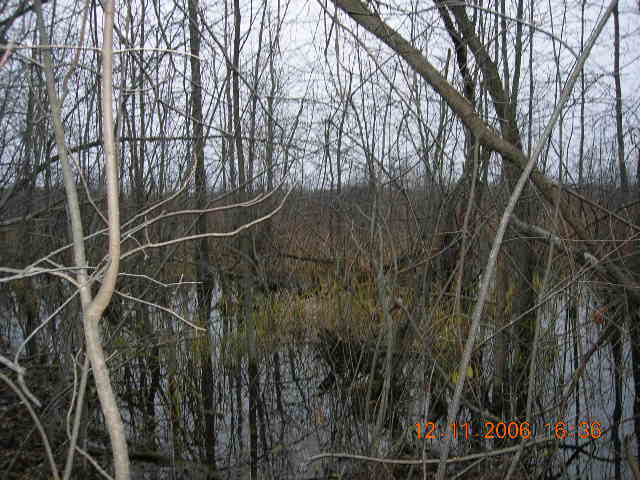
During my walk on the the ice-covered marsh several weeks ago I came across at least two dozen muskrat houses or lodges all located fairly close together. This is only what I witnessed on my short walk so there are likely many more. In past years the lodges were few possibly because the water level was much lower. In fact there was very little if any open water and mostly bog. The water must be at least a 30 cm. [1 foot] higher now allowing for all this open water and now ice.

The muskrat [Ondatra zibethicus] is a very large rodent and according to http://www.aquatic.uoguelph.ca/mammals/freshwater/accounts/muskrat.htm there can be as many as a dozen inhabitants in one of these lodges. If this is so then there could be over several hundred individual muskrats in this marsh area.

Several years ago I blogged that I trapped, or rather cornered, a fisher - a very large member of the weasel family - up a tree. The tree looked over open water and I did see a muskrat swiming in it. It would seem that the fisher was then stalking the muskrat.

Although an omnivor - eats both plants and animals - the muskrat is mainly a herbivor and thrives best on cattails of which there are many as you can see in the picture.

With respect to the food chain it is obvious from the many internet websites that the muskrat is prey for a large number of predators as is the snowshoe hare.

Monday, December 25, 2006

The Swamp Rose.


A couple of weeks ago we had a relative cold snap where the temperatures plummeted to minus 15 degrees Celsius (5 degrees Fahrenheit) for the entire night. Next morning there was also a light dusting of snow on the ground so I thought that this would be an ideal time to walk the woods to seek out some animal tracks, but alas none were found. The temperatures dropped enough mind you to freeze the ice on marsh at the back of the property; solid enough to allow me to walk on. There was nary a crack in the ice other than right next to shore where there was some running water.

While walking on the marsh ice I found a rose as pictured here. According to “Shrubs of Ontario” by Soper and Heimburger ISBN 0-88854-283-6, published by the Royal Ontario Museum, 1982, this is the Swamp Rose [Rosa palustris Marsh] and its range includes all of Southern Ontario. According to various websites it is also common in all of eastern United States, southern Quebec and the Maritimes.

Saturday, December 16, 2006

Stores for the Red Squirrel

This is the second year now that I have witnessed these small piles of Sw (white spruce) cones throughout the forest under the Sw tree of course. It is a rather unusual sight. I know that when we lived in town we had black squirrels that contributed immensely to the random planting of crocus and tulip bulbs, chestnuts, and acorns, as they cached their winter supplies. There was no other explanation for how the tulips and crocuses grew among our bushes. I have yet to figure out how these rodents ever found their hidden treasures. The numbers of successfully sprouted tulips would belie that they were not that successful.

The only settled tree dwellers found here are red squirrels [Tamiasciurus hudsonicus] who regularly chatter and chirp as they announce to all other forest dwellers your imminent arrival. There was once a black squirrel seen on the property but I am guessing that the food supply for it was not sufficiently abundant. It seems that the black squirrel http://www.fcps.edu/StratfordLandingES/Ecology/mpages/eastern_gray_squirrel.htm, - which is actually a black phase of the eastern gray squirrel [Sciurus carolinensis], according to Burt and Grossenheider* - is only interested in “The big sugar” provided by bird feeds in the suburbs and not this paltry fare of the native forest.

So these small piles of cones must be the work of red squirrels as they set up their winter food caches. This squirrel must also have regular eating places. One will often find piles of cone shucks under a tree or on a prominent rock.

The range of the Red Squirrel tends to be to the north and west of here whereas the Grey or Gray Squirrel ranges south down all the way to Florida.

Burt and Grossenheider, “A Field Guide to The Mammals, 1964, The Peterson Field Guide Series, The Riverside Press, Cambridge, Mass.

Saturday, December 09, 2006

Greeting Cards are Available with FSC Certified Stock


We recently received junk mail from a charity that included ‘free’ greeting cards. The cards had the FSC Mark on them which looks like the mark pictured here. This is great news and also very important news. We – you and I – can now choose to buy card stock that originates from properly managed woodlots and through an approved chain of custody. It also encourages us certified woodlot owners to continue this practice and helps sell the concept to the other more sceptic or uninformed woodlot owners.

We, greeting card consumers can now opt to make one more purchasing decision that will protect the environment for our future generations – our grandchildren.

You are either a part of the problem or a part of the solution. Here is an opportunity to be part of the solution.

When you look under the symbol on the cards you will see a certification code. For example the card that we happened to receive had the certificate code: sw-coc-1356. I am guessing that SW stands for Smartwood. COC stands for chain of custody. If one looks up this code on www.fsc.org you will find out that the card was printed by Primrose Printing Inc. O/A as Allegra Print & Imaging, located at 278 Albert Street Ottawa, Ontario K1P_5G8, Canada.

We should patronise these companies.

The interesting fact is that the FSC site is an international organisation. Participants include countries with rainforests like Bolivia.

Friday, November 17, 2006

The Vernal Pools topped up and quacking ducks


Last evening when I arrived home I was welcomed by a most untimely choral greeting. I was hearing peeps in the woods, a sound typically reserved for late spring. This I am quite sure must have been the spring peeper frogs whose seasonal rhythms must have been upset by the unusually warm and very wet weather. We have had about two weeks of steady rain and the woods are very wet. All the vernal pools that were dry a couple of weeks ago are now brimming. Vernal pools typically dry up at least once a year which creates a special environment, i.e. no fish or similar predators, where certain species like salamanders can survive.

The wetlands at the back of the property where teaming with duck. I couldn’t see them from the edge of the high water in the woods by I could hear the cacophony. It is an odd behaviour. The ducks would go into these quacking fits. They would all quack at different times. I presume it has something to do with courting and procreation. Does anybody know what that is about? I could see the ducks flying overhead but I could not identify them through the trees. This is the first year that I have seen this presence of duck on our property.
http://www.vernalpool.org/

Saturday, June 03, 2006

Loostrife Report No. Three


This is year three that I am reporting on Purple Loosestrife [Lythrum salicaria L.] According to "Weeds of Canada and the Northern United States", 1999, by France Royer and Richard Dickinson, ISBN 0-88864-311-X, Purple Loosestrife has been introduced in the late 1800s, and yet it was only in the last couple of decades that the plant has become an invasive and unmanageable plant. As a kid I can still remember seeing the plant grow along the roadside and often picked it and brought it home to Ma to put in a vase.

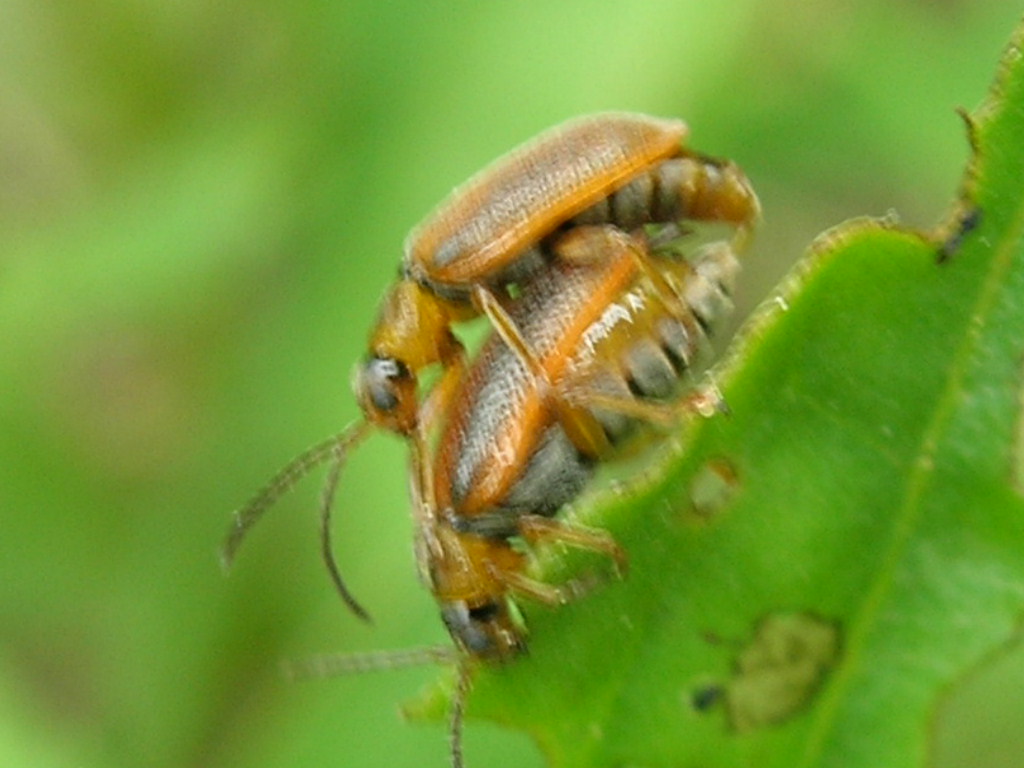
Two years ago I posted a lament on the loosestrife curse. Last year I reported the finding of the loosestrife beetle or Galerucella beetle and this year in Heartwoodlot the loosestrife has become basically invisible. Whatever plants remain are no more than some 30 cm. (1 foot) tall and all are riddled with holes in the leaves. Each plant is literally infested with several Galerucella beetles such as the couple pictured here. There are also egg clusters visible. I believe that this is the Galerucella calmariensis or black margined beetle, but I am no expert. Obviously the beetle population is doing well but its food supply is dwindling and hence the overcrowding.

The only problem now is that we no longer get that beautiful view of the purple field, but we can live with that. I do like the cattails and bulrushes just as much and they are now re-emerging nicely.

Monday, May 22, 2006

The Bloomin’ Hawthorne Tree


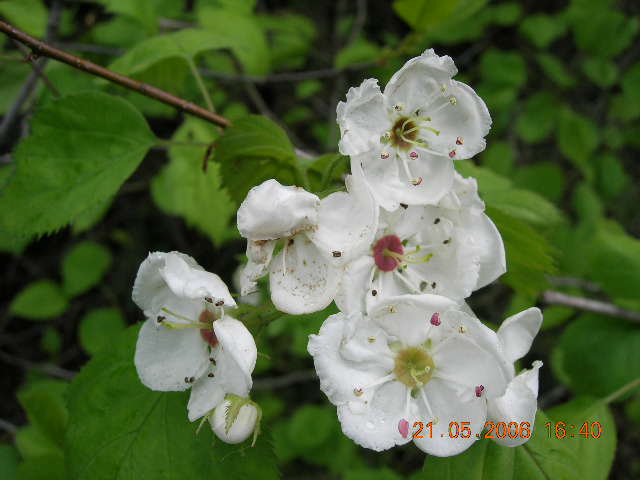
The Hawthorne bushes are blooming. The Hawthorne variety here exhibits a flower that is very similar to apple and is very short lived. The blossoming apple tree that I photographed just over a week ago is still partially in bloom whereas the hawthorns started blooming about two days ago and are already dropping their petals. With the steady rain that we have had it as been difficult to get a good picture before the flower started to disappear. A picture of the tree shows nothing after what was left after the heavy rains so here is a picture of a blossom instead.

I have been trying to identify which Hawthorne species we have but apparently there are hundreds of varieties. It will take a much more concerted effort to identify it exactly. I have a few leaves from the tree but they look very similar to several varieties on the field guide and too different yet for positive identification. I will need to examine the characteristics of rest of the tree further for a definitive identification.

Sunday, May 21, 2006

WHAT TO DO WITH THE GARLIC MUSTARD

One tends to fear those things unkown more than anything. The purple loosestrife episode is behind me. In the past I covered considerable posts on purple loosestrife which is now happily under control due to an introduced beetle. This spring when the beetle emerges I will post a photo of it now that I have the means to take close up photos.

My new invasive species project will be on garlic mustard. I have for the last day or so spent considerable time finding out how to properly dispose of the garlic mustard plants.

The Andirondack Park Invasive Plant Program is one of the best sites I have found so far. See: http://www.adkinvasives.com/Terrestrial/Ecology/Ecology.html. It also provides a best management practices that you can down load as a word document. It also covers a number of other invasive plants that do not seem to be too much of a problem here, like Japanese Knotweed.

I have cut and pasted a portion of the text from document BMPs3-06 Appendix A, of the above website entitled Best Management Practices.

CONTROL METHODS FOR GARLIC MUSTARD (Alliaria petiolata)

PLANT DESCRIPTION

Garlic mustard is a naturalized European biennial herb that typically invades partially shaded forested and roadside areas. It is capable of dominating the ground layer and excluding other herbaceous species. Its seeds germinate in early spring and develops a basal rosette of leaves during the first year. Garlic mustard produces white, cross-shaped flowers between late April and June of the following spring. Plants die after producing seeds, which typically mature and disperse in August. Normally its seeds are dormant for 20 months and germinate the second spring after being formed. Seeds remain viable for up to 7 years.

MANAGEMENT OPTIONS

1. Pulling.

Effectiveness:
Hand pulling is an effective method for removing small populations of garlic mustard, since plants pull up easily in most forested habitats. It is best to pull plants when seed pods are not yet mature, but they can be pulled during most of the year.

Methods:
Soil should be tamped down firmly after removing the plant. Soil disturbance can bring existing garlic mustard seed bank to the surface, thus creating a favorable environment for additional germination within the control site.

Cautions:
Care should be taken to minimize soil disturbance but to remove all root tissues. Re-sprouting may occur from mature plants root systems if not entirely removed. Cutting is preferred to pulling when garlic mustard infestations are interspersed amongst native grasses/forbs or other sensitive or rare flora.

Disposal:
If plants have capsules present, they should be bagged and disposed of to prevent seed dispersal. Bag all plant parts & remove from site (compost at DOT Residency, dispose of in approved landfill or incinerate with appropriate permits).

Sanitation:
Clean all clothing, boots, & equipment to prevent spread of seed.

2. Cutting

Effectiveness:
Cutting is effective for medium-to large-sized populations depending on available time and labor resources. Dormant seeds in the soil seed bank are unaffected by this technique due to minimal disturbance of the soil.

Methods:
Cut stems when in flower (late spring/early summer) at ground level either manually (with clippers or a scythe) or with a motorized string trimmer. This technique will result in almost total mortality of existing plants and will minimize re-sprouting.

Cautions:
Cuttings should be conducted annually for 5 to 7 years or until the seed bank is depleted.

Disposal:
Cut stems should be removed from the site when possible since they may produce viable seed even when cut. Bag all plant parts & remove from site (compost at DOT Residency, dispose in approved landfill or incinerate with appropriate permits).

Sanitation:
Clean all clothing, boots, & equipment to prevent spread of seed.

3. Herbicide

Effectiveness:
Roundup will not affect subsequent seedling emergence of garlic mustard or other plants.

Methods:
Use glyphosate formulations only. Should be applied after seedlings have emerged, but prior to flowering of second-year plants. Application should be by spray bottle or wick applicator for individual spot treatments.

Cautions:
This herbicide is not selective (kills both monocots & dicots), thus should be applied carefully to prevent killing of non-target species. All tank mixes should be mixed with clean (ideally distilled) water because glyphosate binds tightly to sediments, which reduces toxicity to plants.
Do not apply in windy conditions because spray will drift and kill other plants. Do not apply if rain is forecast w/in 12 hours because herbicide will be washed away before it can act. Choose Rodeo® formulation for applications in standing water or along a shoreline.

-------

Saturday, May 20, 2006

The Chokecherry is in Bloom


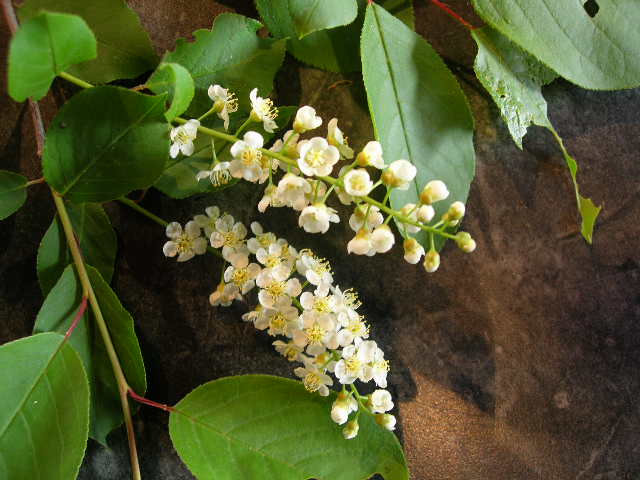
I have been noticing a small shrub along the roadside in my commutes to and from work that has an interesting flower pattern. From a distance the flower arrangement looks like a tree or shrub of little white tubes. In my morning stroll in the rain today, - it has been raining for two weeks straight now – I found the same shrub and took some branches home for identification. The branches are alternate. The leaves looked a lot like Buckthorn but the flowers distinctively were not. A little research and help from my friend Carroll we zeroed in on the Chokecherry [Prunus Virginiana L. var virginiana] which it definitely is. The flowers make a nice arrangement in a vase.

Have not found any more garlic mustard in the woodlot thankfully.

Attack of the Garlic Mustard in the Woodlot


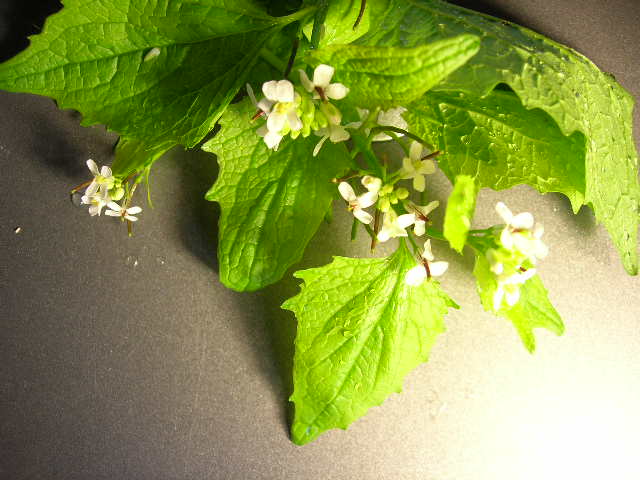
With much concern I discovered Garlic Mustard [Alliaria petiolata (Bieb.) Cavara & Grande] on our property last night for the first time. It took hold in a patch along the eastern edge of our driveway presumably carried in by the dirt on the tires or on the car. For the time being the contamination seems to be confined to a roughly circular area no more than three metres (10 feet) across. This morning I have pulled all the flowering plants from the patch and will now watch it diligently. I also noticed stalks of the plant that probably grew there last year. There are many rosettes that have taken hold in small garbage can lid sized clearings.

The book Ontario Weeds (reprinted February, 2001), By J.F. Alex, published by Ontario Ministry of Ariculture, Food and Rural Affairs, to order see www.gov.on.ca/omafra ) devotes a full page on the plant. It states that Garlic Mustard only reproduces by seed so I will watch the flower development and keep plucking them.

For more info there are many websites on this invasive weed such as: http://www.omafra.gov.on.ca/english/crops/hort/news/hortmatt/2005/10hrt05a4.htm
The flower of the Garlic Mustard is easily recognised by its small white cross shape as in the photograph here. The flowers in this photo range from 8mm to 10 mm. (approx. 5/16 to3/8 in.) across.

In the urban parts of the City of Ottawa especially downtown this invasive weed has completely taken over the gardens especially in the greenspace areas along the edge of the river. I am curious to know what the City or the National Capital Commission – custodian for much of Ottawa’s greenspace – are going to do about it. It has spread there to epidemic proportions and in time I fear that it will spread out to here to a degree where it will no longer be manageable. In other words it will start creeping in from the neighbouring lots which are uninhabited and which I have no control over.

Garlic Mustard will completely take over ground cover areas in forests and choke out natural indigenous species. Thus it has a very negative effect on forest biodiversity. Also a recent article claims that the plant kills fungi in the ground that are essential for the growth of trees such the Sugar Maple. For a story on this see: http://www.680news.com/news/national/article.jsp?content=n051404A

This plot was weedable but I was still not able to remove all the rosettes. They are quite small and planted among rocks which is hard to get at. Some of the larger plants broke off at the root since the roots were firmly embedded among the rocks. I will watch them to see if they will sprout.

Let’s hope that it will be a long time before more of this scourge really arrives.

Sunday, May 14, 2006

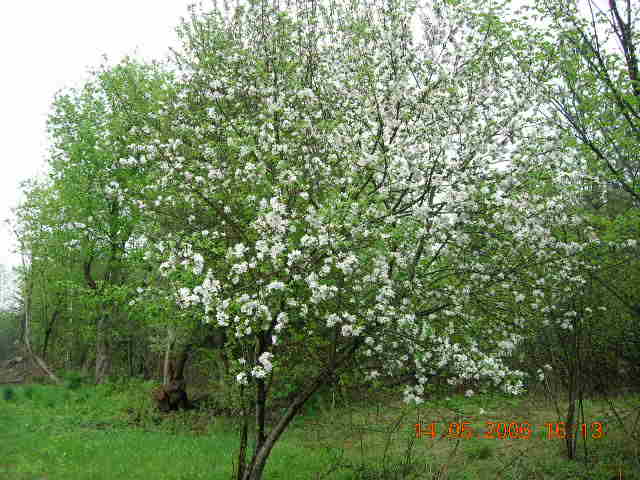
Nature’s own Floral Displays or perhaps an Introduced Pioneer Apple Tree


This is a picture of one of a dozen or so apple trees that seem to be haphazardly planted around this woodlot. Most of them bear a small tart apple. Yet one apple tree near the middle of the woodlot bore a yellow-green apple with a rusty hue and rough texture, which I believe is identified as the russet. It produced apples in abundance one year but very few before or since. I tasted one that was probably not ripe yet as it was still sour. I figured that the pioneers probably thought it was great for pies or preserves or something. The russet I am told is a true pioneer apple and I mean pioneer in the sense that the early settlers introduced it. The adjective “pioneer” should not be confused with pioneer trees such as poplars and birches which tend to be the first to take root in clearings and prepare the soil for subsequent higher quality trees like oaks and maples.

I was not even aware of this little apple tree in the photo, until I had cleared out the Manitoba Maples [Acer negundo L.] a.k.a. box-elder (particularly in the US), or Ashleaf maple, that choked out the surrounding area. The tree was completely taken over and dominated by Manitoba Maples. These Maples are locally ranked in the “Soft Maple” category since the wood is indeed not very sound, but they grow profusely. This year the apple tree has come out in full bloom as the photo depicts. It is a lovely celebration of its release.

Another beautiful flowering tree is the Hawthorne, which are abundant in this woodlot along the edges of clearings. Their time to flower has yet to come. Stay tuned.

Sunday, May 07, 2006

A Fat Starnose Mole, Page 2 of 2.


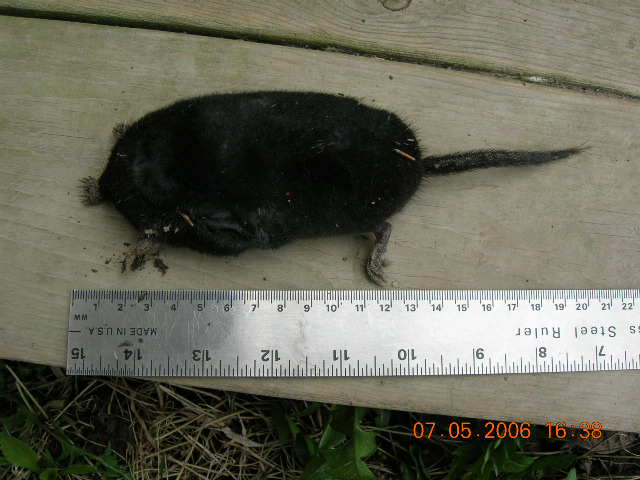
According to my trusty Peterson Field Guide “A Field Guide to the Mammals – Field Marks of all Species found north of the Mexican boundary” by William Henry Burt and Richard Philip Grossenheider, The Riverside Press – Houghton Mifflin Co., Cambridge, MASS. 1964, the Starnose mole is recognized as follows: Head and body, 4 ½ - 5 in.: tail 3-3 ½ in.; wt, 1 1/5 – 2 4/5 oz.

So this mole is within but at the upper end of the range for what this mole should be. 2 4/5 oz is exactly what I weighed this one at. You can see the length of the mole from the pictures with the scale shown.

This field guide was my first field guide, a birthday present in 1965 on my 13th birthday. It still seems as accurate today as it was then.

A Fat Star Nosed Mole, Page 1 of 2.


This evening after a walk in the woodlot, as I arrived at the house, I found a dead starnose mole [Condylura cristata] at the base of the stairs to the back deck. The mole seemed awful big, but then not being familiar with the species, it may well be normal. I placed the ruler in the photo to get some idea how large it is. It weighed about 85 grams (~2.8 oz.) using a letter weigh scale. It has a smoky black fur of a very fine texture.

Page 2 has a picture of the mole from the other side. This may seem a little gory and not the most pleasant for some but then it is really quite unusual and might be interest others.

Tuesday, May 02, 2006

Sudden blossoming of the Serviceberry


Sudden blossoming of the Serviceberry

This morning the Serviceberry [Amerlancier spp.] shrubs suddenly appeared in bloom. I was expecting them soon and during our drive last Sunday we were actively looking for them, so their blossoms did arrive it was quite sudden. In these parts it is common to see the white spots of the blossoms along the forest edges of various woodlots in the area. Just as is pictured you can easily make out the white blossoms from a good distance against the grey background of the still unfoliated woodlot.

I made the identification of this shrub after looking up the plant in "Weeds of the Woods - Small trees and Shrubes of the Eastern Forest", by Glen Bouin, Goose Lane Editions, Fredericton, New Brunswick, ISBN 0-86492-127-6.

Sunday, April 30, 2006

An Amphibious Chorus

Spring brings so many wonders of new life. The winter – as mild as it was – was long enough for one to appreciate just how magnificent spring is when it does arrive. As I have posted previously, each spring the chorus of northern spring peepers [Pseudacris crucifer] serenades us in the evenings. I could also hear another sound that for the longest time I mistook for a cricket. The peeper makes a fairly shrill peep. This other sound was a much softer and quite pleasant vibrating whistle.

Last summer at one of the meetings or conferences that we attended I picked up a CD entitled: “Natural Sounds of Ontario, Birds, Frogs and Mammals” by Monty Brigham. It is distributed by RMP Biological Ltd. C/o Monty Brigham, P.O. Box 1061, Manotick, ON K4M 1A9, Canada. Sale of the CD supports the activities of the Eastern Ontario Biodiversity Museum in Kemptville ON. See http://www.rmpbiological.pwo.ca/ for more details.

The CD is a compilation of 97 natural sounds. Through this CD I was able to determine that the sound that I thought was a cricket was actually an American Toad [Bufo Americanus]. According to Peterson Field Guide, Reptiles and Amphibians of Eastern/Central America, by Roger Conant and Joseph T. Collins, ISBN 0-395-90452-8, this toad is probably the most common in this area and we are located in the midst of its range. For some more local information on the toad see http://www.nature.ca/rideau/b/b3d-e.html. This toad has a voracious appetite for insects and other invertebrates which is great as we have lots.

So now when I go to sleep to the amphibious lullaby I will know who is performing.

Saturday, April 01, 2006

Screaming In the Woods, or Another Meso-Predator Bights the Dust.

At four thirty this morning I was wakened by a violent noise a distance away in the woods, that sounded like a small mammal - possibly racoon - in a vicious fight. This reminded me of a topic that was presented at the Ontario Woodlot Association AGM that was held in Peterborough, Ontario on Saturday March 18th last month. The talk was entitled Forest Songbirds in Southern Ontario presented by Erica Nol of Trent University. The presentation was introduced with the following text:
Forest songbirds are an integral part of our forest ecosystems. The range and abundance of songbirds is determined to a large extent by the availability of suitable breeding habitat. Come and learn about some of the common forest songbirds found in southern Ontario woodlots, their habitat requirements and some of the pressures impacting their habitat and populations.
In her talk I recall that she described the impact of meso-predators on forest songbirds. Meso-predators typically include the racoon, skunk, fox, bobcat and opossum. Opossums are not known here but are becoming common in Southern Ontario. These mammals will attack bird nests and prey on the eggs and young. The thrush family is a typical woodland bird that builds its nest low to the ground and thus is suseptible to this predator.

The speaker stated that the absence of major predators such as the wolf and mountain lion has allowed the release – or expansion – of meso-predators since they keep the meso predators in check. I am not sure where the coyote or fisher would fit into the predator ranks, but I am quite sure that what I heard was a coyote or fisher attacking or preying on a racoon. I have heard that racoon sound before when we lived in the suburbs when racoons were fighting either with themselves or another animal. In the suburbs we had many racoons and skunks in our garbage yet around here we have much fewer visits by these meso-predators. I am inclined to believe that the coyote and fisher are doing their part in playing the role of the major predator and keeping the meso-predator numbers down. Domestic cats, though unnatural probably qualify as meso-predators as well.

Sunday, March 19, 2006

A brief Report on the OWA AGM 2006 Our Forests our Legacy

Carroll and I attended the 2006 Annual General Meeting of the OWA (Ontario Woodlot Association). This year’s theme title was “Our Forests – Our Legacy” a conference for woodlot owners and managers of Ontario's private forests. It was held on March 18, 2006 in Peterborough, ON.


Some personal observations, I found the talk on “The Value of Natural Capital in Settled Areas of Canada“ particularly interesting. Much of the estimates of the Values were not very rigorously calculated however there were some very good examples given. One is New York City’s dilemma where it has to decide to invest eight billion dollars in a water treatment plant, or invest in protecting green space in the Catskill mountains where the water supply currently originates. The second option examined the cost of encouraging area farms to use natural friendly practices such as natural buffers along watercourses etc. The entire presentation is available on the Internet. If and when I find it I will post the URL here.
There were also many other titbits provided in the other presentations which I will blog post on later.


The Meeting Program as published follows:


Ontario Woodlot Association
13th Annual General Meeting and Woodlot Conference
Our Forests – Our Legacy

You are invited to attend the Ontario Woodlot Association’s annual general meeting and woodlot conference, Our Forests – Our Legacy, to be held on Saturday, March 18, 2006, in Peterborough, Ontario.

Conference Details

This year’s annual general meeting and conference will feature topics that are relevant to woodlot owners and managers from all walks of life. We’ve invited presenters who will capture your imagination and provide you with a range of information about managing your woodlot.

Here are some of the features of this year’s event.

The Value of Natural Capital in Settled Areas of Canada (Jim Anderson, Ducks Unlimited)

Natural areas provide numerous benefits that have economic value, not only for people living near these areas, but also for other communities further away. Natural areas contribute to clean water, clean air, wildlife habitat, recreation, biodiversity, erosion control, aesthetics, cultural pursuits, etc. This presentation will provide some insight into a case study where economic estimates of the values of natural areas -- natural capital -- have been developed.

Woodland Amphibians and Vernal Pools (Janine McLeod, Biologist)

Vernal pools are fascinating ecosystems with unique habitat. Fairy shrimp, wood frogs and mole salamanders are some of the species that would not survive without these small, temporary wetlands. Learn what you can do as a landowner to help conserve these important natural niches in your woodlot.

Agroforestry Opportunities for Landowners (Dr. Andrew Gordon, University of Guelph and Neil Thomas, Landowner)

Dr. Andrew Gordon will discuss some of the agroforestry options available to landowners in Ontario. Agroforestry is a way to enhance already productive agricultural operations by providing farmers with a second commodity to grow and harvest -- trees. The second part of this presentation will feature eastern Ontario landowner Neil Thomas who will tell about his personal experience with agroforestry.

Forest Songbirds in Southern Ontario (Erica Nol, Trent University)

Forest songbirds are an integral part of our forest ecosystems. The range and abundance of songbirds is determined to a large extent by the availability of suitable breeding habitat. Come and learn about some of the common forest songbirds found in southern Ontario woodlots, their habitat requirements and some of the pressures impacting their habitat and populations.

Careful Logging Practices (Martin Streit, Upper Canada Forestry Services)

One of the important steps in managing your woodlot (and in maximizing your future financial returns) is to use logging methods that will minimize the damage to residual trees and the site. This presentation will introduce landowners to a variety of careful logging practices that will help protect their woodlots.

When: Saturday, March 18, 2006

Where: Ervinrude Centre, 911 Monaghan Road, Peterborough, ON

Time: 8:30 a.m. to 4:00 p.m.

Registration: We are requesting that you pre-register for the conference. To register or to get more information, please call Rhonda at the Ontario Woodlot Association at 1-888-791-1103 ext. #221 or e-mail us at before March 1, 2006.

Registration fee: OWA members $20.00 and non-members $25.00 (includes lunch).

Supporters of this year’s conference include: Ferguson Forest Centre, Model Forest Network, K.H. Kesso & Sons Ltd., Nelson Paint Company of Canada, and the Peterborough County Stewardship Council.

As always, guests are welcome… so bring a friend!

Sunday, March 12, 2006

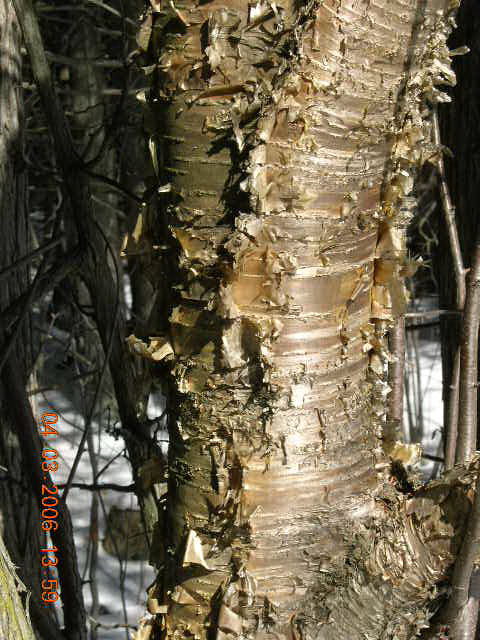
The Yellow Birch

There are several mature yellow birches [Betula alleghaniensis Britt.] in the Heartwood woodlot. This tree is located to the north of a clearing in Area C of the Woodlot Management Plan. I have always been fond of the weird and different birch tree. Birches are normally white while this birch is a beautiful coppery bronze.

During my high school years in the late '60's, I lived some 4 kilometres (2½ miles) out in the country west of the Island of Montreal in Quebec. During the winter and right after school and just before supper, I used to regularly step into my snowshoes and traipse out to the woods past the fields behind our house. The snow was typically 60 centimetres (2 feet) deep those days. Being mid winter I would head out when the sun was still up but by the time I was heading home it would be dark.

Armed with a small hand axe, pocket-knife and a few matches, once I reached my sheltered favourite spot in the woods, I would lay down a small mat of criss-crossed branches on top of the snow and build a small campfire upon it. Using the same spot all winter, over time the small fireplace would develop into a large hole in the snow about 2 metres (6 feet) wide. The snow inside this circle would be melted down to the earth layer.

I would place a log on the snow at the edge of the hole to sit on where I would frequently sit and gaze silently into the flame and listen to the crackling of the fire, the snapping of the frozen branches and distant sounds. This was one of my ways of dealing with turbulent teenage and high school years. In later years I remember my mother saying that I always came home relaxed from these walks. I have learnt since that indeed the characteristics of the flicker of a fire are known to be natural rhythms and relaxing and therapeutic to the brain and is recognised as a meditation and relaxation exercise.

The yellow birch bark as with all the other birches provided an excellent fire starter. The ribbons of bark would light even when wet. I would always only remove the loose flags of bark but never injured the core bark of the tree. This made fire starting easy and after a while I was able to start fires at any outside temperature and even in rain. In time you learned tricks such as to use the small dead branches at the base of coniferous trees as kindling. These were usually dry even after a heavy rain.

What I recall of that forest was that the yellow birches tended to be isolated trees among other species. This forest was a sugar bush dominated by the sugar maple [Acer Saccharum] and ash with poplar along the clearing edges. The forest must have been tapped for maple sugar at one time, since there were remains of a sugar cabin in the forest. The remains included a damaged 3 metre (10 feet) long maple sap steaming pan or kettle. This rubble must have already been at least 10 years old and thus dated back to the '50s.

After about an hour I would slowly let the fire die out and head home in the dark, striding back on my snowshoes in the blue glistening snow, which often sparkled in the moon light against the backdrop of the black silhouetted trees. That was all part of the experience.

Sunday, March 05, 2006

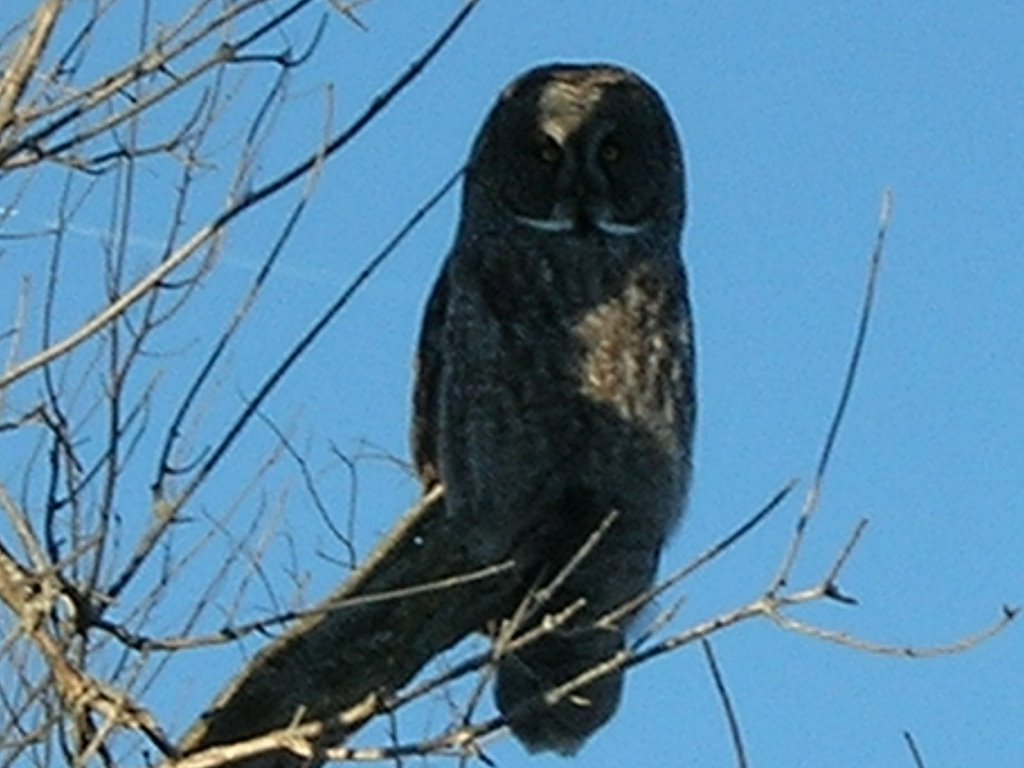
A Second Visit from a not-so-Shy Great Gray


This afternoon, as we drove up our driveway this big staring Owl welcomed us home. It was probably the same Great Gray Owl [Strix Nebulosa] that visited us last weekend. The owl was perched in the tallest Manitoba maple in our back yard. This tree died just this summer but it was for exactly this purpose that I did not take it down. It make a great perch for birds. Anyway, I thought that we would spook the bird as we busily exited the vehicle and entered the house, but instead, I was able to enter the house, return with a camera, take several pictures from up close - about 10 metres (30 ft.) away. We then unloaded the trunk and entered the house. All the while the owl remained unphased and instead attentively inspected all of our activities. Only about 15 minutes later after turning on the dryer – which caused air to blow out of the dryer vent – did the owl disappear. This is the best of the pictures I took.
.
All winter, we we been broadcasting cracked corn on the snow at the front of our house for the wild turkeys and I suspect that this is likely also attracted field mice, which in turn is attracting this owl.

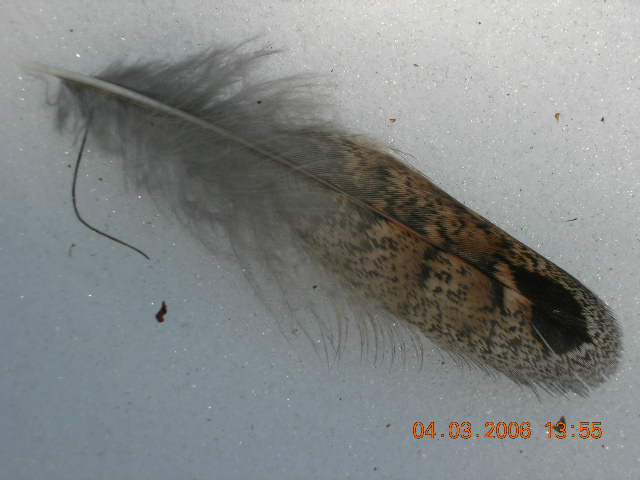
A Feather on Crusty Snow


Yesterday was a beautiful day with a bright sun and clear blue sky. The air was cool, hovering around the freezing mark, and the mild west wind made the humid air nippy. The snow is not very deep at about 15 cm (half a foot). There is a thick crust of ice on top of old snow and a light wisp of new snow on top of the ice. The wispy layer is blown off the ice in the windy clearings. When walking one noisily breaks through the crust, so any ideas of startling and sighting some wildlife were out. Indeed I did not flush out any wildlife as they were well forewarned by this noisy operation.

This snow and ice strata allowed for easy observing of animal tracks and the dramas told. Snowshoe hare tracks were plentiful as were those of fisher, coyote and fox. There were also some ruffed grouse tracks. The ice layer must make it hard for the herbivores to forage. The snowshoe hares have completely eaten and stripped all the bark from one branch that broke off of a poplar tree along one of the trails. Poplar is not a tasty food so the supply must be getting scarce. Is that possibly why the hares are moving around so much and all the tracks?

Halfway out I came across a handsome feather that fell on the snow. It is pictured above. From the down at the base of the feather it is likely a breast feather and the colour pattern makes me think that it could be form a ruffed grouse; but there is considerably more brown than is typical of a ruffed grouse and it is quite large so it could also be from a hawk or owl.

Saturday, February 25, 2006

Definitively a Great Gray


Late this afternoon I sat down for a break to read up on some research on my inherited wall clock. My mother gave me a wall clock that has been in her family for 80 some years. After some Internet research I found literature that helped me identify the maker and origin of the clock. It led me further to some online bookstores that sold books on this specific clock maker, now identified as Gustav Becker a well know clock maker from Freiburg in what was then Germany and now part of Poland. Gustav Becker died in 1885 but the company remained in existence up to WW2.

Yesterday we received a parcel notice from the post office. Since our mailbox is too small, it had to be picked up in the village. I had ordered the two books about Gustav Becker so I was expecting this parcel to be those two books. So this morning I drove the 6 country kilometres (4 or so miles) through white open fields into the Kars village though a snowstorm to retrieve my anticipated prize. All the while, Carroll has been tentatively watching the Turin 2006 Winter Olympics this morning which interested me too but not as much as this.

So during my break I read up on the clock and found out that it was in fact built or sold in 1926. It was still blowing and snowing outside, and so hard that the snow created horizontal lines in the air against the gray wooded background.

Then out of the corner of my eye I could make out a large bird alighting in a red pine tree very close to the house. At first I automatically assumed that it was a turkey as it was a big black bird. Then after further examination it had a round head with a noticeably flat face that rotated like a turret. It was not a turkey but an owl. The bird was perched in the far side of the tree so it was difficult to identify. After several minutes at that perch it flew to another tree near the front of the house. I was now able to get a few photos of it with our portrait camera which were not the best but better than nothing – I ought to get a better camera some day. The background was gray and the subject was gray, and also it was starting to get dark, all of which colluded to create what amounts to a black and white photograph. As you will see from the above picture it was perched with its back to us, but at times when it swiveled its head to the side I was able to make out the white swipe mark below its eye discs. The owl later moved to a lower perch and faced directly towards us. We were now able to clearly see the mustache shaped white marks below the eye discs. This is a characteristic mark and it confirmed without a doubt that we were looking at a Great Gray Owl [Strix Nebulosa].

Back in February 13th last year, I had reported a sighting of a grey owl but the evidence was not definitive. That post also provides considerably more detail about the owl and the fact that it was not a natural bird in this area and that such sightings are usually accidental. The gray in fact has become a regular in these parts for the last couple of years, during winters.

Saturday, February 18, 2006

Closing the Loop on Woodlot Certification

  • Closing the Loop on Woodlot Certification

We normally get a bag of flyers in our mailbox Friday night or Saturday mornings. There is the normal bunch of flyers from Home Hardware, Leons Furniture, Home Depot, Sears etc. I always take a minute or two to go through each of the flyers to see if there is anything of remote interest on sale. I admit it that I am a flyer junky. Neighbours at our former home in suburbia did the right thing and reduced pollution by refusing flyers – or more aptly put, junk mail – in their mailboxs. I could never do that.

I came across something interesting in today’s Home Depot flyer. As part of its marketing strategy Home Depot is marketing ECO Options that cater to clients who are “Looking for ways to make better environmental choices when they renovate their home”. On page eight, Home Depot is selling a Maple Veneer Core Panel 4’ x 8’ x ¾”with the FSC trademark or Forestry Stewardship Council A.C.
The ad then includes a descriptive green bar with the following text:

FSC  Certification helps sustain our forests  The Forest Stewardship council is an international non-profit organization that supports environmentally appropriate, socially beneficial and economically viable management of the world’s forests.  When you see the FSC symbol, you know that sustainable forest practices have been followed


So how does this close the loop?

You will see from a posting on this blog on Thursday September 1, 2005 that I had Scott Davis, Certification Coordinator of the Eastern Ontario Model Forest (EOMF), Forest Certification Program visit and inspect my woodlot. As a result we had our woodlot certified and we now adhere to the certification criteria and entered the woodlot certification program. We also joined the Eastern Ontario Certified Forest Owners (EOCFO) organisation formed by individuals in Eastern Ontario who had been seeking, and in 2003 obtained, FSC group forest certification for their woodlots.
What does this mean?

FSC certification program requires that:

  • Wood is not harvested faster than it grows;
  • Water, wildlife and forest ecosystems are protected;
  • Standards are developed through a stakeholder process, not controlled by industry;
  • Standards measure on-the-ground results, not just policies, programs and plans; and
  • Standards, performance and recommendations are made public.

See http://eocfo.eomf.on.ca/ for full details.

So now we have come full circle. Our good management practices will now be recognised not only because it is the right thing to do in its own right but also in a more tangible means where the measures are recognised and valued in the marketplace. Also this will now let the non-woodlot owner and client for wood products participate in and promote the program.

I would say it is a good thing.

Sunday, January 22, 2006

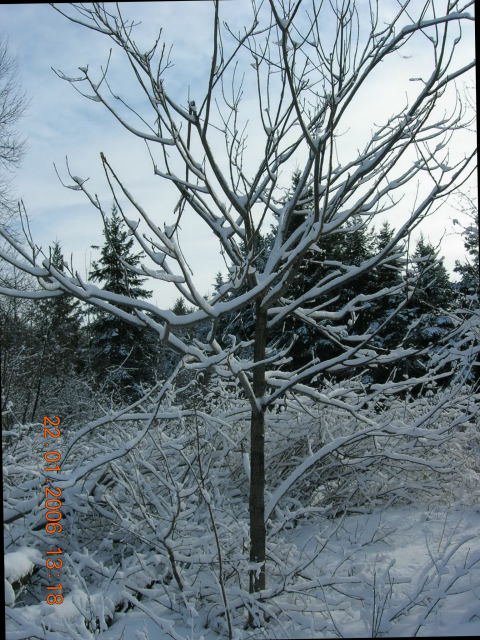
A Young Butternut Tree in Winter


This picture is of a small butternut tree growing about 300 metres (~1000 ft) from the house. On the ground to the right is a bare patch that I believe is created by the butternut root’s characteristic of transmitting the juglone toxin to neighbouring tree roots thus limiting their growth. Only shallow rooted plants such as grass will grow in this area that do not contact the roots. To the left it is also clear. The branches on the ground are left over from a Manitoba maple that was felled and limbed just before the snow fell.

Saturday, January 21, 2006

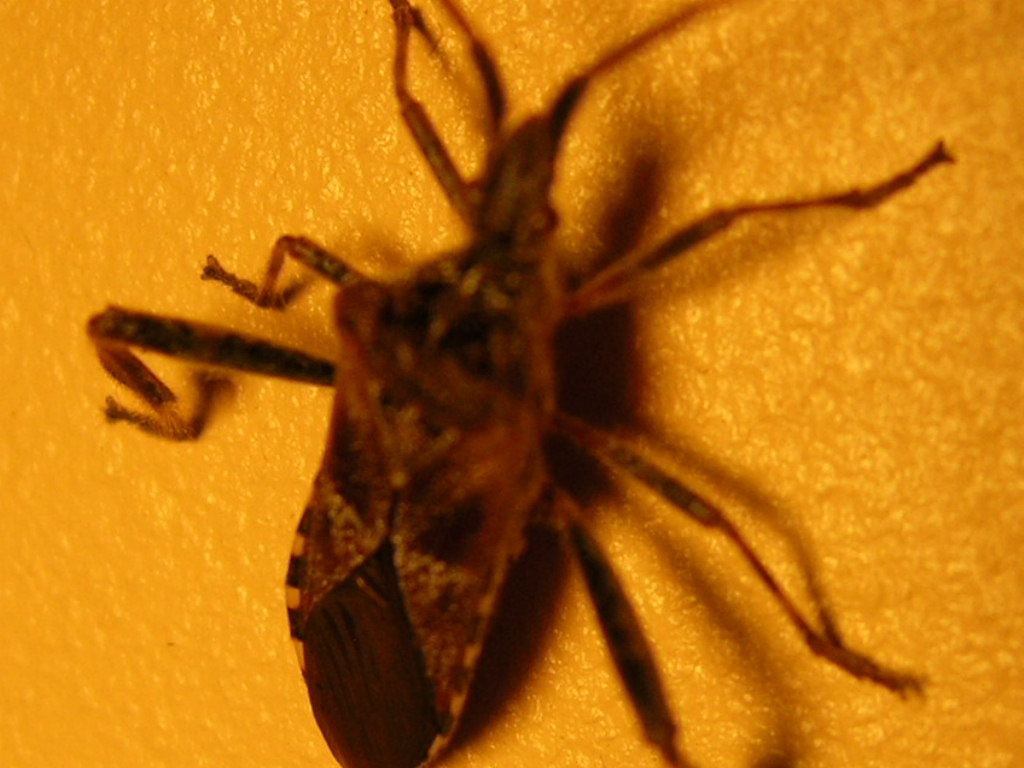
A visit of a Leaf-Footed Bug


Throughout the winter we are in the company of several persevering insects. These include ladybugs in the highest abundance as well as some cluster-flies and the odd single curious bug such as the one pictured here.

According to Insects by Borror and White it is the leaf-footed bug, Family Coreidae. There is little else provided in the field guide. It may be predaceous or a plant feeder.

According to http://bugguide.net/node/view/3393 it is a Western Conifer Seed bug [Leptoglossus occidentalis].
According to http://www.forestry.ubc.ca/fetch21/FRST308/lab2/leptoglossus_occidentalis/leaf.html it damages douglas fir, ponderosa pine and incense cedar. None of these trees exist on this woodlot that I know of so I wonder what host trees it feeds on around here?

INSECTS, Borror, Donald J. and White, Richard E., Peterson Field Guides, 1970, ISBN 0-395-91171-2 (pbk.).

Sunday, January 15, 2006

Only Two Turkeys So Far this Winter


From past postings on this blog, you will note that we have had as many as a dozen or so turkeys on a single visit at our bird feeding station for the last three winters. This year has been disappointing as we have only had these two turkeys pictured here.
I captured this picture this morning just as they started to take flight. The wing breadth and span is quite impressive and they fly very well. This time they flew off over the tree tops out of sight.

Saturday, January 07, 2006

Found several Snowshoe Hare Beds


Just before dark this evening, I took a little stroll around the two spruce plantation plots near the house. I found numerous snowshoe hare tracks and several beds. The snowshoe hare must rest right on top of the snow. It is a well used patch with a concentration of rabbit droppings.

I also found ruffed grouse tracks and flushed out two perched high up in the trees.

An Inspection of a Fisher Pelt

A colleague brought a pelt – fully tanned hide with fur intact – of a fisher [martes pennanti] to work, which we proceeded to inspect and hover over during lunch break. He is a certified trapper in the Province of Quebec so he is permitted to trap fur-bearing animals. The pelt was that of a male fisher. It is not as nice and dark as that of a female I am told. What intrigued me about this pelt were the porcupine quil puncture marks that were clearly visible from the inside of the pelt. The head, shoulder and upper body area of the pelt were scared by several dozen quil punctures. Probably not a good skin for making waterproof clothing. I have heard that the fisher is able to resist injury caused by the quils and this pelt obviously proves the point. The fisher was caught because it had become a local nusance and was devouring neighbourhood cats where my colleague lives in Quebec. It was still quite healthy and thus not affected by the quils.

Friday, December 30, 2005

Glistening Ash Trees


With the cooling weather, mother nature is again decorating our trees and just on time for Christmas. This photo is of the tops of a grove of very tall ash trees can be seen from our house. This photo was taken in the morning from our house looking east into the sun. This type of ice coating could be seen on trees throughout the entire area. On that morning we drove through the countryside to Vars where we caught the highway 417 on our way to New Brunswick. We could still see the same decorations for a good 50 kilometres (30 mi.) away from home.

Sunday, December 18, 2005

Return of the Snow Buntings

Just this week while driving home I was fortunate to observe several large flocks of snow buntings [Plectrophenax nivalis] out in the open fields near here. They were around last winter too but appear to be more abundant this year that before. Back the 70’s when I was posted in the Arctic I frequently observed them there during the summer. According to the literature in winter they come down to these latitudes almost right across North America. They have a very white patch on their wings which is very visible as they swirl over the fields. I could see them land in areas where the snow layer is thin and usually wind swept, presumably to feed on the seeds exposed on the bare earth. They are quite the site to see.

Friday, December 09, 2005

American Bittersweet


In earlier posts I mentioned finding several occurrences of a vine along the northern woodlot boundary next to the snake fence. The vine is very woody and it spirals clockwise up around tree saplings. The identification of the vine from the ground was difficult up to now because they reached up at least 10 metres (30 feet) and well into the canopy before it produced any leaves or flowers or berries. The leaves were also hidden by tree foliage. There are at least two relatively large vines with a base trunk diameter of nearly 3 cm. (one inch plus). The vine wraps around the trunk of the trees and in many cases the host tree died from mere physical strangulation. The vine trunk has a characteristically grey and relatively smooth bark.

During my walk in the clearing area G at the north-eastern corner of the woodlot I found American Bittersweet [Celastrus scandens L] which I was able to positively identify by its beautiful red berries and orange shells which (according to the various websites), is only produced by the female plant. I would venture to say that the woody trunk of this plant was identical in description to the vines noted above. I feel quite confident that the above vines are also American bittersweet.

Years ago while we were still preteens, my mother would take my bother and me, for walks in the woods. In a forest across what was then the old #2 highway (today it is the 2 and 20), and also across the CN and CP railway tracks which ran parallel to the highway – we found one patch of bushes that had berries just like these. I remember fondly how our mother used them with coniferous boughs to make beautiful Christmas wreaths. I recall though that these plants appeared to grow as bushes and not vines like those above.

Friday, December 02, 2005

Remnants of the BA British American Oil Company in the Woodlot

During my visit to Area G in the woodlot, I found several rusty oil cans. I thought then that if I was able to determine the dates of the oil cans I would be able to establish when much of the logging activity was carried out. It also would help date the age of the new tree growth.

On several of the oil cans I was able to make out the familiar-to-me BA symbol which stood for the British American Oil Company. The symbol was very familiar to me since as a youth we lived right next to a BA Gas Station in the Montreal outskirts. During our hot summer vacation days, my brother and I often washed car windshields and pumped gas there as volunteers anxiously anticipating a 10-cent tip. We usually made enough for an ice cream at the Dairy Queen which was several miles down the highway. So after making enough money for an ice cream my brother and I would bicycle off for our reward of our labours.

In the interest of dating the cans, I web-browsed and found an interesting and pleasantly designed website about BA memorabilia. I particularly liked the historical essay of BA. To cut to the chase, BA was bought out by Gulf Canada and continued under the same name until 1969 when the Gulf Canada name replaced the BA symbol. Gulf Canada later became Petro Canada which still exists today.

So we can now safely estimate that Area G was logged for its cedar trees before 1969.

Saturday, November 19, 2005

A Butternut Grove

During my walk today I visited the clearing area at the northeastern corner of the woodlot referred to as Area G in the woodlot management plan. Area G is the only clearing in the whole woodlot which was not intentionally kept open through cultivation or clear cutting. It should in time have grown in with trees and yet there is but a thin and sparse planting of several poplar trees and others. I always wondered why is this so? This area had very old and well rotted cedar tree stumps which were cut some 30 or more years ago. In fact there was evidence that it was cleared at least 45 years ago. The field has remained undisturbed for all these years and yet but few trees took root as well as grass and some small herbaceous vines.

Having become sensitised to the plight of the butternut tree [Juglans cinerea L.] and the fact that in certain parts of North America it is becoming an endangered species due to major die off created by the butternut canker, I have become more experienced at identifying the tree. So during this visit to area G to my amazement I found very many butternut trees in area. Many were dead trunks with the characteristic butternut canker scares, some were alive but in poor condition and a few others seemed still healthy. I counted some 3 dozen trees or remains of trees all together. Now that the trees were bare it was easier to identify and count them all. One butternut tree was much larger than the others and may well have been the parent that provided the seed source for the rest. It had a dbh (diameter at breast height) of 35 cm (14 in.). In forestry, the stem diameter of a tree is measured at breast height or 1.3 metres (approx. 4 feet) above the ground hence the term dbh.

I have long wondered why area G stayed clear and think I may have hit upon the answer. The butternut tree has an interesting characteristic in that it produces Juglone toxin in its roots. Other plants whose roots touch the butternut root will draw this toxin and wilt and even die. This also occurs with black walnut. The article at http://cecommerce.uwex.edu/pdfs/A3182.PDF published by the University of Wisconsin well describes this phenomenon. This provides a plausible explanation for why area G is so lightly treed. One has to wonder then if reforestation of the area will work at all without removing all the roots of the dead butternut trees, a ridiculously arduous and prohibitively expensive job. Buckthorn and the elm also adversely affect or stunt the growth of neighbouring plants near their roots, but I am not sure if these species use the same process, something to investigate for another post.

Saturday, November 12, 2005

Flying Turkeys and Rutting Deer

Took a walk in the woodlot today dressed in my protective chain saw gear with the intent of doing some serious bush whacking. The hardhat and screened face shield or visor along with the legging chaps provide much needed protection when bush whacking through dense under brush. The male white-tailed deer [Odocoileus virginianus] or bucks are now entering the rut and becoming quite aroused. During my walk in the bush today I found three patches indicative of the bucks in rut. Bucks will scratch a bare earth patch on the ground about a 30 cm. (a foot) across and nearby one can usually expect to find a small shrub all mangled up often with the bark scratched right off which the buck does by thrashing his antlers. I found these throughout the woodlot and not in any specific area. There were also deer tracks although not more than usual.

On the walk back I came across three wild turkeys [Meleagris gallopavo] who flew off from a perch high up in a tree. When turkeys are perched in trees it usually means that they were already scared or chased up. It may well be that they saw or heard me coming as I was bushwhacking or they may already have been chased up by other predators.

Saturday, November 05, 2005

The Vernal Pool

During our trip to St. Catharines Ontario, two weekends ago, we toured several woodlots on Sunday. During one of the tours we were introduced to the concept of the vernal pool a visited a few that were purposely designed as such in a reforested field that used to be farmed. Vernal as in vernal equinox I presume implies seasonal or that it dries out at least once yearly. We learnt that a vernal pool will support a unique habitat. The process of drying will not let certain plant and animal species survive in a vernal pool that would otherwise survive in a continually filled pool for example fish. This means that certain species which cannot cohabit with for example fish can survive in a vernal pool. These species include virtually all amphibians including many frog species and salamanders and bugs.

We have many amphibian here on our property and I know of a couple of pools that dry up each year. There is a swale or shallow ditch that is only full in the springtime. I imagine that these pools must have actually contributed to and provided the ideal conditions for the abundance of frogs in this woodlot.

Monday, October 24, 2005

Visit to the Carolinian Forest and the Comfort Maple.


Last weekend my wife Carroll and I were in St. Catharines, Ontario and surroundings to attend an OWA (Ontario Woodlot Association) meeting and to tour some local woodlots. Even though it rained steadily all day Saturday and most of Sunday it was a great visit.

The area on the Niagara Peninsula is now covered with vineyards, were the area used to be dominated by fruit trees. On Sunday we visited about half a dozen woodlots. I understand that the area forests are called Carolinian since the forests resemble those of the Carolinas in the United States. We saw many tulip trees of formidable size, black walnut is very common and well established. We also saw sassafras trees, which is quite rare here but common in the mid-eastern United States. Because of the climate there is a much larger diversity of plants and trees and the trees grow much faster.

We visited several woodlots that belonged to OWA members including a mature maple sugar woodlot, a newly planted field, soon to be forest, and several other forests with spectacular and unusual trees like the chinquapin oak and a swamp white oak.

The day culminated with a visit to the spectacular “Comfort Maple” pictured above. Carroll and I are to the far right and right next to the dog. The others are the hard core OWA members that stayed on after the meeting regardless of the rain. This tree is claimed to be the oldest living sugar maple in Canada. It is estimated to have germinated circa 1500 a.d. http://www.geocities.com/Heartland/Hollow/3442/comfort_maple/photos/photo_2.html has pictures of the tree and a short description.

In an attempt to measure the tree, I used the reach of my outstretched arms which is very close to two metres and it took about three and half of these to measure the circumference. So the approximate circumference was thus seven metres. The diameter is calculated as 2.22 metres (7 1/3 feet). On any account, this is a big tree.

Saturday, October 15, 2005

Field Session on management for value of red pine plantations in the Petawawa Research Forest

Today, I and 14 other members of the Renfrew Chapter of the OWA attended a field session on management for value in red pine plantations in the Petawawa Research Forest. Steve D’Eon, Forest Manager of the Petawawa Research Forest (PRF) hosted the session.
A little background to the Petawawa Research Forest – it was established as a forest research site in 1918 and is the oldest continuously operated forest research centre in Canada. The site encompasses 100 square km; about 85% being productive forest land. It is dominated by mixed wood stands (70%) and also containing stands of hardwood (22%) and softwood (8%). Until 1996 the site hosted the Petawawa National Forestry Institute and more than 2 000 experimental plots and sites were established. In 1996 the research programs were transferred to other Canadian Forest Service research centres across Canada but the PRF remains, has been maintained and serves as a facility for scientific research by the CFS (Canadian Forestry Service) science and technology networks and for co-operating scientists and partners from other agencies.
The program for the session involved plantation red pine (PPr) with three general aspects being examined:
1. Initial spacing: how red pine uses the site and responds to density such as those created by planting at different initial spacing. We visited Crowbar's Field – Crowbar was the name of the farmer who owned the field before it became part of the Forest – within the PRF which has 7'x7', 10'x10', and 12'x12' initial spacing. This site provided excellent teaching tools to illustrate the biology of growing PPr and was very interesting to observe the reaction of the trees under these somewhat clinical conditions.
2. Thinning: how one can manipulate density later in a plantation's life to grow more valuable products. We looked at a first thinning (age ~30+) at the PRF Sturgeon Lakes area and then some older plantations that have been thinned a few times to different residual densities. We also looked at some data from a rich site, data on products and prices for those products and relate our yields/values to the thinning regimes and the site productivity. The Sturgeon Lakes area is on the poorer side of sites.
3. Next crop: Growing the next crop using plantation red pine as a starter crop. We looked at three options on what one can do as a plantation approaches rotation age to start the next forest/plantation. These are, clear cut, plant in strips, under plant Pw using two planting layouts, and catch natural red pine with scarification. Scarification basically means to scratch the duff layer on the ground to expose the mineral soil that thus allows tree seeds to take. This was also at the Sturgeon Lakes area where PRF staff are generally practicing continuous cover forestry using plantations established in the 1930's.
It was an excellent day despite the rain showers.

Tuesday, October 11, 2005

The Butternut Tree

So far I have identified about half a dozen butternut trees on this woodlot. In certain areas all that remains are dead trees likely killed off by the ice storm followed by the Butternut Canker. I will have to check them out more carefully one day to determine the cause of death. Other trees appear completely healthy. One article that reports on a study of the DNA of the Butternut Canker fungus states that the disease had been introduced to North America around the 1960’s. The disease has had a devastating effect on the NA butternut population which centres around Northeastern US. In Canada it exists in Southern Quebec, Southern Ontario and parts of the Maritimes. In some areas of the US, the populations have been reduced by as much as 80%.

Several of the Butternut trees here seem to remain quite healthy and according to internet research i.e. see: http://www.na.fs.fed.us/spfo/pubs/howtos/ht_but/ht_but.htm biologists are interested in finding surviving butternut trees with the hope of finding a canker resistant strain. In Canada The Forest Gene Conservation Association, based in Peterborough ON, wants landowners to come forward with reports of occurrences of the tree. See http://www.fgca.net/conservation/sar/butternut_helpus.aspx

There is another project one could embark upon in one’s spare time.