Sunday, September 06, 2009

A Caterpillar eating a Milkweed Leaf


Today I did a visit and inspection of all the Canker resistant butternut trees in the woodlot. All but 2 are found and accounted for. Of the remaining 8, two are dead. The cause does not appear to be the disease but rather trampling by wildlife, or poor soil conditions. All will be reported on their respective blogs. On my way out I came across this very interesting looking caterpillar. I immediately associated it with the monarch butterfly which also eats milkweed, however it turns out that the monarch feeds on the milkweed when it is still young, and besides I have not seen any monarch butterflies around.

It turns out to be the Milkweed Tussock Caterpillar [Euchaetes egle], the caterpillar for the Tussock Moth a.k.a the Milkweed Tiger Moth. This caterpillar feeds on older milkweed plants and indeed this is approaching the end of our vigourous growing season.

Saturday, August 29, 2009

Jewel Beetle or Metallic Wood Boring Beetle

While in Nova Scotia I spotted this motionless beetle on the ground. It appeared to resemble the Emerald Ash Borer (EAB) so I put it in some alcohol and saved it until I was able to identify it with my library of wildlife books, or so I thought. Based on what little I know so far this beetle appeared to be much too large to be an EAB but I was curious none-the-less. Bugs of Ontario, by John Acorn and Ian Sheldon, ISBN 1-55105-287-3 most closely identified it with the Gold Dust Buprestid [Buprestis confluenta], although in the book the bug is much greener and much less metallic. The book states the length is 17 mm, and while comparing it with the dime in the photo I calculate this beetle to be 21 mm (13/16 in.) long. After further internet research it turns out that there are literaly 1000s of species of Buprestidae. There are many websites with pictures but none come close to identifying this bug. I so far have been able to confirm that the general term is either metallic wood-boring beetle or jewel beetle since they are known to be used to make jewelry particularly in southern countries. After digging further, and having subsequently found a copy of Field Guide to Insects of North America, Eric R. Eaton and Kenn Kaufman, ISBN 0-618-15310-7 -- that I must have bought recently since I didn't know I had it -- I was able to establish that it is very likely the Buprestis Lineata primarily by its shape and more even colouring. The book shows two variations one with gold strips which appears more common and one that is more evenly coloured like that photographed here.

Tuesday, August 25, 2009

Pictured above is a ruffed grouse [Bonasa umbellus] the only species of fowl-like birds that I know of that resides in our woodlot. They are particularly common in the low brush areas of our woodlot. Quite often as I go for my walks I will flush one out but rarely do I get a good glimpse of one. You can occaisionally hear the males drumming in the woods with the classic, foop foop foop foop furrrrrr. My wife was lucky to capture these photos today as the grouse casually walked across our lawn. They remain here yeararound.

Saturday, August 22, 2009

Our resident and most common Snake

This is without a doubt the most common snake in this area since if I find a snake it is of this species. I did once come across a black snake with a red belly but never saw it again.

A Black and Yellow Spider


I encountered this black and yellow spider on the side of our house that seemed quite busy. It is one of the more attractive and interesting spiders I have seen. It most resembles the Yellow Garden Spider, [Agriope aurantia] as viewed in Bugs of Ont. ISBN 1-55105-287-3..

Thursday, August 20, 2009

The everpresent and successful Poison Parsnip


This is a stout specimen of the wild parsnip (Pastinaca sativa) which grows very well on our property. I first posted on this plant early on in this blog since it was quite dominating in places. I find however that it can be managed although with some vigilance.

This plant was very common in the fields of the Montreal west end where I grew up. I frequently would get rashes from it. It is quite hard to determine the cause of the rash since it shows up about 3 days later. Also it required UV light to stimulate the rash, so if I pull the weed late in the day shortly before sundown, I don't get the rash at all, with the weak sunlight. I don't even have to bother wearing protective clothing.

Thursday, June 11, 2009

Skunks, skunks and more skunks.


We installed a gazebo about 25 metres (25 yards) away from our house. Today while on her way out to the gazebo my wife was greeted by the four baby skunks pictured here. Skunks are in fact beneficial animals that have a large appetite for insects and especially grubs that kill your lawn. Since we are in an isolated area away from any dense populations and with an extremely ample supply of insects, we have decided to co-habit with the skunk. I just have to be careful not to startle the animals in my walks around the woodlot. We don't have a dog and our cats seem to be able to handle the skunks well. When we lived in town our house cat was often seen frolicking with a resident skunk, yet careful enough to stay out of reach.

This is a striped skunk [Mephitis mephitis] which very common in these parts and the only skunk species here that I know of.

Sunday, May 03, 2009

Tiny Red Spiders


Every now and then I come across a tiny red spider or mite as photographed here foraging in the earth. I believe it is Anystis baccarum which is a beneficial predator particulary to fruit growers. According to studies available on the net, one such insect can kill and consume up to 12 similar harmful insects in a day. It is quite difficult to identify the insect precisely, so I am willing to be corrected. If you can better identify this insect please leave a comment below or email me at pieter.leenhouts@gmail.com.

In comparison to the dime in the photo I would think that this insect is about 3-4mm long. In comparison to the pictures on the internet this spider is quite large and fat so it must be doing quite well.

Thursday, April 30, 2009

Our Very Own Vernal Pool


If it wasn't for a lecture at one of the Ontario Woodlot Association meetings, I would likely never have found out about the vernal pool. Vernal is commonly used since these pools typically fill up in spring from snow melt and runoff. The pool in this picture is definitely vernal, since by summer time it will be completely dry.

The periodic drying up of the pool is what makes this pool special. It will not support fish and other predators which allows certain woodland creatures to lay eggs etc in relative safety. Next time I am back to this spot I will wear some rubber boots which will allow me to wade in a ways to observe the pool from a closer vantage point. These sneakers were keeping me away and confined to high and dry ground.

It would be interesting to see some salamanders. The only such amphibian I have ever seen was the quite common redbacked salamander up on the mountain in Ile Perrot where I grew up west of Montreal Quebec.

Dust to dust (What is left of Lefty)


In my short evening walk today I found the skeletal remains of Lefty, the porcupine that died near my house. I had reported on this porcupine in several earlier posts. I called it lefty because it had broken one of its toes on its left front paw and the bone had reset with the toe pointing up. It was easy this way to identify Lefty even way up in a tree. Being so close to the house I grabbed some rubber gloves and picked up the carcass and moved it to a spot further inside the woodlot and away from our trails. The plan was of course to let the wild predators have at it. Oddly enough, this carcass, unlike others, was never preyed upon. I gather that the turkey vulture did not like to feed on carrion located in the woods since it is less safe than in a clearing. The coyotes, raccoons etc. possibly were wary of my scent on it.

I recall when I carried the carcass that one of the needles went right through the glove and into my finger. It was a strange feeling trying to pull the needle out. It stuck like glue. Apparently the barbs on the needles are extremely fine and barely visible even under a regular microscope. There was no easy way to pull it out but mere force. It drew no blood and never festered so all was well.

In the photo, the skull is clearly visible as well as a smattering of odd bones. Maybe the animals did get into it after all since the bones dispersed over time. And the rest went back to the earth whence it came.

Monday, April 13, 2009

The Turkey Vulture and Global Warming


On my way to a friend's cottage at White Lake, Ontario, I drove by this field where I spotted a crow and several turkey vultures [Cathartes aura] huddled around this dark object. By the time I opened the car window and had the camera ready the crow had flown away. These vultures were feeding on the carcass of a fairly large raccoon that the right-most vulture, in the picture, is standing on.

My first bird book, Birds of North America, Robbins, Bruun, and Zim, (1966) showed the range of the Turkey Vulture to be no farther north than a latitude of the middle of Lake Erie or about 400 km (250 mi.) south of here. As a youth and active birdwatcher back in the 60's and 70's I had never witnessed a Turkey Vulture anywhere in the area around Montreal where I grew up. The newer bird books -- and I referred to four; Stokes, Royal Ontario Museum, Kaufman and Sibley -- consistently show the Turkey Vulture range is now well north of North Bay, Ontario to a point over 200 km (125 mi.) north of here. I have personally seen them as far north as Otter Lake, Quebec on one of my drives there. I would say that this is real evidence of global temperature change wouldn't you say?

Sunday, March 22, 2009

The Border Fence


A part of the north by north west border of the property is marked by a very old fence pictured here and referred to here in the vernacular as a snake rail fence made of white cedar split rails. As you can see in the photo there is no shortage of eastern white cedar on either side of the fence. This is probably the easiest fence to build requiring local materials, a few tools, and no post hole digging. The land here is glacial till or hard pan in local parlance and that is made out of 60% to 80% rock. So post hole digging is not really viable.

Sunday, February 15, 2009

Another girdled Tamarack Tree


On the return path of the walk I came across this newly gnawed tamarack tree. There is so little bark left on this tree that it will certainly die. Tamarack is a favoured food of the local porcupine.

A Red Squirrel's Midden


I first came across the term midden when reading a report on archaeological findings where middens or piles of shells were found on the beaches of Prince Edward Island as evidence of early inhabitation by man. Always thought it was odd to have such a name for a simple pile but then it is a better explanation than just a pile. In fact Dictionary.com says that a kitchen midden is a "mound consisting of shells of edible mollusks and other refuse, marking the site of a prehistoric human habitation." That is quite specific. I have also heard it used for the small piles of spruce or pine cone husks left by squirrels as pictured here. Numerous such middens have been found throughout the property today. It must be that the reduced food supply may be diminishing to a point where cone seeds now become the best there is on the forest menu of the red squirrel.

A mammal's Breathing Hole


There is an old fence/tree line that runs near the centre and along the length of the woodlot. I call it the Hawthorn line since it is made up mainly of hawthorn trees and basswood trees. Along this line I found a hole in the snow pictured here and the outer rim of the hole was covered in hoar frost crystals as shown in the photo. This is typical of a breathing hole for a mammal that is hibernating or holed up in the snow. There are at least two of these that I know of on the property. The other is from underneath an old barn floor.

Nature's home Builder, the Pileated Woodpecker


In today's walk the second exhibit I encountered was the hard work of the pileated woodpecker [Dryocopus pileatus]. The bird, as it seeks food such as insects in the trees, hollows out sizable holes which make ideal nests for small bird or mammals. The huge chips of wood in the snow bely that the construction was quite recent, and this size of wood chip is typical of the pileated.

The woodpecker must be able to hear the insects inside the tree. Some think that the woodpecker damages trees while in fact the tree by now is already rotted or insect infested in the centre.

In woodlot management it is recommended that a number of dead trees be left standing to provide habitat for animals. This tree will likely serve as a home for some animal one day.
 

The Highbush Cranberry


Today's walk in the woods provided a number of interesting exhibits. We have a number of highbush cranberry shrubs throughout our woodlot that were generated naturally. In winter they provide a rather attractive showy red berry against the dreary white and gray winter background. Apparently after a frost the berries do not taste as strong as when they are first ripened. In fact I tried one of these berries which has a rather pretty heart-shaped seed inside and it tasted a lot like a cranberry, though it is not of the same family.

Saturday, January 31, 2009

A Walk to the Red Pine Grove


Our woodlot has a very pronounced red pine grove located near the center of the bush. The grove must have been hand planted since the trees are not planted in exact rows and yet they are nicely spaced apart. It is an interesting grove since many of the trees there are shaped like a Y. I am guessing it is because of porcupine damage killing the top of the tree, and leaders then growing out of the sides below the bark damage. I am assuming it is porcupine since some of the red pines located near the house have noticeable porcupine scars which also created leaders.

This renders the wood of the trees quite valueless from a commercial perspective, so I will be thinning this grove over time, besides red pine has to be thinned. If I leave it the way it is red pine will keep growing but become thinner and overtime will not be able to withstand high winds. We have had some incredible wind storms lately with 100 km/h winds.

Today we snowshoed to the grove, my wife, my 4 yr. old grandson and I. We have had quite a bit of snow this winter. The accumulated snow was knee deep ~ 60 cm. (2 feet) next to the trails and the snow shoe trail was packed down to half the depth of ~ 30 cm (1 foot).

Along the trail we came across a well used porcupine highway which is a 15 cm (6 in) deep track in the snow.

Sunday, December 28, 2008

Mice, those cursed rodents


There is no shortage of mice in the fields and forests of this woodlot. Our cat leaves us mice part offerings on an almost daily basis during summer and fall. In this picture, the hole in the snow is a ventilation or observation hole for some mice burrowing in the snow. That is likely why we see as many fox and raptors -- that prey on mice -- in this area.

There are a number of varieties of mice in this area.

Sunday, November 02, 2008

Invasion of the Common Reed


I had the occasion recently to drive between Quebec City and Montreal and during that drive I was astonished at the continuous growth of Phragmites Australis a.k.a. the Common Reed, for, I would guess, at least 100 solid kilometres. I had to stop the car, get out and take the these pictures of this biological phenomenon. The plant literally coated both sides of the 4 lane highway and the median for many many kilometres without interruption.

Phragmites is a recent but known invasive weed in eastern Ontario. It was first brought to my attention by Fred and Aleta when I visited the Bishops Mills Natural History Centre, located less than half an hour from here. For more on the centre see http://www.pinicola.ca/bmnhc.htm

My neighbour has a very large 2 to 3 acre pond and its north west shore is covered with the plant. He told me once that he lost balance and fell into the weed and its was so sturdy that it broke his fall and held him up.

Around here there appears to be two types of Phragmites. There is the dark very thick tassel variety and a silky white thinner tassel variety. The dark tassel appears notably more invasive in that its stands are typically large and dense and like the type pictured here. The white variant appears to be much less aggressive in its growth and not as dense. The white variety is also often seen as a landscaping plant now in the suburban gardens of Ottawa.

For a fairly thorough study of the plant see:
http://www.fs.fed.us/database/feis/plants/graminoid/phraus/all.html

In a later post, I hope to compare pictures of both types side-by-side.

Monday, September 08, 2008

The ever busy Bumblebee


The bumblebees pictured here characteristically have the dark shiny hump on their backs. There was a citizen article that described a parasite of the Bumblebee which seemed to have a similar appearance. Every bumblebee seen here have that same characteristic hump.

False Dragonhead or Obedient Plant


Found this lovely flower growing along our driveway[Physostegia virginiana]. It turns out to be False Dragonhead or Obedient plant. It is growing among other tall plants including grasses and golden rod.

Saturday, September 06, 2008

An Trillium Fruit

During my butternut survey I found a couple of trilliums as pictured here with a red fruit. At first by the leaves one would guess possibly a Jack-in-the-Pulpit but its fruit is a cluster of red berries. After considerable research-- there is lots about the flower but not much about the fruit -- I have determined that it is definitely the fruit of a trillium. According to the internet literature the fruit body actually contains many seeds. In nature the fruit over time would drop to the ground and ants would then excavate into the fruit and take the seeds back to their nests; hence carry out one of the trilliums means of propagation in nature.

Monday, September 01, 2008

Natural Butternut Tree near our Residence

I have prepared a new blog to track the lovely natural butternut tree nearby. Click on the title.

Update and wrap up of Canker Resistant Butternut Report

Completed observing and logging the position and condition of the remaining unreported butternut trees.

Status of each tree can be found at separate blogs as follows.

Tree #1 is planted in field area i and can be found at: http://crb1i.blogspot.com/
Tree #2 is at http://crb2i.blogspot.com/
Tree #7 is found and reported at http://crb7c.blogspot.com/

- 30 -

Sunday, August 31, 2008

Follow up Inspection of Canker Resistant Butternuts

There was some unfinished business to attend to. Some of the trees still had to be tagged and I found that some of the geographic coordinates were inaccurate.

Also I found tree number seven so this means we have a 9 out of 10 survival rate.

I will be updating each of the individual tree blogs.

I also found additional butternut trees for which I will be creating individual blogs as well. It is becoming apparent that I will have quite a time tracking all the blogs.

How to conveniently label trees


To uniquely label special and noteworthy trees in the woodlot and to track them with a blog they need to be labeled. The label has to be durable enough to last many years. I thought that a plastic square cut from a Javex bleach bottle, or joghurt tub might do. After all these plastic bottles are known to last for up to 30 years in a landfill. The identification information would then be marked on it with an indelible marker. I noticed however that the permanent markers will fade completely when exposed to the sun after only one season. So instead I found the aluminum cat food can lid quite suitable and there is a plentiful supply. Using a punch set - bought from Princess Auto and hoping one day to find a use for it - I could punch the tree code on the lid. I could then tie this to the tree trunk while it is still small with a bit of wire or screw it into the trunk when it is larger. Aluminum corrodes very slowly and will last much longer than 30 years and more like 50 years.

Survey of Canker Resistant Butternut Trees

I visited six of the butternut trees today, took measurements, and tagged them.
Of the trees all survived the summer except: Tree #3 was uprooted and Tree #7 was not found today but may still be healthy and alive.
I still have to measure and report on trees #1 & 2.
For the remaining healthy and measured trees I have created blogs as follows:
http://crb4c.blogspot.com/
http://crb5c.blogspot.com/
http://crb6c.blogspot.com/
http://crb8g.blogspot.com/
http://crb9g.blogspot.com/
http://crb10g.blogspot.com/

Visit these sites to view photographs, geographic coordinates or pictures of the subject trees.
Not all photographs are posted yet.

Saturday, August 30, 2008

New Blog for Butternut Tree CRB1I

This is the first of the butternut trees that are confirmed to have survived the planting and the summer. The code CRB1I for numbering tree means Canker Resistant Butternut #1 in Area I of our woodlot. Click on title to see the blog.

George and Sean Planted the Black Walnut


The Walnut tree has survived the trip to Campbellton. In this picture, see link, my Grandson Sean and Father-in-law /good friend George are planting the tree.

Saturday, August 02, 2008

More about the Black Walnut

At the end of the woodlot tour on Lalandes property, which was held on October 14th, 2006, one of the members was giving away walnuts that he collected from a tree on his property. He gave use about 50 walnuts, which I planned to plant here at Heartwood.

In the mean time we had the nuts stored in a basket outside, and by the time we were ready for planting on December 24th 2006 -- it was a very mild fall -- the squirrels had raided the basket and left us with 36.

We laid out a 6 metre by 6 metre grid and planted the nuts at each one metre intersection. The ground was very soft and wet so to plant them we simply pushed the nut into the ground with the heel of our boots.

Next spring 7 of the nuts sprouted. I cut squares out of old carpet and cut a slit from the middle out and placed the carpets around the nuts that survived. This was to control the weeds around them which worked very well.

The following year we had 14. Yay! seven more nuts sprouted. So what are we going to do with them all?

The previous trees did not do so well and were late putting out leaves. From this website I see now that it might be the high moisture that has delayed the trees. We have had a record number of rainy days this year in this area.

The referenced website also describes the process for transplanting walnuts. It appears that the nut produces a large tap root, so one can not wait too long to transplant them. They should be less than one metre (3 feet) tall. I might have another year yet since these seedlings are only about half a metre (16in.) tall.

This weekend I potted one of the walnuts as a gift for my father in-law who lives in northern New Brunswick. Some members of my family were going up to see him and took it with them. It is much colder up there and the winters are much longer. We are already at the northern edge of the Walnut habitat. I wonder how it will do.

Sunday, July 20, 2008

Regarding Walnut and Butternut Toxicity

There is an excellent article provided by the Purdue University on this subject at: http://www.ces.purdue.edu/extmedia/HO/HO-193.pdf

Monday, May 05, 2008

Canker Resistant Butternut Tree Planting

As part of the Butternut Recovery Program, I accepted delivery and planted 10 butternut trees that are selected as being resistant to the butternut Canker. These were planted today. I will report on them again near the end of summer.

Friday, April 11, 2008

RIDEAU VALLEY FLOOD WARNING UPDATE

This Warning affects our area and is a result of the exceptional amout of snow we received this winter.

Local rivers and streams in the Rideau Valley peaked overnight; however, today’s precipitation will extend the peak flows over the next 24 to 36 hours. If most of the precipitation falls as expected by midnight Friday, water level could increase again, rising as much as another 15 to 25 centimetres (6 to 10 inches) above current water levels in flood vulnerable areas.

Thursday night’s peak was close to “1 in 5 year” spring flood levels — which means there is a 20% chance, each and every spring, of these conditions being reached or exceeded as a result of snowmelt and rainfall runoff.

High water conditions can be expected to persist for several days.

The snow cover is largely, but not yet entirely, gone from open areas. Forested areas of the watershed continue to hold snow.

Environment Canada weather forecasters advise that up to 20 mm of mixed precipitation can be expected in our region over the next 48 hours, most of it falling between noon and midnight today.

This Flood Warning will be terminated when rivers and streams have crested and there is no significant rainfall in the short-term.

Saturday, March 22, 2008

A walk ON the snow

This is a record year for snow. According to the weather channel, we are around 35 cm. (~14 in.) short of reaching the record of the winter of 1970-1971 which was 444 cm. (~14.5 ft.) Trudging through the bush has been quite a work out even on snowshoes. About a week later we had some heavy thawing followed by a freeze so the snow has become rock solid, though still not solid enough to walk on. The boots still go down a good 50 cm into the snow. But on snowshoes it is like walking on solid ground.

Being so high – I would say about a metre ( 3 feet) above the ground, the paths are virtually not recognizable. What one was able to walk under at ground level when there is no snow is now a mere crawl space. But on the plus side I can walk right over much of the brush.

One would suspect that the deep snow would be hard on wildlife as it tries to forage for food. Indeed there were no deer tracks to be found so the deer that have survived have likely moved to their “deer yards” – protected areas where the deer keep paths open and where there may be some food. When desperate enough, deer are known to eat cedar and there is lots of cedar in this area.

The snowshoe hare seems to be doing ok, as there were a number of their tracks to be found. Also there are very many fisher tracks. There were no coyote tracks. I was advised that a neighbour has been shooting them.

In this morning’s walk I found a new butternut tree in the woodlot which I will add to my database. I have walked by it before but never identified it. It must look different when one is standing a metre off the ground.

Saturday, February 02, 2008

Butternut Blogs

In this area, butternut trees are becoming endangered due to a fungus that is killing off many of our trees. There is considerable interest now to find and track butternut trees that exhibit a resistance to this disease. Just under 20 butternut trees have been identified on this property and there are likely a few more. To enable the tracking of the progress of individual trees, I intend to create a blog for each individual butternut tree that I am aware of in this woodlot. I will identify each tree by a code. The code will start with a letter which denotes the area or zone in the woodlot management plan and then number the trees in the order that they are found. For each tree I will attempt to post a picture of that tree at least once a year. I will also from time to time take a measurement of the tree being the height and the DBH diameter. I will pay particular attention to scars on the tree or any signs of disease.

Sunday, January 27, 2008

A Visit from a Cottontail

Being the early bird or morning lark, just after I get up, I often will take a quick look through the windows outside in the dark before I turn the lights on and consequently scare off any wildlife that may have ventured near the house. For the last couple of mornings I have witnessed a small bunny eating the cracked corn that I have spread out on top of the snow near the bird feeder. This is likely an eastern cottontail [Sylvilagus floridanus] the only wild rabbit common to this area. The only other similar species here is the ever common snowshoe hare [Lepus americanus] which is technically a hare, not a rabbit. The snowshoe however in winter changes to a white coat thus clearly distinguishing it from the cottontail at this time of year.

Sunday, October 14, 2007

Velvetleaf


Velvetleaf

Sometimes weeds can be more curious and interesting that flower gardens. For example this fall we found this very interesting metre and a half tall plant which we later identified as Indian Mallow [Abuliton theophrasti]. “Ontario Weeds” ISBN 0-7729-9691-1 identifies this plant as Velvet Leaf. There are also many other names including Abuth, abuliton, Butter-print, Elephant ear, Pie Maker, abuliton feuille de velours.

It does not have an attractive flower but the seed pods are quite unique.

It appears that in some areas this plant is considered a very invasive weed according to http://www.al.gov.bc.ca/cropprot/velvetlf2.htm . The site states that the seeds can last dormant for up to 50 years. According to http://www.lib.ksu.edu/wildflower/velvetleaf.html this plant was introduced to North America two centuries ago – late 1700s, early 1800s. Since the plant actually sprouted on land that has not been tilled or disturbed for some 40 years I suppose it is possible that the seed has laid dormant for all those years, like the goosefoot that I posted about earlier.

Monday, October 08, 2007

New Brunswick Trespassing Rules

Since the last post I have found the trespassing rules for the Province of New Brunswick (NB). There are interesting similarities and yet complete contradictions to the Ontario Rules.

New Brunswick similarly uses the red and yellow discs but the description is not as specific about the disc dimensions. Instead it describes yellow or red discs or painted bands around the trees and posts.

In NB, the posted red disk or painted red bands around trees or posts means no shooting, hunting or trapping is allowed, not even for the owner, which strikes me a a bit odd. In Ontario the red disc implies no trespassing and thus no hunting or any activity of any kind and this does not apply to the owner.

A description of the New Brunswick Rules can be found at http://www.legal-info-legale.nb.ca/showpub.asp?id=4


Monday, October 01, 2007

The 10 cm. (4 inch) Red Dot


If you drive the Ontario country side, especially near forests you will from time to time see a red circle painted on a tree, rock or fence post. I had been told that the symbol meant “no trespassing”. If you seek out the origin of this custom on the web there is very little information about the custom.
In time I found this custom well described in the Ontario Hunting Regulations for example in
Hunting Regulations 2007 • 2008, ISSN 0882-1936 under General Regulations on page 25 is the following text and I quote:

A person is trespassing if the person enters onto property
or carries out an activity on property that the owner has given
notice is not allowed. Commonly the owner may give this
notice to the general public by having a fence, sign, symbol or
by verbally telling someone.
A hunting licence does not give hunters the right to enter
private property.
ALWAYS ask for permission and obey signs. Signs may be in
three formats:
Red or yellow markings of such a size that a circle of
10 cm (4 inches) can be contained wholly within them.
Red means no entry is permitted. Yellow markings mean no
entry is permitted except for activities that may be allowed.
• Graphic representation of a permitted or prohibited activity.
• A written sign.
If it is not evident what activities are allowed, ask for permission
from the landowner. Not all land is signed. Unsigned
lands may be private land as well. (If property is fenced, no
access is permitted without permission of the landowner.) It is
your responsibility to find out who owns the land you wish to
hunt on and obtain permission. If unsure, stay out. Positive
landowner/hunter relationships are important to the
future of hunting in Ontario.
Be sure you are familiar with the Occupiers’ Liability Act and
the Trespass to Property Act before entering private land. (You
may obtain these two acts from Publications Ontario or online
at www.e-laws.gov.on.ca). You will also be violating the Fish
and Wildlife Conservation Act if the landowner asks you to
leave and you do not do so immediately, or if you do not obey
signs prohibiting trespassing, hunting or fishing.
 
We know of very little incidence of trespassing on our woodlot, and based on the above, it seems that a fence will suffice and there is no need to “Post” red circles.
Interestingly this regulation is quite well described for Ontario. If one were to look at regulations in other provinces such as New Brunswick or Nova Scotia one will find the regulations have a different meaning not nearly as clear and explicit. New Brunswick rules are described in a later post. 


This information can also be found on:
. http://publicdocs.mnr.gov.on.ca/View.asp?Document_ID=10734&Attachment_ID=20631

Sunday, September 16, 2007

Goosefoot


Earlier this summer in June, we had some excavation done on our property. This activity disturbed areas which have been untouched for many decades. In particular this was around an old collapsed horse barn. Subsequently weeds appeared which were entirely unfamiliar to me. One is what I believe is Maple Leafed Goosefoot [Chenopodium gigantospermum] as pictured here. I am not entirely certain of its identification although I can not find any literature that provides me with a better I.D. to prove the contrary. Could it be that the seeds remained dormant for so many years? The infestation as the pictures will attest was intense, and very unusual. I can not think of any other way that the seeds were introduced here. It was limited to one particular area so was not likely brought in on the equipment.

Chicken in the Woods


About two weeks ago I was returning to the habit of doing regular patrols of the forest. The leaves are starting to dry up so you can see quite a bit more through the underbrush. Also all bird nests will be abandoned by now so one is less likely to disturb them. During that first walk I came across this very showy fungus growing on the base of a butternut tree. Unfortunately a fungus on a tree is a bad sign for the tree, likely meaning that the inside core of the tree is rotting. This fungus resembled most closely the “Chicken in the woods” [Laetiporous sulphureus] and is supposedly quite common according to Mushrooms of Ontario and Eastern Canada, ISBN 1-55105-199-0. I found it to be an interesting sight none-the-less.

Monday, September 03, 2007

Adding some photos

I have updated some old posts by adding pictures that have been waiting to be released. Last week after enduring 7 years of slow speed dial up internet connection out here in the rhubarb, we are connected to a radio based high speed connection.
The service is transmitted from a several hundred metre high antenna located about 4 kilometres south of Kemptville Ontario. It will be so much easier now to update blog postings.

Monday, July 02, 2007

Black and Blue moth with an Orange Head on a Blue Flower


After living several decades in the “burbs”, one tends to lose touch with, and at the same time become more aware of the huge diversity of plants and insects that exists in the country side. At our previous home in the Ottawa suburbs, we were exposed to a very limited variety of insects, including mainly ants and flies, wasps, some bees and the odd butterfly, crickets and very few mosquitoes. I would think that pesticides had a role to play in that, after all that is what they were intended for, were they not? Today I came across this orange-headed black moth with an iridescent blue body. With the wings closed it looks like an iridescent blue patch draped on its shoulders. When we first moved here we found many of these moths in our house as we were building. According to “Bugs of Ontario” ISBN 1-55105-287-3, this is a Virgninia Ctenucha [Ctenucha virginica].

Today I found several of these moths feeding on flowers of this blue plant called blueweed, [Echium vulgare L.]. According to “Weeds of Canada” ISBN 0-88864-311-X, this was introduced from North Africa as a garden plant. It was used as an antidote for snake bites. The moth was feeding off the flower nectar as were a number of bumble bees.

This plant along with a number of other unusual weeds emerged on the weeping bed of our septic system where topsoil was brought in, hence the likely seed source of this plant. It doesn’t occur anywhere else on the property.

Sunday, June 17, 2007

Back in the Saddle

The centennial celebration went well and is all behind now. I will now catch up on posts on this blog. The event was quite successful, with some 800 participants. I have been taking pictures all the while and will catch up on past observations at the woodlot.

Bye for now.

Saturday, February 10, 2007

Suspension of blog postings

Last October I decided to get involved with the organisation of my High School's Centennial Celebration that is to take place on May 18,19 and 20. 2007. We anticipate a large turn out - as many as 2000 - student alumni from all over the world. The last time I was involved in the year 2000 we had 1700 alumni from as far as Argentina, Japan, Australia, Africa etc. Many participants had a great time in 2000 and plan to return and others missed the event so we expect more this time.

The school is located in Ste. Anne de Bellevue on the western tip of the Island of Montreal, which is more than two hours drive from here in Kars.

This organising is taking up every spare moment of my time from now until the Victoria Day long weekend, so I won't be posting much on this blog until then.

If you are interested, see www.machigh.org for more info.

Thursday, December 28, 2006

Muskrat Town


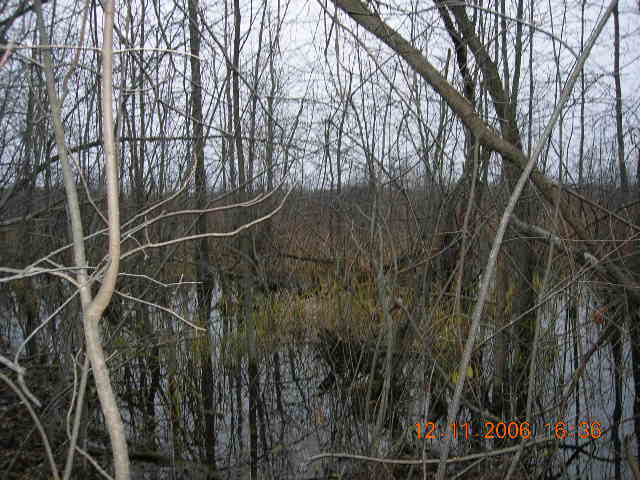
During my walk on the the ice-covered marsh several weeks ago I came across at least two dozen muskrat houses or lodges all located fairly close together. This is only what I witnessed on my short walk so there are likely many more. In past years the lodges were few possibly because the water level was much lower. In fact there was very little if any open water and mostly bog. The water must be at least a 30 cm. [1 foot] higher now allowing for all this open water and now ice.

The muskrat [Ondatra zibethicus] is a very large rodent and according to http://www.aquatic.uoguelph.ca/mammals/freshwater/accounts/muskrat.htm there can be as many as a dozen inhabitants in one of these lodges. If this is so then there could be over several hundred individual muskrats in this marsh area.

Several years ago I blogged that I trapped, or rather cornered, a fisher - a very large member of the weasel family - up a tree. The tree looked over open water and I did see a muskrat swiming in it. It would seem that the fisher was then stalking the muskrat.

Although an omnivor - eats both plants and animals - the muskrat is mainly a herbivor and thrives best on cattails of which there are many as you can see in the picture.

With respect to the food chain it is obvious from the many internet websites that the muskrat is prey for a large number of predators as is the snowshoe hare.

Monday, December 25, 2006

The Swamp Rose.


A couple of weeks ago we had a relative cold snap where the temperatures plummeted to minus 15 degrees Celsius (5 degrees Fahrenheit) for the entire night. Next morning there was also a light dusting of snow on the ground so I thought that this would be an ideal time to walk the woods to seek out some animal tracks, but alas none were found. The temperatures dropped enough mind you to freeze the ice on marsh at the back of the property; solid enough to allow me to walk on. There was nary a crack in the ice other than right next to shore where there was some running water.

While walking on the marsh ice I found a rose as pictured here. According to “Shrubs of Ontario” by Soper and Heimburger ISBN 0-88854-283-6, published by the Royal Ontario Museum, 1982, this is the Swamp Rose [Rosa palustris Marsh] and its range includes all of Southern Ontario. According to various websites it is also common in all of eastern United States, southern Quebec and the Maritimes.

Saturday, December 16, 2006

Stores for the Red Squirrel

This is the second year now that I have witnessed these small piles of Sw (white spruce) cones throughout the forest under the Sw tree of course. It is a rather unusual sight. I know that when we lived in town we had black squirrels that contributed immensely to the random planting of crocus and tulip bulbs, chestnuts, and acorns, as they cached their winter supplies. There was no other explanation for how the tulips and crocuses grew among our bushes. I have yet to figure out how these rodents ever found their hidden treasures. The numbers of successfully sprouted tulips would belie that they were not that successful.

The only settled tree dwellers found here are red squirrels [Tamiasciurus hudsonicus] who regularly chatter and chirp as they announce to all other forest dwellers your imminent arrival. There was once a black squirrel seen on the property but I am guessing that the food supply for it was not sufficiently abundant. It seems that the black squirrel http://www.fcps.edu/StratfordLandingES/Ecology/mpages/eastern_gray_squirrel.htm, - which is actually a black phase of the eastern gray squirrel [Sciurus carolinensis], according to Burt and Grossenheider* - is only interested in “The big sugar” provided by bird feeds in the suburbs and not this paltry fare of the native forest.

So these small piles of cones must be the work of red squirrels as they set up their winter food caches. This squirrel must also have regular eating places. One will often find piles of cone shucks under a tree or on a prominent rock.

The range of the Red Squirrel tends to be to the north and west of here whereas the Grey or Gray Squirrel ranges south down all the way to Florida.

Burt and Grossenheider, “A Field Guide to The Mammals, 1964, The Peterson Field Guide Series, The Riverside Press, Cambridge, Mass.

Saturday, December 09, 2006

Greeting Cards are Available with FSC Certified Stock


We recently received junk mail from a charity that included ‘free’ greeting cards. The cards had the FSC Mark on them which looks like the mark pictured here. This is great news and also very important news. We – you and I – can now choose to buy card stock that originates from properly managed woodlots and through an approved chain of custody. It also encourages us certified woodlot owners to continue this practice and helps sell the concept to the other more sceptic or uninformed woodlot owners.

We, greeting card consumers can now opt to make one more purchasing decision that will protect the environment for our future generations – our grandchildren.

You are either a part of the problem or a part of the solution. Here is an opportunity to be part of the solution.

When you look under the symbol on the cards you will see a certification code. For example the card that we happened to receive had the certificate code: sw-coc-1356. I am guessing that SW stands for Smartwood. COC stands for chain of custody. If one looks up this code on www.fsc.org you will find out that the card was printed by Primrose Printing Inc. O/A as Allegra Print & Imaging, located at 278 Albert Street Ottawa, Ontario K1P_5G8, Canada.

We should patronise these companies.

The interesting fact is that the FSC site is an international organisation. Participants include countries with rainforests like Bolivia.

Friday, November 17, 2006

The Vernal Pools topped up and quacking ducks


Last evening when I arrived home I was welcomed by a most untimely choral greeting. I was hearing peeps in the woods, a sound typically reserved for late spring. This I am quite sure must have been the spring peeper frogs whose seasonal rhythms must have been upset by the unusually warm and very wet weather. We have had about two weeks of steady rain and the woods are very wet. All the vernal pools that were dry a couple of weeks ago are now brimming. Vernal pools typically dry up at least once a year which creates a special environment, i.e. no fish or similar predators, where certain species like salamanders can survive.

The wetlands at the back of the property where teaming with duck. I couldn’t see them from the edge of the high water in the woods by I could hear the cacophony. It is an odd behaviour. The ducks would go into these quacking fits. They would all quack at different times. I presume it has something to do with courting and procreation. Does anybody know what that is about? I could see the ducks flying overhead but I could not identify them through the trees. This is the first year that I have seen this presence of duck on our property.
http://www.vernalpool.org/

Saturday, June 03, 2006

Loostrife Report No. Three


This is year three that I am reporting on Purple Loosestrife [Lythrum salicaria L.] According to "Weeds of Canada and the Northern United States", 1999, by France Royer and Richard Dickinson, ISBN 0-88864-311-X, Purple Loosestrife has been introduced in the late 1800s, and yet it was only in the last couple of decades that the plant has become an invasive and unmanageable plant. As a kid I can still remember seeing the plant grow along the roadside and often picked it and brought it home to Ma to put in a vase.

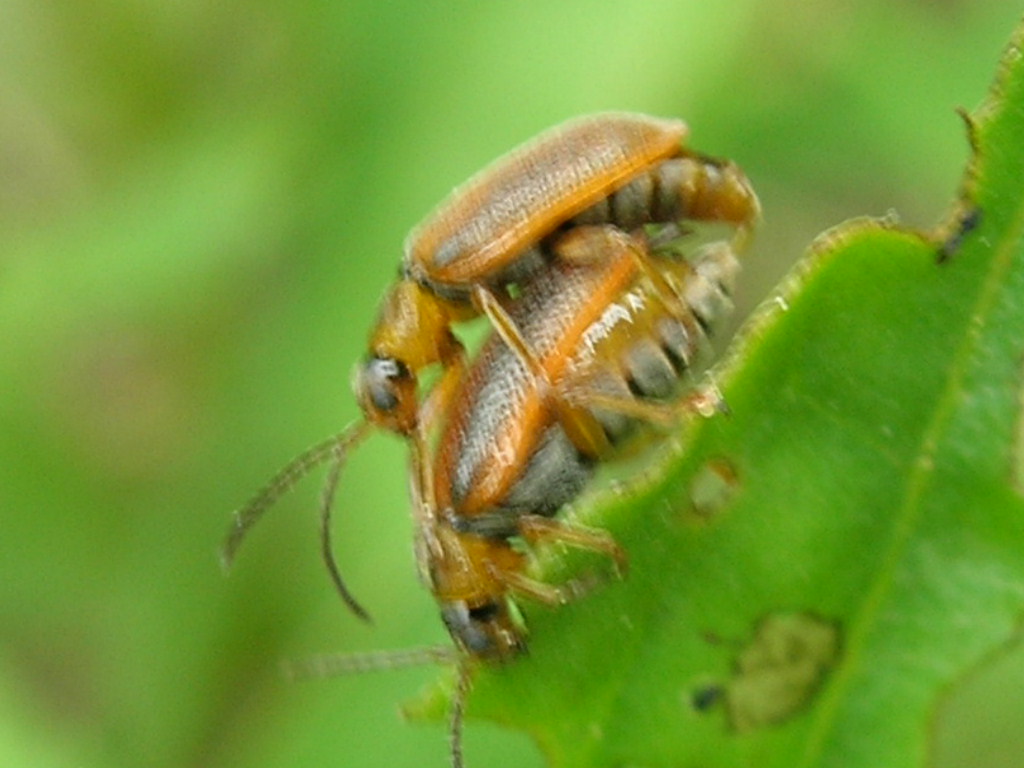
Two years ago I posted a lament on the loosestrife curse. Last year I reported the finding of the loosestrife beetle or Galerucella beetle and this year in Heartwoodlot the loosestrife has become basically invisible. Whatever plants remain are no more than some 30 cm. (1 foot) tall and all are riddled with holes in the leaves. Each plant is literally infested with several Galerucella beetles such as the couple pictured here. There are also egg clusters visible. I believe that this is the Galerucella calmariensis or black margined beetle, but I am no expert. Obviously the beetle population is doing well but its food supply is dwindling and hence the overcrowding.

The only problem now is that we no longer get that beautiful view of the purple field, but we can live with that. I do like the cattails and bulrushes just as much and they are now re-emerging nicely.