Sunday, July 20, 2008
Regarding Walnut and Butternut Toxicity


Monday, May 05, 2008
Canker Resistant Butternut Tree Planting
Friday, April 11, 2008
RIDEAU VALLEY FLOOD WARNING UPDATE
This Warning affects our area and is a result of the exceptional amout of snow we received this winter.
Local rivers and streams in the Rideau Valley peaked overnight; however, today’s precipitation will extend the peak flows over the next 24 to 36 hours. If most of the precipitation falls as expected by midnight Friday, water level could increase again, rising as much as another 15 to 25 centimetres (6 to 10 inches) above current water levels in flood vulnerable areas.
Thursday night’s peak was close to “1 in 5 year” spring flood levels — which means there is a 20% chance, each and every spring, of these conditions being reached or exceeded as a result of snowmelt and rainfall runoff.
The snow cover is largely, but not yet entirely, gone from open areas. Forested areas of the watershed continue to hold snow.
Environment Canada weather forecasters advise that up to 20 mm of mixed precipitation can be expected in our region over the next 48 hours, most of it falling between noon and midnight today.
This Flood Warning will be terminated when rivers and streams have crested and there is no significant rainfall in the short-term.
Saturday, March 22, 2008
A walk ON the snow
This is a record year for snow. According to the weather channel, we are around 35 cm. (~14 in.) short of reaching the record of the winter of 1970-1971 which was 444 cm. (~14.5 ft.) Trudging through the bush has been quite a work out even on snowshoes. About a week later we had some heavy thawing followed by a freeze so the snow has become rock solid, though still not solid enough to walk on. The boots still go down a good 50 cm into the snow. But on snowshoes it is like walking on solid ground.
Being so high – I would say about a metre ( 3 feet) above the ground, the paths are virtually not recognizable. What one was able to walk under at ground level when there is no snow is now a mere crawl space. But on the plus side I can walk right over much of the brush.
One would suspect that the deep snow would be hard on wildlife as it tries to forage for food. Indeed there were no deer tracks to be found so the deer that have survived have likely moved to their “deer yards” – protected areas where the deer keep paths open and where there may be some food. When desperate enough, deer are known to eat cedar and there is lots of cedar in this area.
The snowshoe hare seems to be doing ok, as there were a number of their tracks to be found. Also there are very many fisher tracks. There were no coyote tracks. I was advised that a neighbour has been shooting them.
In this morning’s walk I found a new butternut tree in the woodlot which I will add to my database. I have walked by it before but never identified it. It must look different when one is standing a metre off the ground.
Saturday, February 02, 2008
Butternut Blogs
Sunday, January 27, 2008
A Visit from a Cottontail
Being the early bird or morning lark, just after I get up, I often will take a quick look through the windows outside in the dark before I turn the lights on and consequently scare off any wildlife that may have ventured near the house. For the last couple of mornings I have witnessed a small bunny eating the cracked corn that I have spread out on top of the snow near the bird feeder. This is likely an eastern cottontail [Sylvilagus floridanus] the only wild rabbit common to this area. The only other similar species here is the ever common snowshoe hare [Lepus americanus] which is technically a hare, not a rabbit. The snowshoe however in winter changes to a white coat thus clearly distinguishing it from the cottontail at this time of year.
Sunday, October 14, 2007
Velvetleaf

Velvetleaf
Sometimes weeds can be more curious and interesting that flower gardens. For example this fall we found this very interesting metre and a half tall plant which we later identified as Indian Mallow [Abuliton theophrasti]. “Ontario Weeds” ISBN 0-7729-9691-1 identifies this plant as Velvet Leaf. There are also many other names including Abuth, abuliton, Butter-print, Elephant ear, Pie Maker, abuliton feuille de velours.
It does not have an attractive flower but the seed pods are quite unique.
It appears that in some areas this plant is considered a very invasive weed according to http://www.al.gov.bc.ca/cropprot/velvetlf2.htm . The site states that the seeds can last dormant for up to 50 years. According to http://www.lib.ksu.edu/wildflower/velvetleaf.html this plant was introduced to
Monday, October 08, 2007
New Brunswick Trespassing Rules
In NB, the posted red disk or painted red bands around trees or posts means no shooting, hunting or trapping is allowed, not even for the owner, which strikes me a a bit odd. In
A description of the New Brunswick Rules can be found at http://www.legal-info-legale.nb.ca/showpub.asp?id=4
Monday, October 01, 2007
The 10 cm. (4 inch) Red Dot

Hunting Regulations 2007 • 2008, ISSN 0882-1936 under General Regulations on page 25 is the following text and I quote:
or carries out an activity on property that the owner has given
notice is not allowed. Commonly the owner may give this
notice to the general public by having a fence, sign, symbol or
by verbally telling someone.
A hunting licence does not give hunters the right to enter
private property.
ALWAYS ask for permission and obey signs. Signs may be in
three formats:
• Red or yellow markings of such a size that a circle of
10 cm (4 inches) can be contained wholly within them.
Red means no entry is permitted. Yellow markings mean no
entry is permitted except for activities that may be allowed.
• Graphic representation of a permitted or prohibited activity.
• A written sign.
If it is not evident what activities are allowed, ask for permission
from the landowner. Not all land is signed. Unsigned
lands may be private land as well. (If property is fenced, no
access is permitted without permission of the landowner.) It is
your responsibility to find out who owns the land you wish to
hunt on and obtain permission. If unsure, stay out. Positive
landowner/hunter relationships are important to the
future of hunting in
Be sure you are familiar with the Occupiers’ Liability Act and
the Trespass to Property Act before entering private land. (You
may obtain these two acts from Publications Ontario or online
at www.e-laws.gov.on.ca). You will also be violating the Fish
and Wildlife Conservation Act if the landowner asks you to
leave and you do not do so immediately, or if you do not obey
signs prohibiting trespassing, hunting or fishing.
Interestingly this regulation is quite well described for
This information can also be found on:
. http://publicdocs.mnr.gov.on
Sunday, September 16, 2007
Goosefoot

Earlier this summer in June, we had some excavation done on our property. This activity disturbed areas which have been untouched for many decades. In particular this was around an old collapsed horse barn. Subsequently weeds appeared which were entirely unfamiliar to me. One is what I believe is Maple Leafed Goosefoot [Chenopodium gigantospermum] as pictured here. I am not entirely certain of its identification although I can not find any literature that provides me with a better I.D. to prove the contrary. Could it be that the seeds remained dormant for so many years? The infestation as the pictures will attest was intense, and very unusual. I can not think of any other way that the seeds were introduced here. It was limited to one particular area so was not likely brought in on the equipment.
Chicken in the Woods

About two weeks ago I was returning to the habit of doing regular patrols of the forest. The leaves are starting to dry up so you can see quite a bit more through the underbrush. Also all bird nests will be abandoned by now so one is less likely to disturb them. During that first walk I came across this very showy fungus growing on the base of a butternut tree. Unfortunately a fungus on a tree is a bad sign for the tree, likely meaning that the inside core of the tree is rotting. This fungus resembled most closely the “Chicken in the woods” [Laetiporous sulphureus] and is supposedly quite common according to Mushrooms of Ontario and
Monday, September 03, 2007
Adding some photos
The service is transmitted from a several hundred metre high antenna located about 4 kilometres south of Kemptville Ontario. It will be so much easier now to update blog postings.
Monday, July 02, 2007
Black and Blue moth with an Orange Head on a Blue Flower

After living several decades in the “burbs”, one tends to lose touch with, and at the same time become more aware of the huge diversity of plants and insects that exists in the country side. At our previous home in the Ottawa suburbs, we were exposed to a very limited variety of insects, including mainly ants and flies, wasps, some bees and the odd butterfly, crickets and very few mosquitoes. I would think that pesticides had a role to play in that, after all that is what they were intended for, were they not? Today I came across this orange-headed black moth with an iridescent blue body. With the wings closed it looks like an iridescent blue patch draped on its shoulders. When we first moved here we found many of these moths in our house as we were building. According to “Bugs of Ontario” ISBN 1-55105-287-3, this is a Virgninia Ctenucha [Ctenucha virginica].
Today I found several of these moths feeding on flowers of this blue plant called blueweed, [Echium vulgare L.]. According to “Weeds of Canada” ISBN 0-88864-311-X, this was introduced from North Africa as a garden plant. It was used as an antidote for snake bites. The moth was feeding off the flower nectar as were a number of bumble bees.
This plant along with a number of other unusual weeds emerged on the weeping bed of our septic system where topsoil was brought in, hence the likely seed source of this plant. It doesn’t occur anywhere else on the property.
Sunday, June 17, 2007
Back in the Saddle
Bye for now.
Saturday, February 10, 2007
Suspension of blog postings
The school is located in Ste. Anne de Bellevue on the western tip of the Island of Montreal, which is more than two hours drive from here in Kars.
This organising is taking up every spare moment of my time from now until the Victoria Day long weekend, so I won't be posting much on this blog until then.
If you are interested, see www.machigh.org for more info.
Thursday, December 28, 2006
Muskrat Town

During my walk on the the ice-covered marsh several weeks ago I came across at least two dozen muskrat houses or lodges all located fairly close together. This is only what I witnessed on my short walk so there are likely many more. In past years the lodges were few possibly because the water level was much lower. In fact there was very little if any open water and mostly bog. The water must be at least a 30 cm. [1 foot] higher now allowing for all this open water and now ice.
The muskrat [Ondatra zibethicus] is a very large rodent and according to http://www.aquatic.uoguelph.ca/mammals/freshwater/accounts/muskrat.htm there can be as many as a dozen inhabitants in one of these lodges. If this is so then there could be over several hundred individual muskrats in this marsh area.
Several years ago I blogged that I trapped, or rather cornered, a fisher - a very large member of the weasel family - up a tree. The tree looked over open water and I did see a muskrat swiming in it. It would seem that the fisher was then stalking the muskrat.
Although an omnivor - eats both plants and animals - the muskrat is mainly a herbivor and thrives best on cattails of which there are many as you can see in the picture.
With respect to the food chain it is obvious from the many internet websites that the muskrat is prey for a large number of predators as is the snowshoe hare.
Monday, December 25, 2006
The Swamp Rose.

A couple of weeks ago we had a relative cold snap where the temperatures plummeted to minus 15 degrees Celsius (5 degrees Fahrenheit) for the entire night. Next morning there was also a light dusting of snow on the ground so I thought that this would be an ideal time to walk the woods to seek out some animal tracks, but alas none were found. The temperatures dropped enough mind you to freeze the ice on marsh at the back of the property; solid enough to allow me to walk on. There was nary a crack in the ice other than right next to shore where there was some running water.
While walking on the marsh ice I found a rose as pictured here. According to “Shrubs of Ontario” by Soper and Heimburger ISBN 0-88854-283-6, published by the Royal Ontario Museum, 1982, this is the Swamp Rose [Rosa palustris Marsh] and its range includes all of Southern Ontario. According to various websites it is also common in all of eastern United States, southern Quebec and the Maritimes.
Saturday, December 16, 2006
Stores for the Red Squirrel
 This is the second year now that I have witnessed these small piles of Sw (white spruce) cones throughout the forest under the Sw tree of course. It is a rather unusual sight. I know that when we lived in town we had black squirrels that contributed immensely to the random planting of crocus and tulip bulbs, chestnuts, and acorns, as they cached their winter supplies. There was no other explanation for how the tulips and crocuses grew among our bushes. I have yet to figure out how these rodents ever found their hidden treasures. The numbers of successfully sprouted tulips would belie that they were not that successful.
The only settled tree dwellers found here are red squirrels [Tamiasciurus hudsonicus] who regularly chatter and chirp as they announce to all other forest dwellers your imminent arrival. There was once a black squirrel seen on the property but I am guessing that the food supply for it was not sufficiently abundant. It seems that the black squirrel http://www.fcps.edu/StratfordLandingES/Ecology/mpages/eastern_gray_squirrel.htm, - which is actually a black phase of the eastern gray squirrel [Sciurus carolinensis], according to Burt and Grossenheider* - is only interested in “The big sugar” provided by bird feeds in the suburbs and not this paltry fare of the native forest.
So these small piles of cones must be the work of red squirrels as they set up their winter food caches. This squirrel must also have regular eating places. One will often find piles of cone shucks under a tree or on a prominent rock.
The range of the Red Squirrel tends to be to the north and west of here whereas the Grey or Gray Squirrel ranges south down all the way to Florida.
Burt and Grossenheider, “A Field Guide to The Mammals, 1964, The Peterson Field Guide Series, The Riverside Press, Cambridge, Mass.
Saturday, December 09, 2006
Greeting Cards are Available with FSC Certified Stock

We recently received junk mail from a charity that included ‘free’ greeting cards. The cards had the FSC Mark on them which looks like the mark pictured here. This is great news and also very important news. We – you and I – can now choose to buy card stock that originates from properly managed woodlots and through an approved chain of custody. It also encourages us certified woodlot owners to continue this practice and helps sell the concept to the other more sceptic or uninformed woodlot owners.
We, greeting card consumers can now opt to make one more purchasing decision that will protect the environment for our future generations – our grandchildren.
You are either a part of the problem or a part of the solution. Here is an opportunity to be part of the solution.
When you look under the symbol on the cards you will see a certification code. For example the card that we happened to receive had the certificate code: sw-coc-1356. I am guessing that SW stands for Smartwood. COC stands for chain of custody. If one looks up this code on www.fsc.org you will find out that the card was printed by Primrose Printing Inc. O/A as Allegra Print & Imaging, located at 278 Albert Street Ottawa, Ontario K1P_5G8, Canada.
We should patronise these companies.
The interesting fact is that the FSC site is an international organisation. Participants include countries with rainforests like Bolivia.
Friday, November 17, 2006
The Vernal Pools topped up and quacking ducks
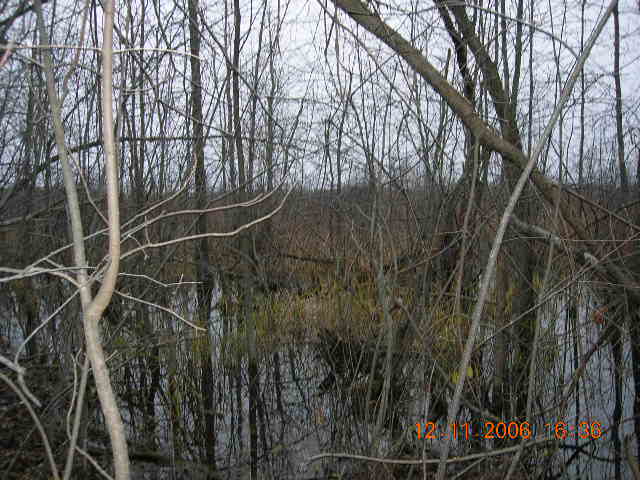
Last evening when I arrived home I was welcomed by a most untimely choral greeting. I was hearing peeps in the woods, a sound typically reserved for late spring. This I am quite sure must have been the spring peeper frogs whose seasonal rhythms must have been upset by the unusually warm and very wet weather. We have had about two weeks of steady rain and the woods are very wet. All the vernal pools that were dry a couple of weeks ago are now brimming. Vernal pools typically dry up at least once a year which creates a special environment, i.e. no fish or similar predators, where certain species like salamanders can survive.
The wetlands at the back of the property where teaming with duck. I couldn’t see them from the edge of the high water in the woods by I could hear the cacophony. It is an odd behaviour. The ducks would go into these quacking fits. They would all quack at different times. I presume it has something to do with courting and procreation. Does anybody know what that is about? I could see the ducks flying overhead but I could not identify them through the trees. This is the first year that I have seen this presence of duck on our property.
http://www.vernalpool.org/
