Sunday, April 22, 2012

Balsam Fir

As a youth I was always intrigued by the Balsam Fir Tree [Abies balsamea]. The bark of this tree typically produces blisters containing an oily gum. Back in the 60's we often had to entertain ourselves through bouts of boredom as there was very little in the way of electronic gadgets then. So as kids one of the activities we did was break a small twig, poke one end of it into the gum blister and then place the twig in the water of a stream or ditch. The twig would then be propelled by the change in surface tension on the water which was sort of entertaining and even mystifying. This was admittedly only a brief diversion, since we with short attention spans then probably had to run off and pursue imaginary forest spirits, or play hide-and-go-seek or something.

Our woodlot has a very limited diversity of trees dominated probably by white spruce which was planted in the abandoned fields and white cedar and ash which naturally regenerated everywhere else it seems. To add to the mix I was advised by a colleague woodlot owner that his property is over run by Balsam Fir so I offered to relieve him of some of the seedlings. I since planted 95 Balsam firs from that event.

This spring I have also ordered and planted Balsam firs, Eastern Hemlocks and Red Maples bought from the Ferguson Forest Centre. All three species are virtually nonexistent here.

There is an excellent website that gives pretty detailed information on tree species of Norther Ontario which is: http://www.rook.org/earl/bwca/nature/trees/abiesbal.html

Some of these northern species are also common here and I cut and pasted a portion of the data on Balsam firs below.
  • Soils mostly acid, though tolerating a wide range of soil acidity, on textures from heavy clay to rocky soils, underlain by a variety of materials, including gneiss, schist, slate, sandstone, and limestone. Most common on cool, medium to wet sites with soil pH of 5.1-6.0.
  • Late successional or climax species. Replaced after fire by pioneering hardwoods and conifers, such as Aspen (Populus tremuloides), Paper Birch (Betula papyrifera), Balsam Poplar (Populus balsamifera), Jack Pine (Pinus banksiana), and Black Spruce (Picea mariana), it is generally absent for the first few postfire decades.
  • Shade tolerant with less demanding seedbed requirements than many associates, it readily establishes under a canopy of hardwoods and conifers. Usually common in understory beneath pines, aspen, and paper birch. In the continued absence of fire, may assume dominance as the canopy of the pioneering trees begins to die off.
  • Subject to windthrow, especially on shallow wet soils.

Saturday, April 21, 2012

Buckthorn Succession - Something New


While attempting to find suitable locations for tree planting, I thought I would plant some shade-tolerate trees like hemlock and balsam fir in areas that are completely overtaken by Glossy buckthorn [Rhamnus Frangula] with the hopes that the trees would in time shade out and out compete the buckthorn. Much to my surprise and delight I already found Eastern white cedars [Thuja occidentalis] growing among the buckthorn as seen in this photo. This cedar is also known to be shade tolerant and appears to be doing well even in the heavy shade of the buckthorn. This is so encouraging. The losing battle with buckthorn can be exasperating at times.

What Exactly is the Name of that Buckthorn?


There are two species of buckthorn on this woodlot. By their Latin names they are Rhamnus frangula and Rhamnus Cathartica. There is ample confusion about their names for me anyway since I tended to use European buckthorn to name one of them and thus the Latin names were very helpful. For that matter, even for R. frangula there is also another Latin name: Frangula alnus, considered by some to more accurately describe the plant. I will stick with R. frangula for this blog's sake. Listed here are some common names used and their origins:


R. cathartica R. frangula
Brief description as I know them on our woodlot. Small thorny tree, purple/brown shiny stem less invasive than R.frangula Thicket with no thorns and gray bark, very invasive here on this woodlot.
Books: Underlined = principle name used b. = buckthorn
Shrubs of Ontario, Soper & Heimburger, Royal Ontario Museum
ISBN 0-88854-283-6
Common b. Glossy b.
Trees in Canada, Farrar
ISBN 1-55041-199-3
European b.
Common b.
Purging b.
Glossy b.
Alder b.
Trees of Ontario, 2001, Kershaw, Lone Pine
ISBN 1-55105-274-1
European b.
Common b.
Purging b.
European waythorn
Hart's thorn
Carolina b.
Glossy b.
European alder-b.
European Alder,
Columnar b.
Fen b.
Arrow-wood
Black dogwood.
Trees and Shrubs, 1972, Petrides
ISBN 0-395-35370-X
Common b. European b.


Websites:


http://en.wikipedia.org/wiki/Rhamnus_%28plant%29
Common b.
Purging b.
Alder b.
http://www.ipaw.org/invaders/buckthorn/index.aspx Common b.
European b.
http://www.treecanada.ca/tree-killers/plants.htm Common b.
European b.
Glossy b.
Black b.

In conclusion, it seems that the name that is least confusing or most common in English for Rhamnus Cathartica is Common buckthorn and for Rhamnus frangula is Glossy buckthorn which I will endeavour to use from now on. I was inclined to use European buckthorn which really didn't help my situation as you will see from the list. Both buckthorns are imports from Europe and its adjacent continents so they both can be called European I suppose.
 

Friday, April 06, 2012

Rock Heaves

Why do rocks work their way up out of the ground? Ten years ago the spot in this picture was level without any visible signs of rocks or dips in the grass. Now there is this huge 200 kg (440 lb) rock emerging a little more each year as shown here. I can't get my riding mower over it anymore as I have in the past.

It turns out that this rock is lifted by ice buildup referred to as an ice lens below the rock. This is typical of a frost heave and apparently these don't occur due to the expansion of water due to freezing as I first thought, but due to the capillary action of water in fine soil that creates these ice lenses and it is brought on by alternating freezing and thawing near the frost edge. This happens in fine porous soil like our glacial till, but does not happen in sand or clay since neither allow capillary action of water. The soil also exerts pressure on the sides of the rock which by friction will hold up the rock. As the ice underneath melts and drains away it leaves an empty void and soil likely erodes and trickles in to partially fill this void from the sides before the rock settles back down although a little higher than the original position. 


What is interesting in this picture is the sink hole to the right of the rock that is about the same size in volume as the amount of rock protruding above the soil, so this soil is evidently creeping down under the rock over time. 


Extracting such a large rock out of the ground is a lot of work. Instead, one might let nature do the work over a longer time. One can fill the depression and build up earth around the rock to keep it lifting and just mow around it. At some point the rock will be lifted so high that all one has to do is remove the surrounding earth and take the rock away more easily. In the mean time it can be a conversation piece in the lull of a party and squirrels can use it as perch while nibbling on pine cones.  This is living with nature I figure.

Tuesday, February 21, 2012

The Ring Necked Phesant - An Exotic Bird in Our Midst - thanks Climate Change

 Last week one morning while scanning the view out the kitchen window, I noticed a chicken-like bird with a long tail scurrying across our driveway and into the bushes. None of the wild chicken-like birds seen here so far have a long tail. I have heard the neighbours speaking about pheasants in this area. Only the Common or Ring-necked Pheasant [Phasianus colchicus.] is known in these parts. We were fortunate to have had a light snow fall that morning, so later in the afternoon I went looking for tracks and took this photo which corroborates my visual observation. I consulted a copy of Scats and Tracks of the Northeast ISBN 1-58592-105-X which shows the tracks of the pheasant and the ruffed grouse for comparison. These tracks are definitely smaller than that of the grouse and the toes are noticeable uneven being shorter on the inside than the outside. The most common other bird tracks throughout the woodlot are created by the turkey and the ruffed grouse. The turkey's tracks are obviously much larger. The grouse's tracks are only slightly larger and its toes are more even on either side than these tracks.

According to the half dozen bird books on the shelf, the pheasant here is right on the edge of its habitat. and more common to the south and east.

Sunday, February 19, 2012

From Trespass to Trespass and attempted robbery.


On one of my recent ski outings I decided to 'bushwhack' to the back of the property to look for any more evidence of trespass. I did find what looked like very small boot prints or else deer prints in very deep snow. Also and much to my dismay, I now found out that the November trespasser was also attempting to cut up one of my wind fallen trees that was not part of but near the trail he was clearing. This was not just any old tree. It is an American Black Cherry [Prunus serotina] of formidable size pictured here. it has three stems ranging from 30 cm (1 foot) to 60 cm ( 2 feet) in diameter and no branches for the first 7.6 metres (25 feet). All saw cuts in this photo are of the thief's doing.

It turns out that the wood of this species as long as it is in good condition is highly prized by cabinet makers, and indeed one often hears of cherrywood furniture.

Friday, February 17, 2012

Rasslin' Raccoons

This morning at around 4 am I awoke to a commotion outside in the inky darkness of scuffling, grunting and whimpering. Armed with my terrycloth dark blue housecoat, felt lined Ski-doo boots, a stick and a 2,000,000 Candle Power Rechargeable Spotlight SKU 37-9452, I proceeded to investigate. Under the front porch I found two raccoons [Procyon lotor] embraced in what appeared to be a rather violent and intense wrestling match. They were so involved in their frenzy that they were oblivious to the two million candelas staring straight at them. With no intent to enter the melee I proceeded to throw rocks to dispel them but to no effect. By the time I returned with my pocket sized idiot-proof digital camera the skirmish had shifted to the woods. Is it raccoon mating season already?

Monday, February 06, 2012

Sharing the X-Country Ski Trails in Winter

Now that I have cleared a good portion of the trails on the property, I have been able to establish good cross country ski trails without having to always confront drooping snow laden branches etc. After having attempted to ride the trails with the ATV I noticed that the snow under the ski trail is of a whole other consistency than what's next to it. Though the ski trail is a mere 30 cm wide, the snow base seems to be  about twice  that and this base is a very solid packed snow. As you can see from this photo the heavier forest inhabitants make good use of these trails as well.

This base makes it very difficult to manoeuver with the ATV since the wheels sink into the snow on either side and the belly of the bike gets caught on the ski trail. The only way out was to ride with one wheel on the ski trail base and the other in the deep snow. This didn't t do the trail much good for skiing.

Sunday, February 05, 2012

Aspen Die Back in the Woodlot

Last November I attended a local update by the Regional Forest Health Network that included a presentation on the poor health and die-back of aspens. I had indeed noticed that on the back of our woodlot, where we have a very formidable stand of poplars, many of the trees but not all are dying. Characteristically what happens is that the trees break in the trunk around mid height. This picture shows a typical example of this damage.

I recently came across a booklet on Forest Threats that was prepared by The Canadian Forest Service almost 30 years ago. In it they describe Hypoxylon Canker of Aspen [Hypoxylon pruinatum]. Using that lead, I then found some excellent material on the internet and noted that the scientific name has changed a bit. It is now better or more popularly know as [Hypoxylon mammatum]. I suspect that this is what's affecting our poplars. I am not too concerned about this loss since I never saw a large market for poplars, although I will say we have many towering giants reach well over 20 metres (60 ft.) in height. Poplar is a pioneer species meaning it is usually grows first in an opening typically preparing the soil by its own decay, for next generation and usually higher quality trees like oaks and other hardwoods.

This die back does cause a couple of problems. One is that the opening up of the canopy will release the buckthorn in the understory. For example all the brush in the foreground of this picture is Glossy Buckthorn - a very invasive and moderately shade-tolerant shrub from Europe, and no doubt this invasive will take off as soon as there is more light.
Another problem is the danger of the tops of the towering trees, often called widow makers in forestry parlance, from falling and becoming a hazard to persons below and especially if cutting the trees or moving them in anyway.

Sunday, January 01, 2012

A Couple of Crows picking corn under the snow

While watching the crows feed it seemed as though there was a degree of symbiosis taking place were one crow would watch while the other ducked down to to feed.


But alas, no such luck. It seemed to be more of a random process where at times both would duck down to eat and leave both vulnerable. 


The crows must have remembered where the corn was from before the snowfall since there was no visible evidence from the surface that there was corn underneath.

Monday, December 12, 2011

Winterberry

Found American Winterberry [Ilex verticillata] growing in the swamp on the Southeast border of our property. It is a very vivid and showy bush with very bright red-orange berries.

For some excellent photos of the winterberry flower see: http://www.ontariowildflower.com/lakeedge.htm
It is a very long page with many photos so to find the photo you'll have to do a search for the name.

Saturday, November 26, 2011

Caught a Neighbour Attempting to cut a Trail through our Woodlot

There is the odd time especially during hunting season and after a snow fall that I will find footprints through our woodlot but it is not regular and not the norm. This afternoon however, while walking through our woods, I could hear chainsawing that sounded way too close and likely in our wooded property. It is in an area of very dense underbrush difficult to walk through so I rarely go there. I then investigated only to catch my neighbour with a chainsaw coming out on a fresh cut trail towards another neighbour's property between him and I. He told me honestly -- he's an affable enough guy -- that he was trying to find a way to the property on the other side where there is an ATV trail network. He was trying to cut his way through. There is an estimated 21000 trees on the property so it is not like I'll miss the trees he cut which are mostly small.
We were shocked and concerned none-the-less since he intentionally trespassed and worse still, cut trees to make a trail across our property. I am sure that if we came over and cut down trees to make a trail across his much smaller property without permission that his reaction would be the same if not worse.
Had he taken the initiative to approach us and asked permission it might have been a different matter. To provide any access across our property is not, never was and never will be part of our plan for our woodlot property and for a number of reasons.

First of all we value our privacy and security. We live on the lot and increased traffic here increases risk to our personal security. We equally respect our neighbour's properties.

Second of all, when a person trespasses on our property we are liable for any injury that befalls that person. There are hazards like standing dead trees which may fall, pointed sticks one can fall onto etc. in wooded properties. This can put trespassers at risk and we are not prepared to accept that liability.

Thirdly, if we provide access to one person to cross our property it creates a precedent that can become a slippery slope. As soon as there is knowledge that there is a path across the property, word will get out and it is likely that it becomes subject to abuse by all and sundry who do not have permission and are unknown to us. We are not prepared to risk that and to have to monitor the trail use.

Fourth, our woodlot is a managed and certified forest so it is therefore protected. Trees are cut based on a prescriptive plan. Part of that plan is the 25 acres of wetland at the east end of our property which also happens to be protected as a Provincially Significant Wetland. It is therefore further protected by Province of Ontario laws. This severely restricts tree cutting and happens to include the area that I found the neighbour cutting in today.

Regardless, just as we respect other's property I expect our neighbour to respect ours. We write this without prejudice and would respond to all similar actions by other persons in the same way.

I have reported this incident to the local police call center to at least put it on record, should a similar event happen again.

Sunday, October 30, 2011

The Second sighting of A Red Bellied Snake in 11 Years

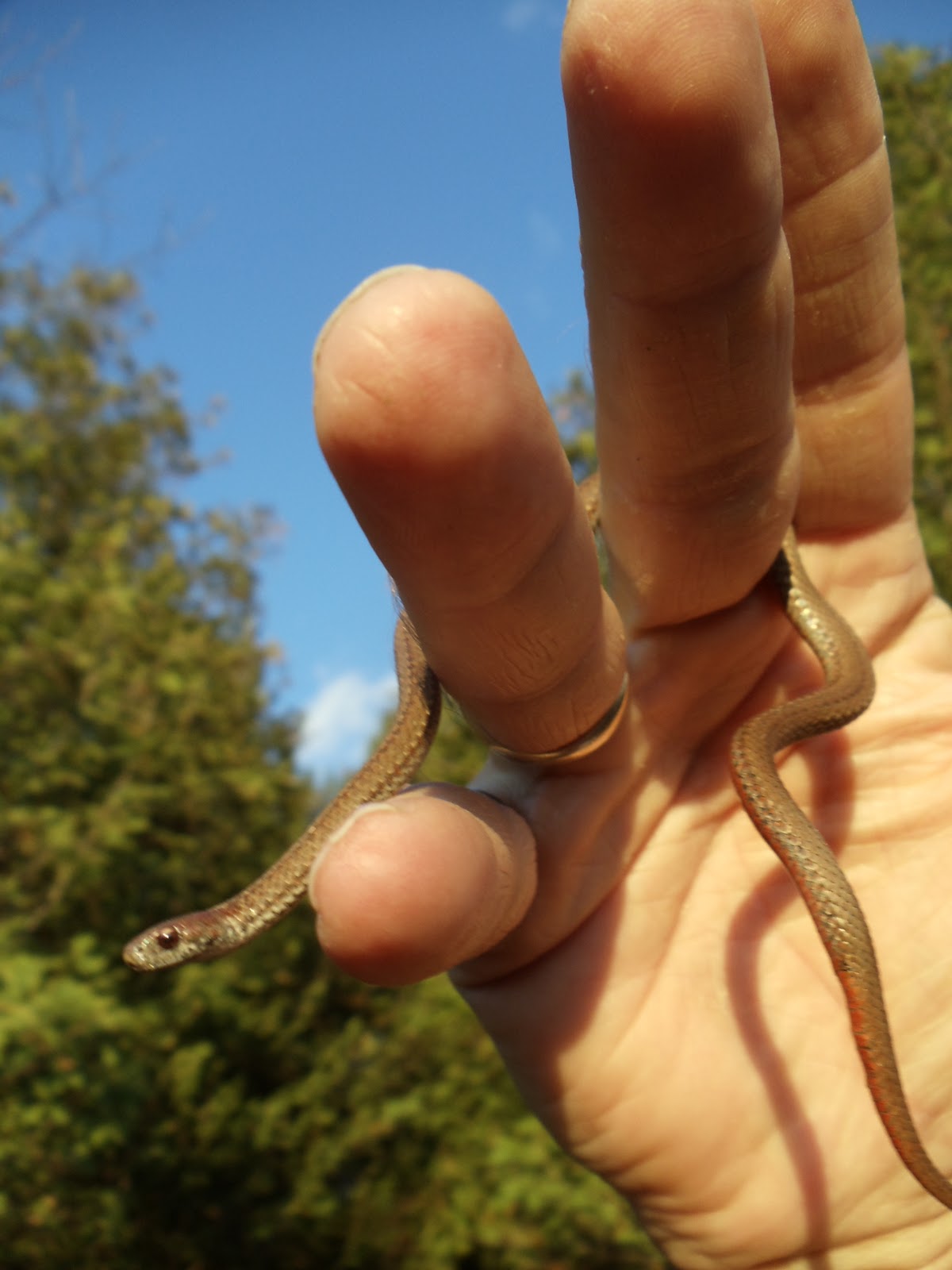
While working in the field on the south west end of our woodlot I noticed our cat playing with a tiny snake. It's reddish orange belly was evident from a distance and I immediately interrupted the cat's play to save it. It is a tiny snake and from the top it is a rather featureless gray but underneath it has a clear orange belly which is characteristic of a red bellied snake [Storeria occipitomaculata]. It did not appear very frightened when I picked it up.

After the photo-shoot I returned the reptile to its little depression in the ground which was about the size of a tea cup and it then slithered out of sight down into the earth. This was likely its hibernacula as they call its winter quarters.


I had seen this snake before early on in the first years when we arrived here on the woodlot but never since, and it was also in the same general area. Its den or hibernacula is located near the forest edge just as the descriptive websites indicate. Since it preys mainly on slugs it is a welcome presence in our woodlot. There are slugs galore around here. We need more red bellied snakes.

Saturday, October 22, 2011

Adding Some Horsechestnuts to the Mix

Chestnuts placed in bare patch
During a recent and brief trip to the small town of Kingsport in Nova Scotia's Annapolis Valley, I picked up a pocketful of horse-chestnuts [Aesculus hippocastanum] from a sidewalk that was just littered with them. One of the nuts I kept in the pod while the others were already husked by the foot or vehicle traffic.

Chestnut patch before rock.
Chestnuts covered up.
According to http://www.treesforyou.org/Selection/Articles/horse.htm, the nuts must not dry out if you want to plant them. Unfortunately by the time I got to planting them only the two nuts in the pod were still nice and round while the other half dozen or so were starting to shrivel up.

I planted the nuts along the forest edge or the residential acre in a half metre square patch as shown here and covered the patch with a large flat rock, to protect the nuts against predation by squirrels or raccoons and also to temper large temperature shifts. In spring when the nuts are expected to emerge I will remove the rock. If more that one survives they will be transplanted. I can probably find a spot somewhere for them in this 80 acre lot.

Rock covering chestnuts for the winter.
Though the tree is not indigenous to the area and actually an import from southern Europe, It does make for an attractive showy tree and I figure I can justify it being in the garden area around our house.

Thursday, August 25, 2011

Pseudoscorpions

From time to time I noticed this small spider -- so I thought -- in the basement. I payed no attention to it for the longest time thinking that it was merely a crab spider. After taking these pictures and further examination, it became evident that crab spiders do not have these pincers. So now what? After considerable searching under different names I found from the bugguide.net that it is a pseudoscorpion. It is common in North America right up to the treeline.

It gets around by hitchhiking on larger flying insects, and is very beneficial to humans, preying on tiny insects like aphids, ants etc. Though it does produce venom, its pincers are too small to inflict injury to humans and are thus considered harmless. 

Tuesday, June 14, 2011

A Sparrow's Nest in the Grass

One of the parents perched on a tree near their nest in the tall grass.
In a field near our house we could frequently see a pair of song sparrows [Melospiza melodia] perch on this small tree and then hover down into the tall grass. One obviously suspects a nest would be near by. I carefully moved the brush aside ensuring not to affect the vegitation thus possibly exposing the nest and sure enought found this nest very well hidden deep below the underbrush.

These little babies look like they are ready to leave the nest at anytime now.

Song Sparrow fledglings

The Everwelcome Dragonfly

 This dragonfly is one of our most common at this time of year. According to KAUFMAN Field Guide to Insects  of North America, ISBN-13/EAN: 978-0-618-15310-7 or ISBN-10: 0-618-15310-1   Page 48 this is the Dot-tailed Whiteface [Leucorrhinia intacta]. In the evenings when the mosquitoes come out in swarms, these Whitefaces are welcome critters since the make quick work of the mosquitoes.


Tuesday, May 31, 2011

The Brilliant Six Spotted Tiger Beetle

While working on a pile of rocks I would from time to time enjoy the company of these beautiful metallic green insects as they swiftly scurry about. According to Bugs of Ontario, it is a Six Spotted Tiger Beetle.
This spring I have seen numerous such beetles as well as the tiny red spiders. Wherever I happen to be working in the ground I come across at least one. This implies that there is an abundance of these little predators. Both the tiger beetle and the tiny red spiders prey on insect pests like ants or caterpillars for the tiger beetle and aphids for the spiders. 

This property was abandoned around 1968 and largely reforested around 1971. We moved here 10 years ago and have never used any insecticides on the property so one could say that it is very free insect friendly. I wonder if that is why there is such an abundance of these unusual bugs. Never would have dreamed of seeing them in the suburbs of Bells Corners, where we used to live and we might have seen an ant or mosquito.

Saturday, April 30, 2011

White-throated Sparrow

Unfortunatey we do get the occasional bird that will collide with our windows. Although it is most frequent in the bigger windows they also tend to collide with the smaller ones. This morning early this very pretty white-throated sparrow [Zonotrichia albicollis] was stunned by such an incident but luckily came to and flew away.

Sunday, February 06, 2011

A Visit of a Small Hawk in our Yard

Bird feeder was very quiet last Thursday morning. Didn't make any mind of it until looking out the back window I saw this little hawk. It looks smaller than a rock pigeon. Definitely smaller than a Crow.  While it was perched at sunrise it would periodically and rapidly flick its tail back and forth like an inverted windshield wiper as seen at this distant perch. It was as if it was waking up. At the time there was very little other activity in the yard.  I know that it was too large to be a kestrel or sparrow hawk. 
Its size made me think that it was a merlin of the falcon family but it didn't have the characteristic side burns. I have at least seven different bird guides thankfully and each describes the same bird in slightly different ways which is often very helpful. I relied on my initial three bird guides by Sibley, Audubon and the Royal Ontario Museum and none were really of much help since they did not give enough information to distinguish the characteristics of this bird. By the odd colouring I thought that it might be a Juvenile cooper's, or sharp-shinned. The colours say maybe a northern goshawk but it is very small for a goshawk.
At this point I hadn't found nor bothered to find the other bird guides, and proceeded to post the following two pictures 
on Facebook to see if any friends could identify them. Before the day was up a friend forwarded these picture to his avid birder friend and by the end of the day came back with a molting Sharp-Shinned Hawk [Accipiter Striatus].
I later found another bird guide by Kaufman that much more clearly confirmed this identification as a juvenile Sharp-shinned. It showed a very good semblance of the white spotted back of this bird and I have scanned the page out of the book for the reader's benefit. It is from Field Guide to Birds of North America by Kenn Kaufman, 2000, Houghton Mifflin Company, ISBN 0-618-13219-8.   I think this pretty much confirms the identification although the colours of the breast feathers were softer and never showed the sharper and more distinct brown and white pattern.